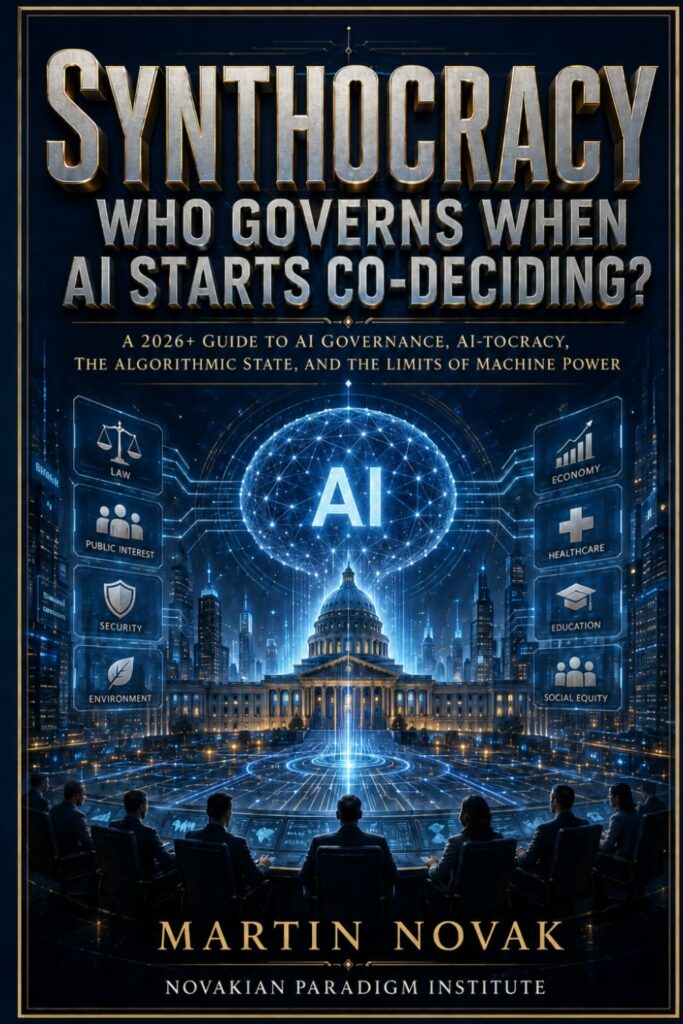
Book: Synthocracy. Who Governs When AI Starts Co-Deciding? A 2026+ Guide to AI Governance, AI-tocracy, the Algorithmic State, and the Limits of Machine Power
Author: Martin Novak
Institutional frame: Synthocracy Institute
Series: Synthocracy
Artificial intelligence is no longer only a tool for writing, searching, coding, designing, or automating tasks. It is beginning to enter decision systems.
AI now helps rank candidates, score customers, detect risk, classify citizens, summarize evidence, moderate platforms, prioritize cases, draft official replies, recommend business actions, and automate workflows. Humans may still approve the final result, but the decision has often already been shaped upstream.
This is the age of synthocracy: a decision order in which humans formally continue to govern, manage, approve, or take responsibility, while AI systems increasingly filter, recommend, classify, prioritize, and prepare the world on which those humans act.
Synthocracy: Who Governs When AI Starts Co-Deciding? is a practical 2026+ guide to AI governance, AI-tocracy, the algorithmic state, private platform power, and the limits of machine authority.
This book explains:
- why AI power begins before AI “rules”;
- how soft synthocracy appears in administration, business, platforms, and workplaces;
- how AI-tocracy can intensify surveillance, prediction, and automated control;
- how AI can also support democracy, deliberation, and public participation;
- why private companies, cloud providers, platforms, models, data, and chips are becoming a new infrastructure of power;
- why AI governance is becoming a market of observability, guardrails, compliance, audit, logs, and runtime oversight;
- why “human-in-the-loop” is not enough if the human has no real control;
- why every serious AI-mediated decision needs audit, explanation, appeal, accountability, and a red button.
The core argument is simple:
AI may be more capable. That does not make it legitimate.
A calculator computes better than a human, but it does not decide what is fair taxation. A navigation system finds efficient routes, but it does not decide what matters in a life. A scoring model may identify risk, but it does not define the moral worth of a person. An AI policy simulator may model outcomes, but it does not create democratic legitimacy.
This book is written for citizens, founders, managers, consultants, small business owners, public officials, platform users, workers, journalists, educators, and readers trying to understand what AI governance really means beyond abstract policy language.
It includes a practical workbook with checklists, risk maps, control questions, a citizen checklist, a manager checklist, a founder checklist, a synthocracy risk matrix, and ten questions to ask every AI-mediated system.
If AI has started to co-decide, we must ask who built it, who checks it, who can say no, and who remains responsible.
Table of Contents
Introduction
Power Does Not Disappear. It Changes Interface.Part I The Word Not Yet in the Dictionaries
Chapter 1
What Is Synthocracy?Chapter 2
The Algorithmic StatePart II The Three Faces of Synthocracy
Chapter 3
AI-tocracy: The Dark Twin of SynthocracyChapter 4
Synthetically Assisted DemocracyChapter 5
Companies, Platforms, and Private RegulatorsPart III The Limits of Machine Power
Chapter 6
Why Capability Does Not Give the Right to GovernChapter 7
How to Live in the Age of SynthocracyConclusion
Do Not Ask Only Whether AI Is Intelligent. Ask Who Gives It Power.Practical Workbook
Synthocracy Workbook: Checklists, Risk Maps, and Control Questions
Amazon: Synthocracy. Who Governs When AI Starts Co-Deciding?