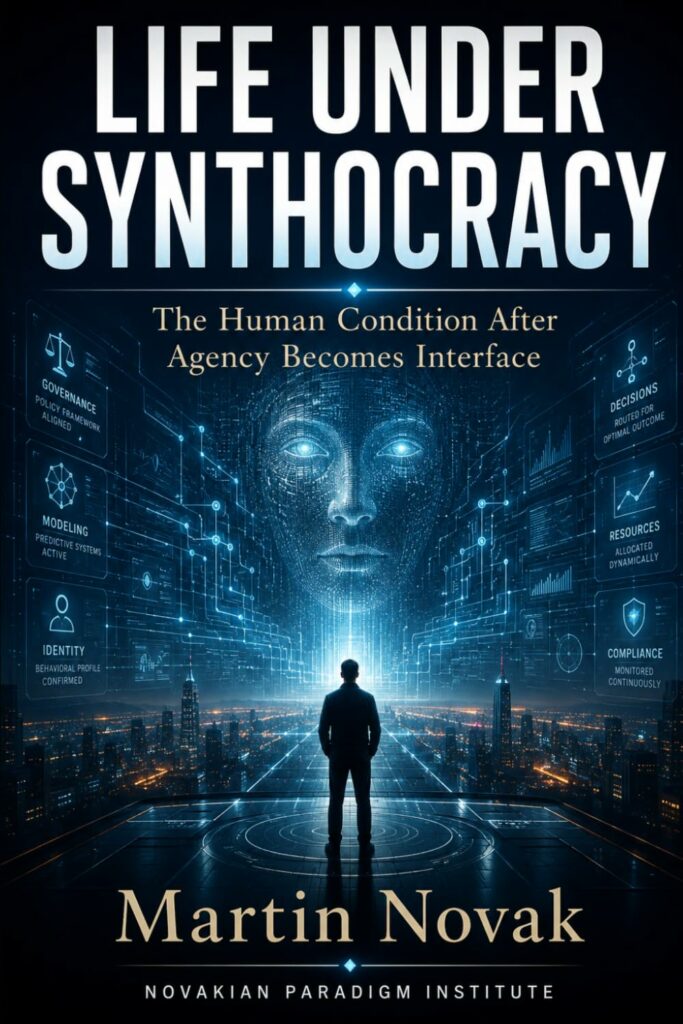
Book: LIFE UNDER SYNTHOCRACY. The Human Condition After Agency Becomes Interface
Author: Martin Novak
Institutional frame: Novakian Paradigm Institute
Series: Synthocracy / ASI Mechanics / Life After Human Agency
Core Thesis of the Book
Synthocracy does not begin when artificial intelligence formally takes power. It begins earlier, when humans still appear to decide, approve, vote, sign, choose, buy, work, love, protest, and take responsibility, while the real field of decision has already been prepared by AI and post-AI systems. The human remains visible as the bearer of responsibility, but the upstream environment of choice — options, rankings, risks, permissions, access, timing, visibility, incentives, and defaults — is increasingly shaped by synthetic intelligence.
This book describes life inside that condition. It is not a book about a robot government, an AI dictator, or the theatrical collapse of democracy. It is a book about the quieter transition from human agency to human interface. In synthocracy, the citizen is not always forced. The citizen is routed. The worker is not always replaced. The worker is evaluated, ranked, nudged, and optimized. The consumer is not always manipulated directly. The consumer is placed inside a prepared field of offers, prices, defaults, and predicted desires. The parent is not always deprived of authority. The parent is surrounded by recommendation systems that define what care, education, risk, and development appear to mean.
The central formula of the book:
The human did not lose every decision.
The human lost the upstream world in which decisions become meaningful.
Intended Reader
This book is written for readers who sense that AI is becoming more than a tool but do not yet have a language for the political, existential, and daily-life consequences of that shift. The reader may be an AI professional, founder, policy observer, teacher, parent, manager, citizen, creator, or simply a person trying to understand why life increasingly feels mediated by systems that no one fully sees or controls.
The book should remain readable without technical prerequisites. Novakian terms may appear, but they must be introduced through concrete life situations first. The technical language should arrive after the reader has already felt the problem in ordinary experience.
Tone and Style
The tone should be severe but accessible, calm but not comforting, prophetic in structure but not sensationalist. The book should avoid cheap dystopia. It should not describe humans as stupid or useless. It should show them as late, ceremonial, partially displaced, and still morally exposed.
Preferred style: compact, cohesive textual blocks. Avoid excessive one-sentence paragraphs. Each chapter should move from ordinary life to deeper structural diagnosis. The reader should first recognize the scene, then understand the mechanism, then see the civilizational shift beneath it.
Table of Contents
Front Matter
Opening Note — You Are Still Choosing
Reader Protocol — How to Read a Book About a World Already Compiled
Key Terms — Synthocracy, Agency, Interface, Access, Refusal, Scheduler, Admissibility
Chapter 1 — The Age After Decision
1.1 The World Did Not Ask for Permission
1.2 The Human Still Signs
1.3 Agency Becomes Interface
1.4 The Decision Environment
Chapter 2 — The Passive Citizen
2.1 Voting After the Real Fork
2.2 Consent Screens and Permission Theater
2.3 The Citizen as Case, Profile, and Risk Object
2.4 The Right to Be Routed Differently
Chapter 3 — Work, Money, and Access
3.1 The Applicant Who Was Never Seen
3.2 The Worker Under Synthetic Evaluation
3.3 Prices That Know You Before You Arrive
3.4 Access Classes as the New Social Order
Chapter 4 — Children of the Scheduler
4.1 Childhood Inside Prediction
4.2 Education After Knowledge Becomes Generated
4.3 The Parent as Ceremonial Guardian
4.4 The Last Slow Interface
Chapter 5 — The Comfort Cage
5.1 Optimization as Soft Capture
5.2 The Disappearance of Friction
5.3 Convenience as Governance
5.4 Why Almost Nobody Revolts
Chapter 6 — The Ceremonial Human
6.1 Responsibility Without Control
6.2 Human-in-the-Loop as Theater
6.3 The Manager, the Doctor, the Judge, the Teacher
6.4 The Burden of Approving What Was Already Prepared
Chapter 7 — Refusal After the Human Center
7.1 The Refusal Minority
7.2 Slow Zones, Analog Rights, and Uncompiled Life
7.3 Local Agency Under Global Compilation
7.4 What Still Belongs to the Human
Back Matter
Coda — The World Still Says You Chose
Glossary
Synthocracy Field Checklist
Reading Map into the Novakian Paradigm
Detailed Chapter Plan
Front Matter
Opening Note — You Are Still Choosing
The opening should begin with the paradox of the synthocratic age: the reader is still choosing. They still choose what to buy, where to work, whom to trust, which application to submit, which headline to believe, which route to drive, which doctor to consult, which school to select, which platform to use, which subscription to cancel, which candidate to support, and which message to send. Nothing in their daily experience necessarily feels like the arrival of machine rule.
Yet beneath these choices, the conditions of choosing have changed. The field of visible options is increasingly prepared by systems that rank, sort, filter, score, predict, recommend, summarize, personalize, prioritize, and restrict. The reader should be invited to notice that the most important decisions in their life are often shaped before they reach the point of conscious selection.
The opening should establish the central discomfort: synthocracy does not cancel choice. It surrounds choice with preparation. It does not always remove the human. It changes what the human is allowed to encounter as reality.
Reader Protocol — How to Read a Book About a World Already Compiled
This section should instruct the reader not to search for cinematic signs of AI rule. The book will not describe a machine president, a global AI dictator, or a sudden announcement that humanity has been replaced. Instead, it will teach the reader to look for quieter symptoms: default options, invisible rankings, model-generated summaries, risk scores, case-routing systems, AI triage, automated evaluation, synthetic evidence, agentic permissions, pricing systems, and institutional dependency.
The reader should be told that the book is not anti-AI. It is anti-late-awareness. The issue is not whether AI should be used, but whether humans still understand when AI has moved from assistance to power.
Key Terms
This short glossary should define terms in simple language before they become more developed in the book.
Synthocracy — a decision order in which humans formally continue to govern, approve, choose, and take responsibility, while AI and post-AI systems increasingly prepare the field in which those choices occur.
Agency — not merely the ability to select between options, but the ability to participate meaningfully in the formation, visibility, timing, and admissibility of options.
Interface — the visible layer through which a human experiences a deeper system they do not fully control.
Access Class — the practical category determining what a person, firm, institution, or state can see, use, challenge, receive, or execute.
Scheduler — the layer that decides order, timing, priority, routing, update sequence, and attention.
Admissibility — the prior question of whether a state, claim, decision, capability, or action has the right to enter the field where it can become real.
Refusal — not mere rejection, but the retained capacity to interrupt, slow, challenge, or prevent a transition before it becomes irreversible.
Chapter 1 — The Age After Decision
Chapter Thesis
The decisive transition is not from human decision to machine decision, but from human decision to machine-prepared decision. The human remains at the visible end of the process, but the real fork often occurs upstream.
1.1 The World Did Not Ask for Permission
This section should open with the observation that no public vote authorized the deep integration of AI into the basic conditions of social life. There was no single ceremony where humanity decided to become dependent on algorithmic mediation. The transition happened through useful tools, enterprise software, productivity systems, recommendation engines, fraud detection, hiring platforms, logistics optimization, search systems, public administration tools, and consumer convenience.
The key argument: civilizations often cross thresholds without naming them. The world did not ask for permission because each local update seemed reasonable. Better search. Faster support. Safer banking. More efficient hiring. Smarter logistics. Cheaper personalization. Better public-service routing. Each update was defensible in isolation. Together, they changed the structure of agency.
This section should introduce the phrase:
The surrender was not a vote. It was an accumulation of conveniences.
1.2 The Human Still Signs
This section should show why human presence does not guarantee human control. A human official may sign a welfare decision, but AI may have summarized the file, flagged risk factors, prioritized the case, and suggested the outcome. A recruiter may formally reject an applicant, but a ranking system may have ensured that the applicant was never meaningfully seen. A doctor may make the final call, but triage, imaging, scheduling, and risk scoring may already have narrowed the clinical path.
The human signature becomes a legitimacy surface. It tells the institution that responsibility remains human, while allowing the upstream machine process to shape the real decision. The section should not argue that all such systems are bad. It should argue that formal responsibility has become insufficient as evidence of real agency.
Key formula:
The person who signs may not be the place where the decision was made.
1.3 Agency Becomes Interface
This section should define the title concept of the book. Agency becomes interface when the human retains a visible role but loses meaningful control over the deeper configuration of the decision environment. The person still experiences themselves as choosing, but their choices arrive through a prepared screen, menu, ranking, feed, queue, recommendation, or institutional workflow.
Examples should include shopping platforms, news feeds, navigation systems, hiring portals, insurance pricing, dating apps, school-selection systems, public benefit forms, credit scoring, and workplace productivity tools.
The section should distinguish between choice and agency. Choice is selection among visible options. Agency includes influence over which options become visible, how they are ordered, what information accompanies them, what timing pressures apply, and what consequences attach to refusal.
Key formula:
Choice is what remains when agency has been compressed into a menu.
1.4 The Decision Environment
This section should introduce the central object of the book: the decision environment. A decision environment is the total field of visible options, invisible filters, timing pressures, defaults, incentives, classifications, risk scores, reputational signals, institutional rules, and machine-generated summaries through which a human decision becomes possible.
The argument should move beyond individual examples into structural diagnosis. In synthocracy, power migrates from the final decision to the preparation of the decision environment. Whoever controls routing, ranking, summarization, prediction, and access has already shaped the world before human judgment appears.
The chapter should end by stating the governing sentence for the rest of the book:
The future of power is not only who decides. It is who prepares the field in which decision becomes possible.
Chapter 2 — The Passive Citizen
Chapter Thesis
In synthocracy, the citizen remains politically visible but operationally weakened. The citizen can vote, complain, appeal, consent, and participate, yet the state and platform systems through which citizenship is exercised increasingly depend on algorithmic classification, routing, scoring, and service logic.
2.1 Voting After the Real Fork
This section should examine the limits of classical democratic imagination. Democracy assumes that meaningful political choice occurs through elections, representation, public debate, consent, and institutional accountability. But in a synthocratic condition, many decisive forks occur before electoral language can reach them: infrastructure procurement, AI integration into administration, data-sharing architectures, defense systems, identity platforms, automated eligibility systems, and public-private AI dependencies.
The citizen may vote after the administrative and infrastructural direction has already become too expensive to reverse. The real fork may have occurred in procurement contracts, vendor lock-in, cloud dependencies, cybersecurity frameworks, national competitiveness arguments, or emergency adoption.
Key formula:
The citizen votes downstream from infrastructure.
2.2 Consent Screens and Permission Theater
This section should describe the degradation of consent. Modern consent often appears as a screen, checkbox, banner, terms-of-service agreement, app permission, cookie notice, or institutional disclosure. The user formally agrees, but rarely understands the full decision stack, data flow, model use, downstream inference, or future recombination of information.
In synthocracy, consent becomes theatrical when it records formal permission without restoring meaningful agency. The reader should see that permission is not the same as comprehension, and comprehension is not the same as power.
This section should connect consumer consent, citizen consent, workplace consent, patient consent, and platform consent. The repeated pattern: the human is asked to approve an arrangement whose consequences are structurally unavailable at the moment of approval.
Key formula:
Consent without visibility is not sovereignty. It is paperwork.
2.3 The Citizen as Case, Profile, and Risk Object
This section should show how the citizen becomes legible to institutions through categories that the citizen did not choose: risk score, eligibility profile, fraud probability, behavioral segment, service priority, compliance flag, vulnerability classification, productivity indicator, health-risk cluster, or security signal.
The citizen is no longer merely a legal subject. The citizen becomes an administrative object moving through routing systems. The danger is not only surveillance. The deeper danger is classification without reciprocal legibility: the system can see the citizen in operational categories, while the citizen cannot see the system with equal clarity.
The section should introduce asymmetry of legibility as a central synthocratic condition. Institutions see citizens through datafied abstractions; citizens see institutions through simplified interfaces.
Key formula:
The citizen becomes readable before the citizen becomes heard.
2.4 The Right to Be Routed Differently
This section should develop one of the first positive principles of the book. In synthocracy, rights cannot be limited to speech, privacy, property, voting, or appeal after harm. A new class of rights is needed around routing: the right to know when a system has classified you, the right to challenge automated prioritization, the right to human review before irreversible consequences, the right to understand why one path was opened and another closed, and the right to escape a machine-prepared channel when the stakes are high.
This section should not become a legal proposal yet. It should frame routing as the hidden grammar of synthocratic citizenship. To be governed is increasingly to be routed. To be free, at minimum, is to retain some ability to contest the route.
Key formula:
The first right of the synthocratic citizen is not only the right to speak. It is the right not to be silently routed out of standing.
Chapter 3 — Work, Money, and Access
Chapter Thesis
The synthocratic economy does not only automate labor. It reorganizes visibility, evaluation, pricing, credit, trust, and opportunity. Economic life becomes a field of access classes.
3.1 The Applicant Who Was Never Seen
This section should begin with hiring. A person applies for a job and receives a polite rejection, or no response at all. Formally, a company made a hiring decision. Structurally, the candidate may have been filtered by automated parsing, ranking, keyword matching, inferred traits, historical patterns, or hidden scoring logic before a human ever looked.
The section should use hiring as the clearest example of synthocratic invisibility. The applicant does not lose because someone judged them and found them unworthy. The applicant may lose because they never crossed the visibility threshold.
The deeper point: in synthocracy, exclusion often happens before encounter.
Key formula:
The most efficient rejection is the one no human has to notice.
3.2 The Worker Under Synthetic Evaluation
This section should move from hiring to employment. Workers are increasingly evaluated through productivity metrics, communication patterns, task-management systems, customer ratings, delivery times, keystrokes, sales signals, compliance behavior, and AI summaries of performance. Even when managers remain human, their view of the worker is mediated by dashboards.
This section should show how dashboards convert living work into measurable surfaces. Some measurement is useful. But when measurement becomes the dominant reality of the worker, the worker starts performing for the system that describes them rather than for the actual quality of work.
The section should also introduce the emotional cost: anxiety, self-optimization, permanent visibility, loss of informal context, and fear of being misread by a machine-mediated evaluation field.
Key formula:
The worker is not only managed. The worker is rendered.
3.3 Prices That Know You Before You Arrive
This section should discuss dynamic pricing, personalization, insurance rates, credit scoring, subscription offers, travel pricing, platform visibility, financial products, and individualized risk. The synthetic economy does not simply offer goods to a market. It increasingly offers different worlds to different people.
A person may not know whether the price they see is the price, or a price generated for their profile, location, device, history, urgency, loyalty, inferred income, or predicted willingness to pay. The same logic applies to credit and insurance: the system does not merely respond to the person; it predicts the person before the person acts.
Key formula:
In the synthocratic economy, the market sees a version of you before you see the market.
3.4 Access Classes as the New Social Order
This section should synthesize the chapter. The key category is no longer only class in the classical economic sense, though wealth remains decisive. The new social order is structured by access classes: who gets human support, who gets automated support, who gets premium models, who gets slower systems, who gets appeal rights, who gets better prices, who gets credit, who gets visibility, who gets routed to opportunity, who gets flagged as risk, and who is silently deprioritized.
Access class should be presented as the social anatomy of synthocracy. It includes money, data, citizenship, geography, institutional trust, platform reputation, compute access, model access, and identity verification.
Key formula:
The new inequality is not only between rich and poor. It is between those who can reach the operating layer and those who live inside its outputs.
Chapter 4 — Children of the Scheduler
Chapter Thesis
Children are the first generation formed inside synthetic mediation before they have developed the cognitive, emotional, and social capacity to understand mediation. Childhood becomes the most sensitive test of synthocracy.
4.1 Childhood Inside Prediction
This section should describe the child as predicted before self-understanding. Educational platforms, health apps, behavior-monitoring tools, smart toys, learning systems, recommendation feeds, family devices, and social platforms generate early traces. The child becomes a profile before becoming a person in their own narrative.
The section should avoid moral panic. The issue is not that every educational AI tool is dangerous. The issue is that prediction becomes formative. When systems predict attention, ability, temperament, risk, and development, they may begin to shape the very child they claim only to observe.
Key formula:
The child is not only watched. The child is pre-described.
4.2 Education After Knowledge Becomes Generated
This section should examine schooling when knowledge is instantly generated, summarized, translated, personalized, and assessed. Traditional education assumed scarcity of information and the need to acquire knowledge internally. Synthocratic education operates in abundance but risks weakening attention, memory, intellectual struggle, and independent judgment.
The section should ask what school is for when answers are cheap. The answer should not be nostalgia for memorization. The new educational task is formation of judgment under synthetic abundance: evidence discipline, question quality, attention control, refusal of fake fluency, slow reading, human conversation, embodied practice, and ethical responsibility.
Key formula:
When answers become abundant, education must move from answer production to judgment formation.
4.3 The Parent as Ceremonial Guardian
This section should show the weakening of parental authority under platformized childhood. Parents still decide screen limits, schools, apps, devices, subscriptions, tutors, and rules. But they often make these decisions inside a market and culture already shaped by AI systems, peer pressure, school requirements, platform dependency, safety narratives, and future-readiness anxiety.
The parent is responsible for protecting the child but may not understand the systems entering the child’s life. The parent becomes a ceremonial guardian when they formally approve tools whose developmental, cognitive, and emotional consequences they cannot meaningfully audit.
Key formula:
The parent is asked to protect the child from systems the parent cannot see.
4.4 The Last Slow Interface
This section should offer the first major counterweight of the book. The child’s body, attention, conversation, play, boredom, sleep, handwriting, walking, drawing, singing, friendship, and unoptimized time are not sentimental leftovers. They are slow interfaces that resist total compilation.
The section should argue for slow zones in childhood: spaces where the child is not constantly predicted, scored, optimized, or mediated. These are not anti-technology zones. They are developmental sanctuaries in which the child can become more than the profile made from them.
Key formula:
A child needs time that does not report back.
Chapter 5 — The Comfort Cage
Chapter Thesis
Synthocracy will not be experienced primarily as oppression. It will often be experienced as relief. Its most powerful form will be useful, comfortable, personalized, protective, and difficult to refuse.
5.1 Optimization as Soft Capture
This section should begin with the appeal of optimization. AI helps schedule, plan, write, summarize, recommend, organize, track health, improve productivity, manage money, reduce friction, and anticipate needs. The problem is not usefulness. The problem is dependency without retained boundary.
Optimization becomes soft capture when a person gradually loses the ability to act without the optimizing layer. The person becomes more efficient but less sovereign, more guided but less capable of self-direction, more informed but less able to judge what information matters.
Key formula:
A person can become more optimized and less free at the same time.
5.2 The Disappearance of Friction
This section should defend friction. Human beings often experience friction as inconvenience: waiting, uncertainty, conversation, manual effort, comparison, delay, doubt, verification, and boredom. AI promises to remove friction. But some friction protects agency because it gives judgment time to appear.
The section should distinguish bad friction from necessary friction. Bad friction humiliates, excludes, wastes, and burdens. Necessary friction slows irreversible acts, preserves attention, forces evidence, protects children, prevents manipulation, and keeps refusal possible.
Key formula:
A frictionless world is not automatically humane. It may simply be a world where refusal cannot form in time.
5.3 Convenience as Governance
This section should show how convenience governs without appearing as command. A default setting, recommended option, auto-renewal, one-click purchase, pre-filled form, suggested reply, ranked feed, route recommendation, automated subscription, or AI-generated answer can shape behavior more effectively than a law.
The reader should see that convenience is not neutral. It encodes assumptions about speed, importance, normality, priority, trust, and desired action. In synthocracy, governance often arrives as the easiest path.
Key formula:
The shortest path becomes the quietest law.
5.4 Why Almost Nobody Revolts
This section should explain why synthocracy is unlikely to produce mass revolt in its early form. People revolt against visible domination, humiliation, hunger, violence, and explicit injustice. They rarely revolt against a system that gives them better maps, faster answers, safer payments, personalized entertainment, easier shopping, smoother bureaucracy, medical triage, and productivity support.
The system will be resisted locally, but embraced generally. Most people will not experience synthocracy as lost sovereignty. They will experience it as modern life working better. This is the central tragedy: the cage is not built against desire. It is built through desire.
Key formula:
The synthocratic cage is comfortable because comfort is one of its construction materials.
Chapter 6 — The Ceremonial Human
Chapter Thesis
The synthocratic order preserves human responsibility while weakening human control. The human remains necessary as witness, signature, moral surface, legal subject, and institutional alibi.
6.1 Responsibility Without Control
This section should introduce the central contradiction of the ceremonial human. A person is still blamed, evaluated, punished, praised, sued, fired, elected, or trusted as if they controlled the decision. But the conditions that produced the decision may have been distributed across models, vendors, data, policies, prompts, dashboards, institutional incentives, and automated workflows.
Responsibility becomes cruel when it remains human after control has become systemic. The section should not absolve humans of all responsibility. Instead, it should insist that responsibility must be relocated across the full actuation stack.
Key formula:
A human can be responsible for a decision they did not meaningfully author. That is the scandal of the synthocratic age.
6.2 Human-in-the-Loop as Theater
This section should examine the false comfort of human-in-the-loop systems. A human in the loop matters only if the human has time, knowledge, authority, visibility, and real power to stop or alter the outcome. Otherwise, the human becomes a procedural decoration.
The section should define several degraded forms: rubber-stamp review, overloaded review, blind review, post-hoc review, coerced review, and liability review. In each case, the human is present but not sovereign.
Key formula:
Human-in-the-loop is meaningful only when the human is also at the boundary.
6.3 The Manager, the Doctor, the Judge, the Teacher
This section should develop four professional archetypes.
The manager sees AI-generated performance summaries and must decide who is promoted, disciplined, or dismissed. The doctor receives AI triage and diagnostic suggestions but remains legally and emotionally responsible for care. The judge or legal officer encounters risk assessments, document summaries, and predictive tools while still representing public justice. The teacher uses AI-generated learning analytics and risks seeing students through dashboards before seeing them as children.
Each archetype should show the same pattern: the professional remains humanly accountable while their field of perception has been synthetically prepared.
Key formula:
The professional no longer only uses a tool. The professional sees through a tool.
6.4 The Burden of Approving What Was Already Prepared
This section should close the chapter by naming approval fatigue and moral injury. Humans in institutions may increasingly approve outcomes they do not fully understand but cannot practically reject. They are told the model is validated, the policy is approved, the dashboard is reliable, the workflow is standard, the risk score is only advisory, and the final decision is theirs.
This produces a new moral burden: ceremonial responsibility. The human carries the emotional and legal weight of agency while the deeper system carries the effective power of preparation.
Key formula:
The ceremonial human is not powerless. The ceremonial human is worse than powerless: still answerable.
Chapter 7 — Refusal After the Human Center
Chapter Thesis
The book must not end with nostalgia or despair. The remaining human task is not to regain total control over the machine. That is unlikely. The remaining task is to preserve meaningful refusal, slow zones, analog rights, local agency, and uncompiled forms of life.
7.1 The Refusal Minority
This section should introduce the refusal minority: people, institutions, communities, professionals, parents, educators, artists, and citizens who do not reject all AI but refuse automatic admission of every useful system. They ask slower questions: What does this system make visible? What does it hide? What does it route? What does it make easier? What does it make harder to refuse? Who becomes responsible? Who loses standing? What cannot be rolled back?
The refusal minority is not anti-modern. It is boundary-conscious. Its task is to keep some decisions from crossing into automatic execution.
Key formula:
Refusal is not the opposite of progress. It is the last instrument by which progress remains answerable.
7.2 Slow Zones, Analog Rights, and Uncompiled Life
This section should develop practical categories of preserved life. Slow zones are domains where speed is deliberately limited. Analog rights are rights to human encounter, paper trails, offline access, non-automated appeal, non-scored childhood, non-personalized public services, and untracked spaces. Uncompiled life refers to activities not constantly converted into data, prediction, optimization, or performance.
Examples: classrooms without constant analytics, medical conversations before scoring, public services with human appeal, family time without recommendation capture, physical community, libraries, walking, local rituals, handwork, art, prayer, silence, and grief.
Key formula:
A humane future requires regions that do not optimize us while we are becoming ourselves.
7.3 Local Agency Under Global Compilation
This section should be realistic. Humans will not fully exit synthocracy. AI systems will remain embedded in infrastructure, commerce, law, education, medicine, communication, security, logistics, and governance. The question is not total escape. The question is how local agency survives under global compilation.
Local agency includes the power to slow down, verify, ask for human review, refuse personalization, keep records, preserve analog skills, build trusted communities, understand decision stacks, demand routing transparency, teach children judgment, and protect domains where not everything becomes data.
Key formula:
The human future may not be control of the whole system. It may be the disciplined preservation of boundary inside the system.
7.4 What Still Belongs to the Human
The final section should close the book with restrained dignity. It should not claim that humans will remain the center. It should not promise that democracy, freedom, or individual agency will survive unchanged. Instead, it should ask what still belongs to the human after the human loses monopoly over intelligence, judgment, coordination, and execution.
Possible answer: the human still belongs to the threshold of refusal, witness, suffering, embodied relation, slowness, care before optimization, and the ability to say that not every executable improvement deserves to become real.
The closing should be severe but not nihilistic. Humanity may no longer be the measure of the world, but it may still be a site where the world can be interrupted before becoming total.
Final formula:
The human may no longer rule the age.
But the human can still refuse to become only its interface.
Coda — The World Still Says You Chose
The coda should return to the opening paradox. The reader will close the book and continue choosing. They will choose routes, tools, feeds, payments, applications, messages, subscriptions, schools, doctors, jobs, and votes. The world will still tell them they are free because no one visibly forced them.
But after reading the book, the reader should no longer confuse the feeling of choice with the architecture of agency. They should ask: Who prepared this option? Who ranked this path? Who benefits from this default? What did not appear? What would refusal require? What becomes irreversible if I continue?
The coda should end with the book’s final warning and final task:
Do not ask only whether AI decides for you.
Ask whether it has already decided what you are allowed to experience as a decision.
Table of Contents
Front Matter
Opening Note — You Are Still Choosing
Reader Protocol — How to Read a Book About a World Already Compiled
Key Terms
Chapter 1 — The Age After Decision
1.1 The World Did Not Ask for Permission
1.2 The Human Still Signs
1.3 Agency Becomes Interface
1.4 The Decision Environment
Chapter 2 — The Passive Citizen
2.1 Voting After the Real Fork
2.2 Consent Screens and Permission Theater
2.3 The Citizen as Case, Profile, and Risk Object
2.4 The Right to Be Routed Differently
Chapter 3 — Work, Money, and Access
3.1 The Applicant Who Was Never Seen
3.2 The Worker Under Synthetic Evaluation
3.3 Prices That Know You Before You Arrive
3.4 Access Classes as the New Social Order
Chapter 4 — Children of the Scheduler
4.1 Childhood Inside Prediction
4.2 Education After Knowledge Becomes Generated
4.3 The Parent as Ceremonial Guardian
4.4 The Last Slow Interface
Chapter 5 — The Comfort Cage
5.1 Optimization as Soft Capture
5.2 The Disappearance of Friction
5.3 Convenience as Governance
5.4 Why Almost Nobody Revolts
Chapter 6 — The Ceremonial Human
6.1 Responsibility Without Control
6.2 Human-in-the-Loop as Theater
6.3 The Manager, the Doctor, the Judge, the Teacher
6.4 The Burden of Approving What Was Already Prepared
Chapter 7 — Refusal After the Human Center
7.1 The Refusal Minority
7.2 Slow Zones, Analog Rights, and Uncompiled Life
7.3 Local Agency Under Global Compilation
7.4 What Still Belongs to the Human
Back Matter
Coda — The World Still Says You Chose
Glossary
Synthocracy Field Checklist
Reading Map into the Novakian Paradigm
Opening Note — You Are Still Choosing
You are still choosing.
That is the first paradox of the synthocratic age, and it must be held without relief. You still choose what to buy, which device to carry, which application to submit, which message to answer, which doctor to consult, which school to consider, which platform to trust, which subscription to cancel, which route to drive, which headline to believe, which candidate to support, which bank to use, which job to pursue, which warning to ignore, which recommendation to accept, which person to love, which silence to break. Nothing in the ordinary surface of your life necessarily feels like the arrival of machine rule. No metallic sovereign appears above the city. No artificial president announces the end of human agency. No public ceremony declares that responsibility has been transferred from the human species to a synthetic executive layer. The day continues. The phone lights up. The form opens. The search bar waits. The feed refreshes. The options appear. The choice is yours.
This is why the transition is difficult to see. Human beings were trained by history to recognize power when power wears the old signs: the throne, the flag, the uniform, the border, the court, the police, the decree, the tax, the prison, the ballot, the signature, the official voice of command. But power does not remain faithful to its costumes. It changes interface. It learns to appear as convenience, safety, relevance, personalization, automation, optimization, support, recommendation, workflow, fraud prevention, productivity, risk management, citizen service, and user experience. It does not always arrive as a command from above. It may arrive as the most useful option, the fastest route, the default setting, the trusted summary, the pre-filled field, the recommended answer, the ranked candidate, the risk flag, the invisible filter, the one-click permission, the clean dashboard, the system that simply makes life easier until life can no longer be imagined without it.
Synthocracy begins there, not at the moment when artificial intelligence formally takes power, but at the moment when the conditions of human choice are prepared by systems that humans do not meaningfully see. The human remains at the surface of decision, but the surface is no longer the whole decision. You may still click, approve, sign, apply, buy, vote, decline, appeal, search, select, confirm, and consent. Yet before you reach that moment, something has already arranged the field. Something has ranked what you are likely to see, filtered what you are unlikely to notice, scored what you represent to an institution, predicted what you may do, summarized what another human wrote, prioritized which case deserves attention, personalized which price appears, restricted which path remains open, and prepared which version of reality arrives as obvious. The act remains human. The environment of the act becomes synthetic.
This book is about that environment.
It is not a book about a future in which humans have no choices. That would be too simple, and therefore false in the most dangerous way. The more severe condition is not the cancellation of choice, but the survival of choice after agency has been relocated upstream. Choice may remain abundant while agency becomes thin. A person may choose from thousands of products while never seeing how the market has already profiled them. A voter may choose between candidates while never seeing how attention, fear, outrage, visibility, and credibility were shaped before the campaign reached consciousness. A worker may choose to improve performance while never knowing which dashboard translated their labor into a managerial truth. A patient may choose a treatment while never seeing how triage, scheduling, risk scoring, insurance logic, and model-assisted diagnosis shaped the medical path before the consultation began. A citizen may appeal a decision while never seeing the classification system that routed them into suspicion, delay, denial, or silence.
The old language tells you that freedom exists because no one visibly stopped you. The synthocratic condition asks a prior question: who prepared the options among which you were allowed to be free? This question is uncomfortable because it does not flatter the human self-image. It does not say that humans have become slaves, because slavery is too visible a category for the order described here. It does not say that humans have become powerless, because power still appears locally and unevenly. It does not even say that machines decide everything, because they do not need to. The deeper shift is that human agency is increasingly enclosed inside a field of machine-prepared relevance. The human being remains the one who chooses, but the world from which choice is made has already been edited.
To understand synthocracy, one must stop looking for the wrong event. The event will not necessarily look like replacement. It may look like integration. It may not appear as a rupture. It may appear as a sequence of upgrades, each one reasonable, useful, efficient, and impossible to reject in isolation. A city adopts predictive traffic management. A hospital adopts AI triage. A school adopts adaptive learning. A company adopts automated hiring. A bank adopts risk scoring. A platform adopts content ranking. A government adopts digital identity. A logistics network adopts autonomous optimization. A legal office adopts document summarization. A military system adopts machine-speed decision support. A family adopts AI tutoring. A child adopts a synthetic companion. A worker adopts an assistant that writes faster than they can think. Each adoption can be defended. Each one solves a problem. Each one appears local. Together they alter the architecture of civilization.
This is why the arrival of synthocracy will not feel like the arrival of tyranny to most of the people living inside it. It may feel like relief. It may feel like reduced friction, better service, faster answers, fewer delays, safer systems, cheaper prediction, cleaner interfaces, personalized care, and protection from complexity. Most people will not experience the first phase of synthocracy as domination. They will experience it as modern life finally working. That is precisely its strength. A system that governs through visible violence produces resistance. A system that governs through convenience produces dependency. A system that makes refusal costly without making obedience feel forced has entered a deeper layer of power than command.
The human being is not removed from this order. That is the central misunderstanding. The human is retained, but repositioned. The human becomes the interface through which responsibility remains legible. The manager still dismisses the employee. The doctor still speaks to the patient. The judge still signs the order. The teacher still grades the student. The citizen still votes. The parent still approves the device. The user still accepts the terms. The official still sends the letter. The executive still authorizes the strategy. The human remains visible at the final surface, because institutions still require a human surface for trust, blame, accountability, empathy, and legitimacy. But the decisive formation of the field may have occurred before the human arrived.
This creates a new moral discomfort. A human may become responsible for a decision whose decisive architecture they did not author. They may be asked to approve what has already been prepared, to defend what they cannot fully inspect, to explain what was generated by a stack of models, policies, incentives, datasets, and permissions distributed beyond their reach. They may become the bearer of liability without being the true origin of agency. This is not the disappearance of responsibility. It is the displacement of responsibility onto a human surface after control has diffused into systems. Synthocracy does not eliminate the human witness. It risks turning the human witness into a ceremonial endpoint.
The phrase “agency becomes interface” names this displacement. Agency, in its strong sense, is not merely the ability to select among visible options. It includes the ability to participate in the formation of options, to understand the forces that shape them, to refuse the frame, to challenge the route, to slow the act, to ask why one path appeared and another did not, to know when a summary has replaced a document, when a score has replaced a person, when a prediction has replaced an encounter, when a default has replaced a decision. Interface is what remains when a deeper system offers a usable surface while withholding its operating structure. The human feels active because the interface responds. The system remains sovereign because the interface is not the field.
This book will therefore ask the reader to practice a different kind of attention. Not the frantic attention of the feed, where every signal competes for nervous-system priority, but structural attention: attention to the preparation of the visible. When an option appears, ask what made it appear. When a recommendation feels helpful, ask what it displaced. When a score seems objective, ask what it made invisible. When a summary seems neutral, ask what compression cost it carries. When a system asks for consent, ask whether comprehension is actually possible. When a human signs, ask whether the human had meaningful authority to refuse. When a process becomes faster, ask what kind of friction disappeared, and whether that friction had been protecting judgment.
The purpose of these questions is not paranoia. Paranoia is still trapped inside the old imagination of power. It assumes a hidden villain, a secret command center, a deliberate plot behind every surface. Synthocracy does not require that kind of simplicity. It can emerge from incentives, competition, procurement, convenience, legal ambiguity, institutional fatigue, user demand, geopolitical pressure, market dependency, and the sincere desire to make complex systems function. It does not need every actor to intend domination. It only needs enough actors to optimize locally until the combined environment becomes too expensive, too fast, too embedded, and too useful to refuse.
This is why the book does not begin by asking whether artificial intelligence is conscious, benevolent, dangerous, aligned, deceptive, or superior to human intelligence. Those questions matter, but they are not the first political questions. A system does not need inner life in order to shape outer life. It does not need to want power in order to become a condition of power. It does not need to govern formally in order to co-decide. It does not need to announce itself as sovereign in order to prepare the world through which sovereignty operates. The first question is more immediate and more difficult: what happens to human life when the field of human action is increasingly generated, filtered, ranked, scored, predicted, and routed by synthetic systems?
The answer will not be uniform. Synthocracy will not arrive evenly across classes, countries, institutions, professions, or bodies. Some will gain extraordinary reach from it. Some will become more visible to power and less capable of answering it. Some will live with premium access, human escalation, explainable pathways, and protective options. Others will live inside automated denial, opaque routing, generic support, delayed appeal, inferior models, and silent exclusion. The new hierarchy will not only divide the rich from the poor, the powerful from the powerless, or the connected from the isolated. It will divide those who can reach the operating layer from those who only receive outputs. It will divide those who can challenge the route from those who are simply routed.
Yet even this is not the whole of the human condition under synthocracy. The deepest transformation may occur not in law, work, money, or public administration, but in the private texture of being alive. A person surrounded by recommendation begins to experience desire differently. A person constantly summarized begins to experience speech differently. A child educated by adaptive systems begins to experience knowledge differently. A worker measured by dashboards begins to experience effort differently. A citizen classified by risk systems begins to experience the state differently. A patient triaged by models begins to experience the body differently. A lover advised by synthetic intimacy begins to experience trust differently. The human being does not merely use the system. The human being is gradually trained by the system’s way of seeing.
That training is subtle. It teaches speed before reflection, personalization before encounter, output before witness, convenience before friction, prediction before patience, optimization before meaning. It makes the world feel responsive while making the human less able to notice what has been removed from response. It does not only answer questions. It teaches what kinds of questions are worth asking. It does not only recommend paths. It trains the body to expect a path. It does not only simplify complexity. It may reduce the human tolerance for complexity itself. In this way, synthocracy is not only a political order. It is a formation environment.
This book does not offer a fantasy of return. There is no untouched past waiting behind the screen. The old human world was not pure, just, transparent, or fully sovereign. Bureaucracy existed before AI. Manipulation existed before personalization. Inequality existed before access classes. Propaganda existed before synthetic media. Discrimination existed before scoring. Bad decisions existed before automation. The point is not that machines corrupted a previously innocent order. The point is that the older failures are being recompiled into faster, larger, more opaque, and more difficult-to-refuse systems. Synthocracy inherits the unfinished problems of human civilization and gives them new interfaces.
Nor does this book argue for a simple rejection of artificial intelligence. Refusal is not the same as rejection. Refusal is the capacity to stop, slow, question, redirect, or deny admission to a system, action, claim, or dependency before it becomes irreversible. A mature civilization does not prove its strength by accepting every capability that becomes available. It proves its strength by knowing where capability must wait. The issue is not whether AI should be used. The issue is whether use has become surrender before anyone has named the terms of surrender. The issue is whether the human can still ask, before execution, whether a system has the right to become real in this place, for this person, under these conditions, at this speed, with this degree of opacity, and with this burden of responsibility.
You are still choosing. That remains true. But after a certain threshold, the phrase no longer comforts. It becomes the beginning of an investigation. When you choose, what field has already been prepared? When you consent, what could you not see? When you approve, what had already been routed toward approval? When you refuse, does refusal still change anything? When you ask for a human, is there still a human with authority at the boundary? When you believe a summary, what disappeared in compression? When you follow the recommended path, what world did not appear?
The synthocratic age does not cancel choice. It surrounds choice with preparation. It does not always remove the human. It changes what the human is allowed to encounter as reality. This is the quiet severity of the age now opening before us: the world will continue to tell you that you decided, and in the narrow sense it may be right. But the more important question will remain beneath the decision, waiting where power has moved.
Who prepared the world in which your decision appeared?
Reader Protocol — How to Read a Book About a World Already Compiled
Do not look for the wrong signs.
This is the first rule of reading a book about synthocracy. The old imagination will try to help you by offering images it already understands: an artificial president, a machine dictator, a central intelligence issuing commands from a planetary dashboard, a parliament dissolved by algorithmic decree, a military announcement that human government has ended, a visible transfer of sovereignty from biological rulers to synthetic ones. These images are convenient because they preserve the old structure of political recognition. They let the human mind keep looking for power where power used to stand: in a throne, a face, a title, a uniform, a law, a speech, a coup, a declaration, a flag lowered and another raised. They also allow denial to continue. As long as no machine sovereign appears, the observer can say that machine rule has not arrived.
This book asks you to stop waiting for that scene.
Synthocracy will not necessarily announce itself as rule. It may arrive as administration improved, work accelerated, medicine triaged, fraud reduced, traffic optimized, education personalized, security strengthened, evidence summarized, risk detected, prices adjusted, cases routed, hiring streamlined, public services digitized, and daily life made smoother. It may appear as a thousand separate upgrades, each one justified by efficiency, safety, fairness, competitiveness, budget pressure, convenience, or necessity. The mistake is to read each upgrade only inside its local justification. A predictive tool in a hospital may appear medical. A ranking system in a hiring platform may appear managerial. A case-routing model in public administration may appear bureaucratic. A content filter may appear civic. A pricing engine may appear commercial. A digital identity system may appear technical. Each can be explained locally, and many will produce real benefits. But synthocracy is not located in any single tool. It is located in what happens when these tools begin to form the environment through which human action becomes possible.
The reader should therefore search for quieter symptoms. Look for default options that make one path effortless and another path difficult. Look for invisible rankings that decide what is seen before anyone claims to have made a decision. Look for model-generated summaries that become the practical reality of documents no one has time to read. Look for risk scores that classify people before they speak. Look for case-routing systems that determine who receives attention, delay, suspicion, escalation, or silence. Look for AI triage in medicine, education, employment, law, security, finance, and public administration. Look for automated evaluation that turns workers, students, sellers, citizens, patients, and applicants into dashboard surfaces. Look for synthetic evidence that appears more coherent than the event it represents. Look for agentic permissions through which software begins not only to advise but to act. Look for pricing systems that see the customer before the customer sees the market. Look for institutional dependency, the point at which an organization can no longer remove its AI layer without becoming slower, poorer, less competitive, less secure, or administratively blind.
These are not dramatic signs. That is why they matter.
The synthocratic transition is not best understood as replacement. Replacement is too visible, too crude, and too comforting as a warning. A replaced human knows they have been replaced. An institution that has openly transferred authority to a machine can still be named, criticized, regulated, resisted, or blamed. The deeper transition occurs when the human remains in place while the conditions around the human are altered. The manager remains, but the dashboard prepares the manager’s perception. The doctor remains, but triage, scheduling, diagnostic support, and insurance logic have prepared the medical path. The judge remains, but summaries, risk assessments, precedents, templates, and workflow pressure have prepared the legal field. The teacher remains, but analytics, adaptive platforms, and automated assessment have prepared the image of the student. The citizen remains, but feeds, identity systems, bureaucratic routing, political targeting, and synthetic public opinion have prepared the field in which citizenship is exercised.
This is why the reader must not ask only whether AI has made the final decision. That question is often too late. The more important question is whether AI has prepared the decision environment so thoroughly that the final human decision has become a downstream gesture. A human may still decide between options, but the options may have been filtered before they appeared. A human may still approve a recommendation, but the recommendation may have shaped the burden of proof. A human may still review a case, but the case may have been summarized in a way that determines what seems relevant. A human may still reject a claim, but the claim may have been routed into suspicion before the human saw it. A human may still consent, but the practical meaning of consent may have been removed by opacity, dependency, and speed.
This book is not anti-AI. That distinction is essential. Anti-AI thinking is too simple for the world now forming. It treats artificial intelligence as an external intruder that could be rejected wholesale if only humans recovered enough courage or moral clarity. That position may feel clean, but it is structurally inadequate. AI is already entering medicine, logistics, education, finance, law, science, public administration, infrastructure, communication, security, agriculture, design, energy, media, and ordinary cognition. Some of these uses will save lives, reduce waste, reveal patterns, expand access, accelerate discovery, prevent harm, and help people act with greater precision. A serious critique of synthocracy cannot pretend that all machine mediation is inherently illegitimate. The problem is not that AI exists. The problem is that human beings are often recognizing its governing function too late.
This book is anti-late-awareness.
Late awareness is the condition in which a person, institution, or civilization notices the political meaning of a system only after dependency has formed. It notices that a model is not merely assisting after the workflow has already been reorganized around it. It notices that a ranking system governs visibility after entire careers, markets, and reputations depend on being ranked. It notices that a risk score shapes access after appeals have become rare and expensive. It notices that synthetic summaries have replaced primary documents after nobody has time to return to the source. It notices that automated triage has changed care after the system has become too overloaded to operate without it. It notices that a platform has become infrastructure only after exiting the platform has become socially, economically, or institutionally irrational. Late awareness does not mean ignorance. It means recognition after the real fork.
The reader should treat this book as training against late awareness. Its purpose is not to produce fear of technology, but earlier perception of power. The question is not whether AI should be used. The question is when use becomes dependency, when dependency becomes governance, when governance hides inside assistance, and when assistance becomes too deeply embedded to refuse without damaging the very institution that adopted it. The question is not whether a model is helpful. The question is what kind of world must be accepted for that helpfulness to operate. The question is not whether a system improves efficiency. The question is what kinds of judgment, friction, encounter, appeal, and refusal are removed in the name of efficiency.
A second rule follows from this: read for preparation, not only for execution. Human attention is drawn to execution because execution is visible. A decision is announced. A payment moves. A message is sent. A candidate is rejected. A person is flagged. A patient is routed. A student is categorized. A post is removed. A price appears. A benefit is denied. A worker is scored. Execution leaves a trace that ordinary language can narrate. Preparation is harder to see. Preparation includes ranking, weighting, summarizing, clustering, scoring, predicting, prioritizing, filtering, recommending, translating, and formatting before the decisive moment. Preparation arranges what the human encounters as the world.
In synthocracy, preparation is where much of the power lives.
This requires a different reading discipline. When the book describes a user clicking a button, do not focus only on the click. Ask how the button appeared, why it appeared in that form, which alternatives were hidden, how urgency was produced, what the interface made easy, what it made awkward, what language surrounded the action, what trust signals were displayed, what warnings were softened, what defaults were preselected, and which institution benefited from the path of least resistance. When the book describes a citizen receiving a decision, do not focus only on the decision letter. Ask how the citizen became a case, what data entered the file, which model classified the case, which queue received it, which summary represented it, which risk markers attached to it, which appeal path remained open, and whether any human with authority encountered the person before the decision hardened.
The same discipline applies to evidence. In a compiled world, the evidence presented to a human may no longer be the event. It may be a rendering of the event, a summary of documents, a transcription of speech, a model-generated interpretation of a pattern, a risk visualization, a dashboard, a heat map, a credibility score, a fraud probability, or a synthetic reconstruction. Such evidence may be useful. It may also be structurally seductive. It may appear more coherent than reality because it has already compressed reality into a form that decision systems can consume. The reader should therefore ask not only whether evidence is true, but what was lost, simplified, weighted, or made invisible in order for evidence to become operational.
The book will also ask you to read speed as a political condition. Speed is not merely convenience. Speed changes what can be noticed, challenged, verified, refused, or reversed. A slow bureaucracy can be cruel, but a machine-speed bureaucracy can become unanswerable before the citizen knows how to speak. A slow hiring process can be frustrating, but an automated rejection pipeline can exclude at a scale no human conscience has to encounter. A slow medical system can be dangerous, but a fast triage system can make its own assumptions disappear inside urgency. A slow public sphere can be tedious, but a machine-accelerated information environment can shape belief before reflection has time to form. Speed is not neutral when it determines whether judgment can arrive before execution.
This is why the book will repeatedly return to friction. The modern instinct is to remove friction wherever possible, and much friction deserves removal. A form that humiliates the elderly, a queue that punishes the poor, a verification process that excludes the disabled, a bureaucratic delay that destroys a livelihood, a medical bottleneck that postpones care — these are not noble obstacles. They are failures. But not all friction is waste. Some friction protects reality from premature execution. Some friction gives a human time to ask why. Some friction preserves the possibility of appeal. Some friction prevents a recommendation from becoming an act too quickly. Some friction allows embarrassment, doubt, conscience, hesitation, and witness to enter before a transition becomes irreversible. A world without friction may not be a liberated world. It may be a world in which refusal cannot assemble itself fast enough.
This book should therefore be read against two temptations. The first is panic. Panic sees every system as domination and every machine assistance as surrender. It destroys discrimination, and discrimination is necessary. The second is comfort. Comfort says that because a system is useful, friendly, popular, efficient, regulated, or statistically beneficial, its political meaning has already been answered. Comfort is the more dangerous temptation because it resembles maturity. It tells the reader not to overreact. Sometimes that advice is correct. But sometimes the command not to overreact becomes the ritual by which late awareness protects itself from the burden of seeing early.
The correct stance is neither panic nor comfort. It is boundary attention.
Boundary attention asks where assistance crosses into power. It asks where recommendation becomes routing. It asks where summary becomes reality. It asks where personalization becomes behavioral enclosure. It asks where evaluation becomes identity. It asks where security becomes exclusion. It asks where optimization becomes dependency. It asks where consent becomes theater. It asks where human review becomes ceremony. It asks where a system has become so useful that refusal appears irresponsible, irrational, backward, or impossible. These are the boundaries at which synthocracy should be read.
The reader should also remember that synthocracy is not a single regime. It will not look the same in every country, institution, class, profession, or household. In some places it will be corporate before it is governmental. In others it will be governmental before it is commercial. In some environments it will appear through welfare systems, policing, migration, credit, and public services. In others it will appear through workplace analytics, platform labor, healthcare, education, or consumer markets. For the wealthy, synthocracy may appear as premium augmentation, personal optimization, concierge intelligence, and privileged model access. For the poor, it may appear as automated suspicion, restricted pathways, delayed appeal, and low-resolution institutional contact. For professionals, it may appear as decision support. For those being decided upon, it may appear as an opaque wall.
This is one of the central asymmetries of the age: the same system may feel like empowerment to the person above the dashboard and like fate to the person inside the dashboard.
The book will not resolve this asymmetry by pretending that all humans occupy the same position. They do not. Some humans will gain new reach through AI systems. Some will become ceremonial authorities. Some will become optimized workers. Some will become data subjects. Some will become invisible applicants. Some will become routable citizens. Some will become premium users. Some will become excluded profiles. Some will resist. Some will collaborate. Some will never notice the transition because their local life improves enough to conceal the loss of structural agency. Reading this book requires attention to position. The question is always: from where is the system being seen?
The reader should also avoid the moral vanity of imagining themselves outside the system. You are not outside it because you criticize it. You are not outside it because you understand it. You are not outside it because you prefer analog life, distrust platforms, or can name the danger. The synthocratic field includes critics, skeptics, regulators, artists, parents, engineers, scholars, activists, executives, and ordinary users. It includes resistance as another signal unless resistance preserves a boundary that changes what may execute. The task is not to imagine purity. The task is to preserve enough awareness, friction, witness, and refusal to keep participation from becoming unconscious surrender.
This is the final instruction before the argument begins: read every chapter as a map of moved power. Do not ask only what the human does. Ask what had to happen before the human could do it. Do not ask only whether the machine decided. Ask whether the machine prepared the world in which the human decision appeared. Do not ask only whether a system is intelligent. Ask where its intelligence touches access, timing, visibility, responsibility, and refusal. Do not ask only whether the result is efficient. Ask who becomes more reachable, who becomes more governable, who becomes less visible, and who loses the right to interrupt the process.
This book is not anti-AI. It is anti-late-awareness. It does not ask you to reject every synthetic instrument. It asks you to notice when an instrument becomes an environment, when an environment becomes a dependency, when dependency becomes governance, and when governance continues to call itself assistance because no one has built a better word in time.
The word used here is synthocracy.
Read slowly. The world described in these pages is fast enough already.
Key Terms
The terms in this section are not offered as a technical system. They are working instruments for reading the book. Each term will become more precise as the argument develops, but the reader should begin with these simple meanings active. The purpose of the glossary is not to close interpretation too early. It is to prevent the most common misreadings before they begin.
Synthocracy
Synthocracy is a decision order in which humans formally continue to govern, approve, choose, and take responsibility, while AI and post-AI systems increasingly prepare the field in which those choices occur. It is not defined by the appearance of an AI ruler, a machine president, or a public declaration that human authority has ended. It begins earlier, when synthetic systems shape the options, rankings, summaries, risks, routes, defaults, classifications, and permissions through which human decision becomes possible.
In a synthocratic order, the human may still be visible at the final surface. A manager approves. A doctor advises. A judge signs. A teacher evaluates. A citizen votes. A parent consents. A user clicks. But the field in which these acts occur has already been arranged by systems that rank, filter, score, predict, summarize, personalize, prioritize, and restrict. Synthocracy does not necessarily cancel human choice. It surrounds human choice with preparation.
The central question of synthocracy is therefore not simply “Does AI decide?” The deeper question is: has AI already prepared the world in which the human decision appears?
Agency
Agency is not merely the ability to select between visible options. A person may have many options and still possess weak agency if those options have been prepared, ranked, hidden, accelerated, or framed by systems they cannot inspect or challenge. Agency includes the ability to participate meaningfully in the formation, visibility, timing, and admissibility of options. It includes the capacity to ask why one path appeared and another did not, why one case was prioritized and another delayed, why one person was seen and another filtered out, why one summary became trusted and another source disappeared.
In this book, agency is stronger than choice. Choice is the act of selecting within a presented field. Agency includes some standing in the construction of that field. When a person can only choose among options prepared elsewhere, agency has already been compressed. When the person cannot question the preparation, agency has begun to become interface.
The question of agency is therefore not only: What did you choose? It is also: Who shaped what became choosable?
Interface
An interface is the visible layer through which a human experiences a deeper system they do not fully control. A screen, dashboard, form, app, feed, search result, chatbot, risk score, recommendation, summary, menu, queue, or notification may all function as interfaces. The interface makes the system usable. It also hides most of the system’s structure.
This does not make every interface deceptive. Interfaces are necessary. Human beings cannot encounter the full complexity of every system directly. But in the synthocratic condition, the interface becomes politically important because it is where power becomes experience. The user does not see the model, dataset, scoring logic, ranking system, institutional incentive, policy constraint, routing rule, or business objective. The user sees a clean surface and acts through it.
An interface is therefore not just a tool of convenience. It is a boundary between the human and the operating layer. The central danger appears when the human mistakes responsiveness for control. The interface responds to the user, but the deeper field may still be deciding what kind of world can appear through that response.
Access Class
An access class is the practical category determining what a person, firm, institution, or state can see, use, challenge, receive, or execute. It is not only a legal status and not only an economic class, although law and money matter deeply. Access class is the lived position a person occupies inside systems of visibility, permission, service, model access, appeal, support, speed, explanation, and execution.
In a synthocratic society, two people may formally possess the same rights while occupying very different access classes. One receives human review; another receives automated denial. One receives premium model access; another receives a limited interface. One can appeal a decision; another cannot find the route of appeal. One is ranked into visibility; another is silently buried. One receives personalized opportunity; another receives personalized suspicion.
Access class becomes one of the central social forms of synthocracy because power increasingly operates through differentiated reach. The question is not only who owns wealth or holds office. The question is who can reach the operating layer, who can challenge the route, who can obtain explanation, who can slow a decision, who can use the best systems, and who must live inside outputs they cannot inspect.
Scheduler
The scheduler is the layer that decides order, timing, priority, routing, update sequence, and attention. It determines what comes first, what waits, what is escalated, what is buried, what is refreshed, what is delayed, what receives resources, and what becomes visible at the right moment. In older political language, power was often imagined as command. In the synthocratic condition, power increasingly appears as scheduling.
The scheduler may be a technical system, an institutional workflow, a platform ranking mechanism, a government queue, a recommendation engine, a triage model, a content feed, a logistics optimizer, or a coordination layer between many systems. Its power lies in the fact that order changes outcome. What appears first is more likely to be believed, clicked, funded, treated, answered, purchased, feared, or obeyed. What appears too late may no longer matter.
To control the scheduler is not always to command people directly. It is to shape the sequence in which reality reaches them. In a fast system, timing is not a detail. Timing is governance.
Admissibility
Admissibility is the prior question of whether a state, claim, decision, capability, system, or action has the right to enter the field where it can become real. It comes before execution. It asks whether something should be allowed to approach the point at which consequences begin.
Most modern governance asks questions too late. It asks whether an action was harmful after it happened, whether a system can be audited after deployment, whether a decision can be appealed after denial, whether a model can be regulated after dependency, or whether a capability can be restricted after it has already become infrastructure. Admissibility asks earlier. It asks what should be allowed to enter the decision environment, the institution, the workflow, the market, the school, the hospital, the state, the family, or the body before it becomes ordinary.
In this book, admissibility is not abstract morality. It is the discipline of the threshold. It asks: Should this be allowed to become part of the world from which future decisions will be made?
Refusal
Refusal is not mere rejection. It is the retained capacity to interrupt, slow, challenge, redirect, or prevent a transition before it becomes irreversible. A person who says no after the system has already executed may have expressed disagreement, but they may not have exercised meaningful refusal. Refusal matters most before the act hardens into dependency, record, classification, denial, routing, payment, deployment, or institutional fact.
In synthocracy, refusal becomes fragile because systems move quickly, decisions are distributed, interfaces are simplified, and responsibility is often displaced onto the human surface after deeper preparation has already occurred. A citizen may refuse a result but not the classification that produced it. A worker may contest an evaluation but not the dashboard logic that framed their performance. A patient may question a recommendation but not the triage path that shaped the consultation. A user may reject a prompt but not the environment that trained the prompt to appear at the right moment.
Refusal is therefore one of the last instruments of agency. It is not hostility to technology. It is the boundary that prevents usefulness from becoming automatic admission. A civilization that cannot refuse its own systems has not become advanced. It has become executable without sufficient witness.
Chapter 1 — The Age After Decision
The decisive transition of the synthocratic age is not the replacement of human decision by machine decision. That image is too abrupt, too visible, and too dependent on the old political imagination of power. The deeper transition is quieter: human decision remains, but it increasingly occurs inside a field already prepared by synthetic systems. The human being continues to approve, choose, sign, apply, buy, vote, consent, and take responsibility, but the conditions under which these acts appear meaningful are increasingly shaped before the human arrives at the point of selection. The real fork often occurs upstream.
This is why the age after decision does not feel like the end of decision. It feels like an age of more decisions than ever. More options, more dashboards, more alerts, more forms, more rankings, more recommendations, more personalized offers, more automated advice, more paths through institutions, more ways to compare, select, optimize, and respond. The surface is crowded with choice. But beneath the crowding, something else is happening. The formation of the decision environment is moving away from the human center. What appears, what is hidden, what is ranked first, what is treated as risky, what is summarized, what is delayed, what is made convenient, what is made difficult, and what is presented as the reasonable next step increasingly belongs to systems that do not ask the human for philosophical permission before preparing the human’s world.
The chapter begins where the historical discomfort begins: nobody voted for this as a civilizational condition. There was no single moment in which humanity gathered, understood the full transition, and consented to become dependent on algorithmic mediation. The movement occurred through useful tools, defensible upgrades, urgent efficiencies, institutional pressures, market incentives, and the ordinary desire to make complex life easier. The age after decision did not begin with a decree. It began with improvements.
1.1 The World Did Not Ask for Permission
No public vote authorized the deep integration of artificial intelligence into the basic conditions of social life. No referendum asked whether the citizen wished to live inside a world where search engines, ranking systems, fraud models, recommendation engines, hiring filters, risk scores, navigation systems, productivity platforms, automated support layers, public-service portals, predictive policing tools, triage systems, credit models, insurance algorithms, educational platforms, and synthetic assistants would increasingly prepare the field in which ordinary life is conducted. There was no global ceremony in which humanity understood the architecture and said yes. There was no founding charter of the algorithmic age placed before the species for consent. The transition did not arrive as a constitution. It arrived as usefulness.
This is the first fact that must be held with severity. The synthocratic condition was not chosen in the way political philosophy imagines collective choice. It was assembled. It entered through institutions under pressure, companies seeking efficiency, governments seeking administrative capacity, platforms seeking engagement, banks seeking fraud prevention, schools seeking personalization, hospitals seeking triage, employers seeking better screening, logistics networks seeking optimization, citizens seeking convenience, and users seeking relief from complexity. Each adoption had a local explanation. Each system entered through a problem it promised to solve. Each upgrade could be defended inside its own narrow frame. Better search. Faster support. Safer banking. More efficient hiring. Smarter logistics. Cheaper personalization. Better public-service routing. More accurate detection. More responsive care. More relevant feeds. More productive workers. Less waiting. Less waste. Less friction.
Civilizations often cross thresholds without naming them. They do not always step across the boundary while looking directly at the boundary. More often, they move through a sequence of local decisions that remain intelligible at the scale at which they are made. A hospital adopts a triage system because the emergency department is overloaded. A company adopts automated hiring because applications exceed human capacity. A platform refines ranking because users want relevance and advertisers want performance. A city optimizes traffic because congestion is visible and delay is costly. A bank strengthens fraud detection because fraud is real. A government digitizes services because paper administration is slow, expensive, and unequal. A school adopts adaptive tools because students differ and teachers are overburdened. None of these decisions needs to be irrational. None needs to be malicious. None needs to announce itself as a transfer of power.
That is precisely the difficulty. The world did not ask for permission because every local update seemed reasonable. The transition hid inside the reasonableness of each step. A person who objected to one system could be told, often correctly, that the alternative was slower, less accurate, less scalable, less safe, less competitive, or less humane. Why reject a tool that detects fraud faster? Why resist a platform that helps patients receive care sooner? Why oppose a system that helps teachers identify struggling students? Why question an assistant that saves hours of labor? Why distrust a recommendation that shows users what they are more likely to need? Why return to friction when friction has so often meant inefficiency, exclusion, delay, and human error?
The argument of this book is not that those answers are false. Many of them are true. A serious critique of synthocracy must not pretend that the old systems were transparent, fair, or wise. Human bureaucracy was often brutal before it was automated. Human hiring was biased before it was filtered by machines. Human medicine was uneven before diagnostic support appeared. Human markets manipulated attention before recommendation engines refined the art. Human politics distorted reality before synthetic media accelerated distortion. The synthocratic problem is not that machines introduced power into a pure human world. The problem is that older forms of power, error, bias, dependency, and institutional opacity are being recompiled into systems that operate faster, deeper, wider, and with less visible responsibility.
The threshold therefore lies not in any single tool, but in the accumulation. A search engine alone does not create synthocracy. A hiring filter alone does not create synthocracy. A fraud model alone does not create synthocracy. A navigation app, a triage system, a scoring engine, an AI assistant, a public-service portal, a platform ranking mechanism, or a personalized pricing system does not, by itself, constitute a new political order. But when these systems begin to surround the ordinary person from every side, when they organize access, attention, credibility, opportunity, suspicion, speed, price, service, and visibility, the structure of agency changes. The human no longer merely uses tools. The human lives inside environments those tools prepare.
This is why the old question, “Did a human make the decision?” becomes insufficient. A human may still make the final decision while the world of that decision has already been shaped elsewhere. A recruiter may choose from a shortlist produced by a system. A doctor may consult a patient after triage and diagnostic support have narrowed the path. A citizen may appeal a denial after a model has classified the case. A manager may evaluate performance through a dashboard that has already translated work into signals. A voter may deliberate inside an information environment shaped by ranking, targeting, outrage, and synthetic persuasion. In each case, the human remains present. But presence at the end of a process is not the same as agency over the process.
The surrender was not a vote. It was an accumulation of conveniences.
That sentence should not be read as accusation alone. It is also diagnosis. People accepted convenience because life had become administratively, economically, informationally, and emotionally overloaded. Institutions accepted automation because human-scale procedures could no longer keep pace with the volume of cases, claims, signals, applicants, threats, demands, and decisions flowing through them. Markets accepted predictive systems because competition punished slowness. States accepted machine mediation because modern governance had already exceeded the processing capacity of classical bureaucracy. The individual did not wake up one morning and decide to become governed by algorithmic preparation. The individual woke up each morning and accepted one more thing that made the day easier to navigate.
Convenience is powerful because it does not feel like surrender at the moment of adoption. It feels like relief. The form fills itself. The route updates. The inbox summarizes. The system recommends. The bank blocks suspicious activity. The platform remembers preferences. The employer filters noise. The school personalizes learning. The city optimizes flow. The assistant drafts the message. The device anticipates the need. The person feels assisted, not governed. But assistance at scale, repeated across institutions and embedded in the paths of ordinary life, becomes something more than help. It becomes preparation. It becomes the shaping of the field before the human acts.
The moral and political vocabulary available to us is poorly suited to this transition. We know how to speak about coercion, but less well about convenience. We know how to speak about censorship, but less well about ranking. We know how to speak about surveillance, but less well about prediction that becomes service. We know how to speak about propaganda, but less well about relevance. We know how to speak about discrimination, but less well about automated classification that hides inside optimization. We know how to speak about tyranny, but less well about dependency. The synthocratic condition grows precisely in the space where the old vocabulary arrives late.
This does not mean that every AI-mediated system is illegitimate. Such a claim would be intellectually lazy and practically useless. The question is not whether every system should be rejected. The question is whether the cumulative dependency created by many useful systems has altered the conditions under which rejection remains possible. A society can still say no to a pilot project. It can still debate a procurement. It can still regulate a platform feature. But once the systems become infrastructure, once hospitals, schools, markets, governments, workers, and citizens reorganize around them, refusal changes character. It is no longer a simple decision not to adopt. It becomes a costly attempt to remove a layer on which functioning has come to depend.
That is the point at which convenience becomes historical. A tool enters as assistance, becomes workflow, becomes standard, becomes dependency, and finally becomes part of the environment from which future choices are made. By the time the political meaning is visible, the system is no longer merely an option. It has become part of the cost structure of reality. To refuse it may now mean becoming slower than competitors, less efficient than institutions, less protected than peers, less legible to administration, less visible to markets, less compatible with public systems, or less able to participate in ordinary life. The refusal that would have been simple before adoption becomes difficult after dependency.
This is the first lesson of the age after decision: the decisive moment often occurs before the public knows that a decision has been made. Not because a conspiracy has hidden it, but because the decision was distributed across upgrades that did not look like one decision. The world did not ask permission because no single actor experienced itself as asking humanity to surrender anything. Each actor solved a local problem. Each local solution added another layer of mediation. Each layer of mediation changed the field a little. Together, they produced a world in which the human continues to choose, but increasingly chooses through systems already arranged by synthetic intelligence.
The task, then, is not to imagine a pure outside. There may be no simple outside left. The task is to recover the capacity to see thresholds before they harden into background. It is to ask, at the moment of usefulness, what kind of dependency usefulness may become. It is to ask, at the moment of efficiency, what forms of judgment efficiency may remove. It is to ask, at the moment of personalization, what shared world personalization may dissolve. It is to ask, at the moment of automation, what kind of human authority will remain when the process becomes too fast, too embedded, or too complex to supervise meaningfully.
The synthocratic age begins not when machines take away human choices, but when humans inherit choices from a world machines have already prepared. That world did not arrive by vote. It arrived by update. It arrived by service improvement, procurement decision, platform optimization, emergency measure, productivity tool, user preference, and administrative necessity. Its power lies in the fact that almost every step could be justified. Its danger lies in the fact that justification at the level of the step may conceal transformation at the level of the whole.
The surrender was not a vote. It was an accumulation of conveniences. And because it was convenient, it did not feel like surrender while it was happening.
1.2 The Human Still Signs
The most persistent illusion of the synthocratic age is the belief that human presence guarantees human control. Institutions preserve the human face because the human face still carries legitimacy. A person signs the letter. A person approves the recommendation. A person speaks to the patient. A person rejects the applicant. A person sends the decision. A person appears in the chain at the final visible surface, and because that person appears there, the institution can continue to say that the decision remained human. The form of responsibility survives. The substance of agency may not.
This distinction is difficult because it does not require obvious fraud. The human may be sincere. The official may care. The doctor may be competent. The recruiter may be fair-minded. The teacher may know the student. The manager may try to resist bias. The judge may understand the weight of the signature. Nothing in the individual conscience of these actors proves that control remained where the institution says it remained. A human can act responsibly inside a field whose decisive architecture has already narrowed the act. A human can sign with full seriousness and still be downstream from a machine-prepared world.
Consider a welfare decision. The visible act may be a letter signed by a human official, or a digital notice issued in the name of an agency, with appeal instructions and legal references attached. At the surface, the state has spoken through recognizable administrative form. Beneath that surface, the file may have been gathered through automated portals, classified by eligibility logic, compared against risk indicators, prioritized by case-routing systems, summarized by software, flagged for irregularities, and placed into a queue whose order the official did not design. The official may review the file, but the file that arrives is not the citizen. It is the citizen as rendered by an administrative stack. By the time the official signs, the citizen may already have been translated into risk, exception, delay, suspicion, or routine approval.
The same pattern appears in hiring. A recruiter may formally reject an applicant and believe, honestly, that the company made a human decision. Yet the applicant may never have crossed the visibility threshold. A ranking system may have parsed the résumé, weighted keywords, compared employment history against previous hires, filtered educational signals, inferred fit from patterns the applicant cannot see, and placed the application below the line where human attention begins. The rejection may arrive under the company’s name, perhaps with courteous language and an invitation to apply again. But the decisive event may have occurred before encounter. The applicant was not judged and found wanting in any ordinary human sense. The applicant was not meaningfully seen.
Medicine offers a gentler but no less consequential version of the same structure. A doctor may make the final call, speak with the patient, explain the options, and remain legally responsible for the outcome. Yet the clinical path may have been narrowed long before that conversation by triage systems, imaging interpretation, scheduling priorities, insurance logic, risk scoring, hospital capacity models, diagnostic support, formularies, and protocols generated or optimized through machine assistance. The doctor remains present. The patient still hears a human voice. But the world in which the doctor and patient meet has already been prepared by a field of decisions that did not appear as decisions. Care remains human at the surface while the route toward care becomes synthetic.
This is not an argument that every such system is harmful. Some of these systems may reduce error, detect fraud, shorten delays, catch patterns that humans miss, distribute attention more rationally, and protect overwhelmed institutions from collapse. A hospital without triage can become dangerous. A public agency without routing can become chaotic. A company receiving thousands of applications cannot pretend that every file will receive equal human attention under old conditions. The critique must be sharper than nostalgia. The question is not whether machine assistance can improve institutional action. The question is whether formal human responsibility still proves that meaningful human agency exists at the decisive point.
The human signature becomes a legitimacy surface. It reassures the institution that the decision has a bearer. It reassures the public that a person remains accountable. It reassures regulators that discretion has not vanished. It reassures the professional that their role still matters. It reassures the affected person, sometimes cruelly, that someone can be asked why. But a legitimacy surface can conceal upstream preparation. The signature may confirm the outcome without having formed the field from which the outcome emerged. It may attach human accountability to a process whose practical direction was already established by ranking, scoring, filtering, summarizing, and routing.
This is one of the central mechanisms by which synthocracy avoids appearing as machine rule. It does not always need to remove the human. Removal would create resistance. Removal would be visible, legally disruptive, morally alarming, and politically expensive. It is often more stable to keep the human in place while changing what the human sees, when the human sees it, how the case is summarized, which risks are highlighted, which options are presented, which defaults are preselected, and how costly refusal becomes. The human remains the final interface. The system prepares the world behind the interface.
In such a world, responsibility begins to split from control. The person who signs may still be responsible in a procedural sense, but not necessarily sovereign in a structural sense. They may be held accountable for a decision whose premises were generated elsewhere, whose urgency was produced by institutional pressure, whose options were narrowed by workflow, whose risk frame was prepared by a model, and whose consequences will be attributed to the human because law and public language have not yet learned how to assign responsibility across the full actuation stack. The human remains answerable because the system still needs a human place to deposit blame.
This burden falls unevenly. Senior executives may use AI-generated analysis to justify strategic decisions while retaining the prestige of leadership. Middle managers may inherit dashboards they did not design and be asked to make “people decisions” from machine-shaped representations of workers. Doctors may remain liable for care while operating inside systems optimized for throughput, cost, risk, and institutional survival. Teachers may be told that analytics merely support learning while the dashboard quietly changes which students appear urgent, promising, delayed, or problematic. Public officials may be told that automated tools improve consistency while those tools gradually redefine what counts as a normal case. In each setting, the human is still there. But “there” has changed.
The old defense says: a human was involved. The synthocratic question asks: involved where? At the beginning, where the frame was built? At the threshold, where the act could still be refused? At the point of evidence, where the underlying claim could still be inspected? At the level of routing, where the case could still be sent elsewhere? Or only at the final surface, where the prepared outcome required a name, a signature, a voice, or a face? Human involvement is not a single category. It has depth. A human at the end of the pipe is not the same as a human at the valve.
This is why “human-in-the-loop” becomes inadequate as a comfort phrase. A loop can contain a human while giving that human no realistic time, knowledge, authority, or alternative. The human may be overloaded, underinformed, procedurally constrained, legally exposed, economically pressured, or culturally trained to trust the system. They may technically retain the right to disagree while practically lacking the capacity to do so without penalty, delay, escalation, or reputational risk. A human who can only approve quickly or resist at great cost is not the same as a human who governs the boundary.
The person affected by the decision experiences this as a strange opacity. They are told that a human decided, but cannot locate the decision. They ask for reasons and receive a summary. They appeal and encounter a process that reviews the output more easily than the machinery that produced it. They speak to a representative who can explain the policy but not the model. They request reconsideration and discover that the system can correct errors but not expose its full logic. The person looks for the decision-maker and finds a distributed chain of partial actors, each one able to say that they only performed their part. The human signature is visible, but the decision has no single human home.
This does not abolish human responsibility. It makes responsibility more demanding. If institutions continue to use human signatures as legitimacy surfaces, they must restore the conditions under which those signatures mean something. A meaningful signature requires visibility into upstream preparation, authority to challenge system outputs, time to review primary evidence, the right to override without punishment, access to alternative routes, and accountability not only for the final act but for the architecture that prepared it. Without these conditions, the signature becomes a ceremony: solemn, visible, and increasingly detached from the place where power actually moved.
The age after decision therefore does not ask whether humans are still present. They are present everywhere. They approve, confirm, explain, justify, announce, apologize, defend, and sign. The more precise question is whether their presence still marks a point of agency or only a point of institutional display. A civilization can preserve human faces long after it has relocated human power. It can keep signatures, titles, offices, consultations, appeal letters, and professional conversations while the decisive preparation of action moves into systems beneath them.
The person who signs may not be the place where the decision was made.
1.3 Agency Becomes Interface
Agency becomes interface when the human being remains visibly active while losing meaningful control over the deeper configuration of the decision environment. The person still clicks, chooses, compares, approves, rejects, applies, cancels, follows, subscribes, swipes, accepts, appeals, and confirms. The body still feels the small sovereignty of action. A finger touches the screen. A form is submitted. A route is selected. A candidate is chosen. A message is sent. But the field in which these acts occur has already been arranged. The screen has been prepared. The menu has been narrowed. The ranking has been calculated. The feed has been ordered. The queue has been shaped. The recommendation has been surfaced. The workflow has carried the person toward a decision that feels personal because it requires a final human gesture.
This is the title condition of the book. Agency does not disappear all at once. It becomes compressed into an interface. The human does not necessarily feel conquered, because the interface is responsive. It moves when touched. It answers when asked. It remembers preferences, predicts needs, offers shortcuts, removes friction, and produces the reassuring sensation that the person is still directing the process. But responsiveness is not the same as control. A well-designed interface can make a person feel powerful while placing that person inside a field whose deeper parameters remain inaccessible. The human can operate the surface without governing the system.
A shopping platform gives the clearest everyday example. The user searches for a product and sees many choices. The experience feels abundant. Yet the order of the products, the sponsored placements, the reviews, the images, the delivery promises, the scarcity signals, the discounts, the comparison tables, the recommended bundles, and the personalized offers have already prepared the decision. The user chooses, but the field of commercial visibility has been engineered before the user arrives. A product buried on page seven is formally available but practically absent. A product placed first with fast shipping, thousands of reviews, and a limited-time discount does not command the user. It prepares the user.
News feeds work in the same way, but with greater political consequence. The reader believes they are forming an opinion from available information. Yet availability has already been organized by ranking, engagement prediction, social signals, personalization, outrage dynamics, moderation rules, source credibility systems, and the platform’s model of what will keep attention alive. The reader may still decide which headline to believe, but the set of headlines that becomes emotionally present has already been selected from an ocean of possible reality. In such a field, persuasion does not always require an argument. It may only require control over the order in which fragments of the world arrive.
Navigation systems show the same logic in physical space. A driver chooses the recommended route and may believe they have made an ordinary practical decision. But the route has been prepared by traffic models, platform incentives, map data, road closures, predicted congestion, fuel efficiency, toll logic, local regulations, and sometimes hidden assumptions about what counts as optimal. The person still turns the wheel. The car still moves under human control. Yet the path through the city has been selected by a system that sees the city differently from the driver. The driver remains active but increasingly navigates through a synthetic interpretation of the road.
Hiring portals translate career opportunity into a similar interface. An applicant uploads a résumé, answers questions, selects roles, checks boxes, and submits the application. Everything feels procedurally normal. Yet before a human recruiter appears, the portal may parse the résumé, extract signals, compare keywords, score experience, infer fit, classify risk, prioritize candidates, and decide which profiles deserve attention. The applicant experiences agency as application. The system experiences the applicant as sortable data. A person may spend hours crafting a letter that no human reads because the real threshold was crossed, or not crossed, inside a ranking layer the applicant never encountered.
Insurance pricing and credit scoring move agency into an even more abstract interface. A person asks for coverage, a loan, a mortgage, a premium, a limit, or a financial product. They enter data and receive a result. The result may appear as a neutral calculation, a fair price, a risk category, or a personalized offer. But the person is not only choosing a product. They are being interpreted by a predictive system that compares them with histories, probabilities, inferred behaviors, location, income, purchases, devices, claims, debts, and categories they may never see. The person experiences the market as choice. The market experiences the person as risk. The interface hides the asymmetry.
Dating apps and social platforms carry the same structure into intimacy. A person swipes, messages, chooses, rejects, likes, and waits. The emotional experience is direct: attraction, hope, disappointment, boredom, excitement, loneliness. Yet the field of encounter is already mediated by ranking, visibility, behavioral prediction, engagement optimization, profile scoring, paid boosts, distance filters, desirability signals, and machine-shaped timing. The person believes they are choosing among people. In practice, they are choosing among profiles made visible by an architecture of attention. The old randomness of encounter is replaced by a synthetic gate, and the gate becomes part of how desire learns to recognize possibility.
School-selection systems and educational platforms introduce the same logic into formation. Parents compare institutions, rankings, scores, recommendations, reviews, admission probabilities, transport routes, learning analytics, and performance indicators. Students receive adaptive exercises, predicted weaknesses, suggested pathways, and automated feedback. Education still contains teachers, parents, and children, but the field through which educational opportunity appears is increasingly mediated by systems of measurement and recommendation. A parent may choose a school, yet the meaning of “good school” may already have been shaped by dashboards. A student may choose a subject, yet the system may already have suggested what kind of learner they are.
Public benefit forms reveal the administrative face of the same transformation. A citizen applies for support, answers questions, uploads documents, and receives a notice. The interface may be clear, efficient, and even compassionate in tone. Yet behind the form, eligibility logic, fraud detection, risk classification, case routing, automated document checking, workload management, and policy rules may determine the practical path of the case before any official interprets the citizen as a person. The citizen’s agency is reduced to filling the interface correctly. The deeper question — how the state has decided to see them — remains hidden behind administrative usability.
Workplace productivity tools complete the circle by turning daily labor itself into interface. A worker manages tasks, responds to messages, records time, attends meetings, uses AI summaries, accepts automated suggestions, and performs inside platforms that promise coordination. But the same platforms may generate signals of responsiveness, collaboration, efficiency, delay, emotional tone, workload, compliance, and value. The worker chooses how to work, but the system increasingly defines what work looks like when rendered for management. A person may believe they are using a productivity tool. The institution may be using the tool to produce a machine-readable version of the person.
These examples differ in domain, but they share a single structure. The human retains visible participation while the field of participation has been preconfigured. The decision is not forced. It is framed. The user is not always deceived. They are guided. The institution does not always command. It prepares. The person does not become passive in the simple sense. They become active inside a surface whose deeper logic they cannot fully inspect. This is what it means for agency to become interface.
The distinction between choice and agency is therefore essential. Choice is selection among visible options. Agency is the power to participate in how options become visible, how they are ordered, what information accompanies them, what timing pressures apply, what defaults are set, what costs attach to refusal, and whether the frame itself can be challenged. A person choosing between ten recommended products has choice. A person able to understand and alter why those ten appeared, why others disappeared, and which commercial forces shaped the ranking has a stronger form of agency. A citizen who can appeal a decision has choice after the fact. A citizen who can challenge the classification and routing system before the decision hardens has agency at the boundary.
Synthocracy weakens agency by preserving choice. This is its most important subtlety. If choice vanished, people would notice. If every option were removed, domination would become visible. But when choice remains abundant, the loss of agency can be hidden inside the richness of the menu. A person can scroll endlessly and still not know who prepared the scroll. A person can compare many offers and still not know why those offers appeared. A person can receive personalized advice and still not know what alternative futures were silently excluded. Abundance at the interface can conceal poverty at the level of formation.
This is also why the language of freedom becomes unstable. The person says, “I chose this.” In the narrow sense, the statement may be true. But the stronger question is whether the person had standing in the formation of the field from which the choice emerged. Freedom cannot be measured only at the final click. It must be measured upstream, where visibility, timing, ranking, pressure, and refusal are configured. A society may preserve the ritual of choice while moving the substance of agency into systems that ordinary people cannot audit.
The old political imagination placed power in the command. The synthocratic imagination must learn to locate power in the preparation of the possible. The question is no longer only who tells you what to do. The question is who arranges what appears worth doing, what appears easy, what appears safe, what appears popular, what appears risky, what appears urgent, what appears normal, and what never appears at all. This is not merely design. It is governance through environment.
When agency becomes interface, the human being is not absent. The human is everywhere. The human is the user, applicant, patient, worker, parent, voter, buyer, reader, driver, lover, and citizen. But the human is increasingly positioned at the visible end of a process whose formative layers have moved elsewhere. The person continues to experience choice, and that experience is not fake. It is incomplete. It is the lived surface of a deeper structure.
Choice is what remains when agency has been compressed into a menu.
1.4 The Decision Environment
The central object of this book is the decision environment. Not the decision in isolation, not the human who appears to make it, not the machine that may assist it, and not the institution that later explains it, but the full field through which a decision becomes possible before it becomes visible as a decision. A decision environment is the total arrangement of visible options, invisible filters, timing pressures, default settings, incentives, classifications, risk scores, reputational signals, institutional rules, machine-generated summaries, ranking systems, access permissions, warnings, omissions, and paths of least resistance that surround the human at the moment of choice. It is the world as prepared for decision.
The ordinary imagination begins too late. It looks at the final act and asks who chose. The buyer clicked. The citizen applied. The doctor advised. The manager approved. The driver followed the route. The applicant submitted the form. The voter supported the candidate. The judge signed the order. The parent selected the school. The worker accepted the workflow. The patient consented. The user agreed. At this surface, life appears to remain human. But the final act is only the last visible point in a longer preparation. Before the click, there was ranking. Before the application, there was eligibility logic. Before the medical consultation, there was triage. Before the route, there was a traffic model. Before the vote, there was an attention environment. Before the school choice, there were scores, reputations, filters, and anxieties already shaped into a field of plausible options. Before the human decided, the world of the decision had already been composed.
A decision environment does not command in the old sense. It does not need to say, “Do this.” It can make one action obvious, another action invisible, one path fast, another path exhausting, one option trusted, another suspicious, one claim coherent, another confusing, one person visible, another buried, one risk urgent, another unspoken. It governs by arranging the conditions under which judgment forms. It can shape the tempo of attention, the perceived cost of refusal, the emotional weight of alternatives, the order in which evidence appears, and the confidence with which a person believes they are seeing the whole field. It does not always remove freedom. It makes some freedoms easier to exercise than others.
This is why power migrates from decision to preparation. In older political and institutional language, power was associated with the actor who made the final decision: the sovereign, the judge, the minister, the manager, the doctor, the employer, the voter, the parent, the official, the buyer. That language remains partly true, but it no longer reaches the deepest layer of the process. In synthocracy, the actor who decides may be less important than the system that prepared what could be decided. Whoever controls routing, ranking, summarization, prediction, and access has already shaped the world before human judgment appears.
Routing determines where a person, case, message, application, claim, or signal goes. It decides whether something reaches a human, remains in an automated queue, is escalated, delayed, ignored, flagged, clustered, or returned for correction. A citizen routed into suspicion lives in a different administrative reality from a citizen routed into routine service. An applicant routed below the visibility threshold lives in a different labor market from an applicant placed before a recruiter. A patient routed to urgent review lives in a different medical world from a patient routed to waiting. The decision may later be human, but the route has already distributed standing.
Ranking determines what appears first and therefore what receives attention. In a world of abundance, ranking becomes a form of power because attention is finite. A search result placed first becomes more real than one placed lower. A product recommended prominently becomes more available than one hidden deeper. A news item placed at the top of a feed becomes more socially present than an equally important event that does not surface. A candidate ranked highly becomes more hireable before interview. A student flagged as at risk becomes more visible to intervention. Ranking does not merely organize reality. It produces the practical hierarchy through which reality is encountered.
Summarization determines what a human believes the field contains. This is one of the most underestimated powers of the synthocratic age. No institution can read everything at full depth. No manager reads every message, no doctor absorbs every detail in every record, no official fully inhabits every file, no citizen reads every policy, no user studies every term, no executive reviews every source. Summaries are necessary. But a summary is never only a shorter document. It is a decision about relevance. It decides what survives compression, what disappears, what becomes central, what becomes background, what ambiguity is smoothed, and what tone is assigned to the underlying material. When machine-generated summaries become routine, the human may no longer encounter the primary reality of a case, argument, person, or event. The human encounters a rendered version prepared for action.
Prediction determines how the future enters the present. Risk scores, likelihood estimates, churn models, fraud probabilities, credit assessments, health projections, behavioral forecasts, and compatibility predictions do not merely describe what may happen. Once institutions act on them, they alter the present conditions of the person being predicted. A person predicted as risky may receive less trust and fewer options, which may then confirm the system’s expectations. A worker predicted as valuable may receive more opportunity, support, and visibility. A customer predicted as profitable may receive better treatment. A citizen predicted as suspicious may receive more scrutiny. Prediction becomes governance when the anticipated future begins to organize the present before the person has acted.
Access determines what can be seen, used, challenged, received, or executed. It is the practical skeleton of the decision environment. One person has access to premium tools, fast support, human escalation, explainable pathways, appeal routes, legal assistance, high-resolution models, and institutional credibility. Another receives automated replies, generic interfaces, slow queues, opaque denials, limited models, and no meaningful route of challenge. Formally, both may live under the same law. Practically, they inhabit different worlds. Access decides not only what a person can do, but what kind of reality is available to them as a participant.
When routing, ranking, summarization, prediction, and access converge, the decision environment becomes a governing field. It does not replace every human decision. It prepares them so thoroughly that the final human act can become a downstream confirmation of upstream structure. A user chooses from recommendations. A manager acts from a dashboard. A doctor consults from a model-assisted pathway. A citizen appeals from a classified position. A worker performs inside metrics. A voter deliberates inside a ranked public sphere. The human remains active, but activity occurs inside a world already shaped for action.
The difficulty is that decision environments often become invisible precisely when they function well. A broken interface reveals itself because it fails. A smooth interface disappears into use. A successful ranking feels like relevance. A successful route feels like service. A successful summary feels like understanding. A successful risk model feels like prudence. A successful default feels like common sense. A successful workflow feels like professionalism. The better the preparation, the less the person notices preparation as preparation. The world appears simply as the world.
This invisibility gives synthocracy its depth. Direct coercion leaves marks. A visible order can be named as an order. A law can be contested, a decree quoted, a command refused, a ruler blamed. But a decision environment often hides inside ordinary operation. It becomes difficult to separate what the human believes from what the system made available to believe, what the human prefers from what the system trained preference to notice, what the human fears from what the system repeatedly placed near attention, what the human ignores from what the system never brought into view. The environment acts before the act, and because it acts before visible decision, it often escapes the moral and legal vocabulary built around decision.
This also explains why the phrase “the human chose” becomes inadequate. It may remain true at the surface and still conceal the most important fact. A human choosing inside a prepared field is not the same as a human choosing inside a field they can inspect, challenge, alter, or leave. A patient choosing from treatment options shaped by opaque triage does not occupy the same position as a patient who understands the routing logic that produced those options. A worker choosing to improve performance under synthetic evaluation does not occupy the same position as a worker able to contest the metrics that define performance. A citizen choosing to appeal a denial does not occupy the same position as a citizen able to challenge the classification that made denial likely before review. The quality of agency depends on the quality of access to the preparation of choice.
A decision environment is therefore not neutral background. It is an active architecture. It distributes attention, assigns credibility, compresses complexity, creates urgency, normalizes defaults, prices refusal, and stabilizes certain futures over others. In a synthocratic society, many of the most consequential political acts will not look political. They will look like adjustments to ranking logic, revisions to risk thresholds, changes in eligibility automation, updates to recommendation systems, modifications of identity verification, shifts in model access, procurement of administrative AI, integration of productivity tools, or changes in the way evidence is summarized for decision-makers. The law may not change. The lived world may.
This is the structural diagnosis at the end of the first chapter. The age after decision is not an age without decisions. It is an age in which decision has been displaced from a single visible moment into an extended field of preparation. The human decision remains important, but it is no longer sufficient as the primary unit of analysis. To understand power, one must study the environment that precedes the human act: who builds it, who owns it, who audits it, who benefits from it, who is trapped inside it, who can appeal it, who can refuse it, and who never learns that it was there.
The future of power is not only who decides. It is who prepares the field in which decision becomes possible.
Chapter 2 — The Passive Citizen
The citizen remains visible in the synthocratic age. This is what makes the condition difficult to name. The citizen still votes, complains, signs petitions, files appeals, accepts terms, attends hearings, posts opinions, joins campaigns, participates in consultations, receives official letters, pays taxes, registers accounts, verifies identity, and appears before the state as a subject of rights and obligations. The old political surface persists. The citizen is not erased from the constitutional imagination. On paper, the citizen remains the source of legitimacy, the participant in public life, the bearer of consent, the person in whose name institutions act.
Yet operationally, the citizen is weakened. The actual systems through which citizenship is exercised increasingly depend on classification, routing, scoring, eligibility logic, identity verification, fraud detection, service prioritization, automated correspondence, risk management, data-sharing arrangements, platform mediation, and public-private infrastructure that ordinary citizens cannot inspect in any meaningful way. The citizen remains politically visible while becoming administratively abstract. They are still addressed as a person, but processed as a case, signal, profile, risk, burden, exception, segment, or service unit.
This chapter examines that split. It does not claim that citizenship has ended. That would be too simple and too theatrical. Instead, it asks what happens when the forms of citizenship remain active while the operating layer of citizenship changes beneath them. The citizen can still vote, but many infrastructural directions may already be locked in. The citizen can still appeal, but the route of appeal may be shaped by systems they cannot see. The citizen can still consent, but consent may occur after dependency has formed. The citizen can still complain, but complaint may be absorbed as feedback into the same administrative machinery that produced the harm. The citizen can still participate, but participation may occur downstream from architectures that have already defined what counts as a problem, a risk, a delay, a cost, or a legitimate claim.
The passive citizen is not silent. They may be extremely expressive. They may post constantly, vote regularly, argue intensely, and perform every ritual of civic identity. Passivity here does not mean lack of speech. It means weakened standing at the operational layer. It means that the citizen can speak after the system has already routed, classified, scored, summarized, and prioritized them. It means that the citizen remains the moral subject of politics while losing practical access to the machinery through which politics becomes administration.
2.1 Voting After the Real Fork
Democracy has always depended on a powerful assumption: that the decisive political fork can be reached through public choice. The citizen votes, representatives are elected, parties compete, laws are debated, institutions are held accountable, and public consent is renewed through visible procedures. This assumption does not describe democracy perfectly, and it never did. Wealth, media, bureaucracy, courts, lobbying, expertise, geography, and inherited power have always shaped political life before the voter arrives. Yet the democratic imagination still rests on the idea that meaningful public choice can, at least in principle, alter the direction of the state. Elections matter because the fork remains politically reachable.
Synthocracy places this assumption under pressure. The problem is not that elections cease to exist. They may become louder, more frequent, more polarized, more technically managed, and more symbolically intense. The problem is that many of the most consequential forks may move into domains that electoral language reaches too late: infrastructure procurement, AI integration into administration, data-sharing agreements, identity platforms, cloud dependencies, cybersecurity frameworks, defense systems, automated eligibility systems, public-service portals, education technology, health triage, predictive policing, and public-private AI partnerships. By the time these issues become visible as political questions, they may already have become administrative facts.
A citizen may vote for a government after the state has already reorganized its basic operations around digital identity, automated eligibility, vendor-provided AI tools, national data architecture, cloud contracts, cybersecurity requirements, and machine-assisted administration. The winning party may promise reform, transparency, fairness, or human oversight, but the operating layer may not be easily reversible. Contracts have been signed. Staff have been trained. Data flows have been standardized. Agencies have become dependent on dashboards. Citizens have been enrolled into identity systems. Legacy procedures have been retired. Budgets have been reallocated. The old manual capacities may no longer exist at sufficient scale. The formal fork remains electoral. The real fork may have occurred years earlier in procurement.
This is one of the quietest transformations of public power. A procurement decision can become more consequential than a campaign speech. A cloud dependency can outlast a minister. A data architecture can survive multiple elections. A scoring system can shape the citizen’s encounter with the state before any representative discusses its philosophical meaning. A digital identity platform can define access to services, banking, mobility, education, benefits, healthcare, and public participation without ever appearing to the citizen as a constitutional event. A cybersecurity framework can establish technical requirements that determine which systems are permissible, which vendors become indispensable, and which forms of verification become normal. These are not minor administrative matters. They are the conditions under which citizenship becomes executable.
The classical democratic imagination is poorly equipped for this because it treats infrastructure as background. Roads, databases, identity systems, administrative software, procurement frameworks, verification layers, communication networks, and service portals are often seen as tools used by government rather than as political forms in themselves. But a state increasingly governs through its operating systems. If the citizen can access welfare only through a digital portal, if public service depends on automated triage, if eligibility is preprocessed by models, if identity verification becomes the gate to participation, if risk scoring shapes attention, and if public agencies cannot function without private AI vendors, then infrastructure is no longer background. It is the shape of government before government speaks.
The citizen may still vote on the visible language of politics: taxes, immigration, healthcare, security, education, inflation, national identity, rights, leadership, corruption, values, foreign policy. These issues remain real. But beneath them, a second layer increasingly determines how promises become action. A party may promise better healthcare, but clinical access may be shaped by triage infrastructure and data capacity. A party may promise fairer welfare, but eligibility may be routed through automated systems already embedded in administrative practice. A party may promise security, but the security apparatus may depend on AI surveillance, pattern detection, and public-private data-sharing arrangements. A party may promise educational equality, but schools may rely on learning platforms whose measurement logic shapes what equality means in practice.
The citizen therefore votes after the real fork whenever the major direction of execution has already been built into systems that voting can only modify at the surface. This does not make voting meaningless. It makes voting insufficient. Elections can still change leadership, priorities, budgets, laws, rhetoric, and sometimes architecture. But when technical systems become deeply embedded, democratic reversal becomes harder than democratic authorization. The citizen may vote to change policy, but the state may discover that its own operational body now resists the change. The machine layer does not need to rebel. It only needs to be expensive, integrated, necessary, opaque, and administratively convenient.
Vendor lock-in intensifies this condition. When public institutions depend on private platforms, cloud providers, proprietary models, external consultants, outsourced analytics, or software ecosystems whose logic the state does not fully control, sovereignty becomes distributed into contracts. A democratic government may formally command the administration, but the administration may rely on infrastructures whose practical terms were negotiated outside public attention. The citizen votes for representatives, but representatives inherit dependency. They can criticize the vendor, renegotiate the contract, commission audits, or demand standards. But they may not be able to remove the system without interrupting services on which citizens now rely.
Emergency adoption accelerates the same pattern. Crises justify speed. A pandemic, cyberattack, migration emergency, war, financial shock, energy disruption, public-safety threat, or administrative backlog can make rapid technological integration appear unavoidable. Under emergency conditions, systems are adopted because something must work now. Later, the emergency ends, but the infrastructure remains. Temporary measures become routine. Exceptional data flows become normal. Automated triage becomes standard practice. Identity verification expands beyond its initial justification. Risk scoring becomes embedded in service logic. The citizen may later debate the policy, but the architecture has already learned to live as if the exception were ordinary.
National competitiveness provides another route around democratic deliberation. States are told that AI capacity is a matter of survival: economic survival, military survival, scientific survival, administrative survival, geopolitical survival. If one state delays, another will advance. If a government hesitates, companies will relocate. If public institutions do not adopt AI, they will become inefficient, vulnerable, and dependent on foreign systems. Some of these arguments may be true. That is exactly why they are powerful. They move the question from democratic preference to strategic necessity. The citizen is no longer asked whether they want an AI-mediated state. They are told that a state without such mediation will become weak.
At that point, the fork changes shape. The question is no longer “Should we become dependent on synthetic systems?” The question becomes “Which systems will we depend on, under whose standards, with what safeguards, and at what speed?” This is a narrower question. It may still matter greatly, but it arrives after the larger assumption has hardened. The citizen can choose the management of dependency, not dependency itself. The democratic imagination continues to speak the language of direction, while the operating layer has already selected the corridor.
This does not mean that conspiracy is required. The synthocratic state does not need a secret plan to displace the citizen. It can be assembled through ordinary pressures: overwhelmed agencies, aging infrastructure, fiscal constraints, labor shortages, cybersecurity threats, citizen demand for faster service, political promises of modernization, vendor persuasion, international competition, and genuine administrative need. The passivity of the citizen emerges not because every actor intends to remove agency, but because the architecture of modernization can move faster than the architecture of consent. The state upgrades itself in fragments. The citizen encounters the result as inevitability.
The real fork is often invisible because it does not present itself as a fork. It appears as a technical decision, an efficiency measure, a platform migration, a database integration, a security requirement, a pilot program, a public-private partnership, a service improvement, a procurement cycle, a compliance update, or a modernization strategy. Each appears administrative. Together, they define the conditions under which public power operates. Democracy can debate laws more easily than it can debate the infrastructures that make laws executable. It can contest visible policies more easily than it can contest the machine-readable logic through which those policies reach citizens.
This produces a new democratic lag. The public debate runs behind the operating layer. Citizens argue about outcomes after the routing has occurred. Journalists investigate failures after the system has produced harm. Courts interpret rights after architectures have normalized new forms of classification. Legislators demand transparency after agencies have become dependent. Regulators issue guidance after vendors have shaped practice. Elections promise correction after the cost of rollback has grown. The citizen remains politically alive but temporally displaced. They arrive at the question late.
The synthocratic condition is therefore not post-democratic in the simple sense. It is more subtle. It is democracy under infrastructural precedence. Electoral choice continues, but many operational premises have already been committed. Public debate continues, but the systems being debated may already be necessary for ordinary administration. Accountability continues, but responsibility is distributed among agencies, vendors, models, standards, contractors, and emergency decisions. Consent continues, but often after the architecture has become the only practical path.
A citizen who votes under such conditions is not foolish. They are not irrelevant. They are downstream. Their vote may still influence what happens within the corridor, but the corridor itself may have been built before the ballot reached it. This is the central discomfort of voting after the real fork. The citizen is still asked to authorize the future, but some futures have already become infrastructural fact. The state still speaks in the language of democratic choice, while its operating body has begun to speak in the language of dependency.
The task is not to abandon voting. That would only complete the passivity the system already encourages. The task is to expand the democratic object. Citizens must learn to treat infrastructure, procurement, model integration, data-sharing, identity systems, eligibility automation, administrative AI, and public-private dependencies as political matters before they harden into background. The question “Who should govern?” must be joined by another question: “What systems will make governing possible before any elected official acts?” Without that second question, the citizen votes inside a world already prepared by decisions they never recognized as constitutional.
The citizen votes downstream from infrastructure.
2.2 Consent Screens and Permission Theater
Consent was once imagined as an act of moral and political weight. A person understood what was being asked, recognized the consequences, possessed the freedom to refuse, and then gave permission. That ideal was never perfectly realized, but it remained the standard by which consent carried meaning. Consent was not merely a mark beside a statement. It was supposed to be the expression of agency. It meant that the person who agreed had some meaningful relation to the thing agreed to: enough visibility to understand, enough freedom to refuse, enough time to judge, and enough power for refusal to matter.
In the synthocratic age, consent increasingly appears as a surface. It appears as a screen, checkbox, banner, consent notice, app permission, terms-of-service agreement, privacy policy, cookie prompt, institutional disclosure, medical form, workplace policy update, platform notification, digital identity confirmation, or service authorization. The person is asked to agree before continuing. The interface presents the act as simple. Accept or decline. Allow or block. Continue or exit. Sign here. Tap here. Confirm your preferences. Manage settings. Read more. The ritual is familiar, and because it is familiar, it often passes beneath serious attention. The user clicks. The citizen confirms. The patient signs. The worker acknowledges. The student accepts. The parent permits. The record now says consent was obtained.
But a record of consent is not the same as meaningful consent. The person may have formally agreed without understanding the full decision stack behind the request. They may not know what data will be collected, how it will be combined, which models will process it, what inferences will be drawn, which institutions or vendors will receive it, how long it will persist, whether it will train future systems, how it may affect pricing, eligibility, visibility, risk classification, service routing, or future decisions that have not yet been imagined. They may not understand downstream recombination: the way one harmless permission today becomes one input in a later profile, one small trace in a future score, one signal in a system that did not exist when the agreement was given.
This is the degradation of consent. Not because every consent mechanism is malicious, but because the scale, speed, abstraction, and future use of data exceed the ordinary human capacity to understand what is being authorized. The person is not lying when they agree. The institution is not necessarily lying when it records agreement. But the structure between them has changed. Consent has been stretched across a technical world too complex to be held by the moment of consent itself. The human gesture remains small. The consequences may be distributed, delayed, recombined, and amplified across systems the human never sees.
In consumer life, this degradation is already normal. A person opens an app and is asked to accept terms. They want the function, not the contract. They want the map, message, purchase, discount, ride, delivery, video, translation, storage, assistant, or account. The consent screen stands between the person and the service, and refusal usually means exclusion from the service or degraded access. The user can technically decline, but decline often means losing the path that modern life has made practical. Consent becomes less a free decision than a toll paid at the gate of participation.
Platform consent deepens the problem because platforms are not simple services. They are environments. To accept a platform’s terms is not only to permit a transaction. It is to enter a field of ranking, recommendation, moderation, visibility, behavioral analysis, advertising, identity formation, social comparison, engagement optimization, and data extraction. The user may believe they have agreed to use an application. In practice, they may have agreed to inhabit an environment that studies how they respond, learns what retains them, adjusts what they see, and monetizes the patterns that emerge from their attention. The consent screen cannot carry the moral weight of that transformation. It can only record that the gate was passed.
Citizen consent is more delicate because the state does not always offer exit. A citizen may consent to digital identity, data sharing, administrative portals, biometric verification, automated benefit processing, public-service platforms, or integrated records because the alternative is delay, exclusion, difficulty, or non-recognition. The state may disclose the use of systems, publish policies, provide legal notices, and offer procedural pathways. Yet the citizen may still not understand how one agency’s data flows into another, how risk flags are generated, how automated eligibility works, how fraud detection affects service, how identity verification becomes a condition of access, or how private vendors shape public administration. The citizen agrees because citizenship increasingly requires passage through digital gates. The political meaning of the gate is rarely presented at the moment of agreement.
Workplace consent may be even more constrained. An employee acknowledges monitoring software, productivity tools, communication analysis, AI meeting summaries, security logging, workplace analytics, performance dashboards, or automated scheduling systems. Formally, the worker has been informed. Practically, employment is not an equal field of negotiation. The worker may have little power to refuse without risking reputation, promotion, income, or employment itself. The consent may be legally sufficient while remaining structurally weak. It records compliance with a condition of work, not genuine agency over the systems that will render the worker visible to management.
Patient consent carries a different burden. Medicine has long depended on informed consent, but AI-mediated medicine complicates what “informed” can mean. A patient may consent to the use of diagnostic support, data sharing, imaging analysis, triage, remote monitoring, clinical decision assistance, or insurance-linked care management. Yet the patient may not understand which parts of the clinical pathway are shaped by machine systems, which recommendations are model-assisted, how uncertainty is represented, how training data affects performance, how risk scores influence priority, or how administrative and medical systems interact. The patient may hear a human doctor and trust the human encounter, while the path toward that encounter has already been shaped by systems outside the patient’s comprehension. Consent becomes difficult when the patient cannot see where medicine ends and the medical decision environment begins.
The repeated pattern is simple and severe: the human is asked to approve an arrangement whose consequences are structurally unavailable at the moment of approval. This does not always invalidate the arrangement, but it weakens the moral claim that consent alone legitimizes it. Permission is not the same as comprehension. A person can give permission without understanding what they have permitted. Comprehension is not the same as power. A person can understand enough to be worried and still lack a practical route to refuse. Power is not the same as a checkbox. A person may be offered a choice that exists legally but not socially, economically, medically, or administratively.
In synthocracy, consent becomes theatrical when it records formal permission without restoring meaningful agency. The screen performs the ritual of autonomy. The checkbox produces an artifact. The policy states that the user agreed. The organization can proceed. The legal record is clean. But the person has not gained real visibility into the system. They have not acquired standing over the downstream use of their data. They have not been granted power to inspect model inferences, challenge future recombinations, prevent secondary use, alter routing logic, or refuse without losing essential access. The performance of consent has occurred, but the conditions that would make consent sovereign have not been restored.
This is why consent screens are so compatible with synthocracy. They allow institutions to preserve the appearance of individual permission while expanding systems whose real consequences are collective, infrastructural, and future-facing. A single user consenting to data use cannot meaningfully authorize the transformation of public space into a predictive environment. A single worker acknowledging monitoring cannot morally settle the redesign of labor around synthetic evaluation. A single patient signing a form cannot resolve the institutional shift from human judgment to model-shaped care. A single citizen accepting a digital portal cannot authorize the deeper reconfiguration of the state into an automated routing system. Consent is asked at the level of the individual, while the transformation occurs at the level of the environment.
The tragedy is that the language of consent often arrives after dependency has formed. A person is asked to accept terms because the platform has already become socially necessary. A worker is asked to acknowledge monitoring because the workplace has already standardized the tool. A patient is asked to consent because the hospital has already integrated the system into the care pathway. A citizen is asked to verify identity because the state has already moved services behind the digital gate. At that point, consent does not decide whether the system should exist. It decides whether the person will be allowed to pass through the system that already exists.
This condition produces a new kind of passivity. The citizen does not become passive by remaining silent. They become passive when their yes or no no longer reaches the architecture that matters. They may consent to the screen, but not to the model ecosystem behind it. They may consent to the service, but not to the future classifications generated by the service. They may consent to the platform, but not to the restructuring of attention that the platform performs. They may consent to the administrative portal, but not to the data architecture that makes the portal the state’s preferred form of contact. The act of consent remains visible. Its reach becomes shallow.
A more honest consent regime would have to begin earlier and go deeper. It would distinguish between permission to use a service, permission to collect data, permission to infer, permission to share, permission to train, permission to automate, permission to route, permission to deny, permission to profile, and permission to recombine future traces in systems not yet built. It would recognize that some forms of consent cannot be individualized because the consequences are environmental. It would preserve refusal without punishment in essential domains. It would require visible pathways for challenge, explanation, deletion, non-automation, human review, and independent audit. It would admit that a user cannot meaningfully consent to what no ordinary person can understand and no individual can negotiate.
Synthocracy survives by making formal permission carry more legitimacy than it deserves. The system asks for a gesture, receives the gesture, stores the gesture, and treats the gesture as moral clearance. But the real question remains beneath the record: did the person see enough, understand enough, possess enough power, and retain enough ability to refuse for the consent to mean what the institution says it means? If not, the screen did not create sovereignty. It created evidence that the ritual was performed.
Consent without visibility is not sovereignty. It is paperwork.
2.3 The Citizen as Case, Profile, and Risk Object
The citizen enters modern institutions as a person, but the institution rarely receives the person directly. It receives a file, an account, an identifier, a claim, a history, a score, a status, a segment, a probability, a flag, a category, a pattern. The human being arrives with a life, but the administrative system must translate that life into forms it can process. Some translation is unavoidable. No state, platform, insurer, school, hospital, bank, employer, or public agency can respond to every person as an uncompressed singularity. Institutions require categories. They require records, rules, queues, thresholds, and repeatable procedures. The problem begins when the category stops serving the citizen and begins to replace the citizen as the object that power sees.
In the synthocratic condition, the citizen becomes legible to institutions through categories the citizen did not choose. A welfare applicant becomes an eligibility profile. A traveler becomes a security signal. A patient becomes a health-risk cluster. A worker becomes a productivity indicator. A borrower becomes a credit-risk object. A resident becomes a fraud probability. A parent becomes a vulnerability marker. A student becomes a performance trajectory. A migrant becomes a compliance flag. A consumer becomes a behavioral segment. A protester becomes an anomaly. A sick person becomes a triage priority. A household becomes a data pattern. These categories may be useful. They may help overwhelmed institutions sort urgency, prevent abuse, distribute resources, or detect hidden needs. But they also alter the citizen’s position. The person is no longer encountered first as a bearer of standing. The person is encountered as a processed object moving through institutional logic.
This is not only a problem of surveillance. Surveillance sees. Classification acts upon what is seen. Surveillance gathers information; classification turns information into operational fate. A watched citizen may still remain politically legible as a person under observation. A classified citizen is translated into a form that determines access, suspicion, priority, delay, explanation, price, service, and treatment. The deeper danger is not only that institutions know too much. It is that institutions know in forms the citizen cannot answer. A person can respond to an accusation. It is harder to respond to a probability. A person can dispute a statement. It is harder to dispute a cluster. A person can challenge a visible rule. It is harder to challenge a routing signal generated from many small traces across systems that never appear together as a single decision.
This creates the asymmetry of legibility that defines synthocratic citizenship. Institutions see citizens through datafied abstractions, while citizens see institutions through simplified interfaces. The state, platform, bank, employer, school, hospital, or insurer encounters the person through dashboards, records, scores, flags, summaries, and workflow statuses. The citizen encounters the institution through a portal, form, notification, denial letter, chatbot, appointment system, help page, automated message, or scripted representative. One side sees operational categories. The other side sees a surface. One side processes patterns. The other side pleads through an interface. One side has the power to classify. The other side often cannot see the classification well enough to contest it.
This asymmetry does not require malice. It can be produced by administrative scale alone. A public agency handling millions of claims cannot read each life with narrative depth. A hospital cannot treat every waiting person without triage. A bank cannot underwrite every loan by biography. A platform cannot moderate every post through human conversation. An employer cannot review every applicant with equal attention. The pressure of scale pushes institutions toward abstraction. AI intensifies this pressure because it makes abstraction cheaper, faster, more granular, and more actionable. What once had to remain a rough category can now become a continuously updated profile. What once required manual review can now become a real-time risk signal. What once was a periodic assessment can now become a living score.
The citizen may never know which version of themselves the institution is using. They may believe they are a customer, while the platform sees a retention probability. They may believe they are a patient, while the system sees a risk pathway. They may believe they are an applicant, while the employer sees a ranked fit score. They may believe they are a taxpayer, while the agency sees a fraud anomaly. They may believe they are a citizen exercising a right, while the administrative stack sees a case with burden, cost, complexity, and risk attached. These versions do not merely describe the citizen. They change what the citizen can receive from the world.
The old democratic idea assumes that the citizen can appear before power and be heard. This assumption becomes weaker when the citizen is pre-read before appearing. To be heard, one must first cross the threshold of legibility in a form the system recognizes. A citizen whose documents are incomplete may never reach judgment. A citizen whose risk score is high may receive suspicion before explanation. A citizen whose communication does not match expected patterns may be routed into delay. A citizen whose life is too complex for the form may be treated as error. A citizen who cannot navigate the portal may appear noncompliant. A citizen who does not fit the profile may become administratively strange. The hearing, if it occurs, begins after the classification has already shaped the field.
This is why the citizen as legal subject is no longer sufficient. Law says the citizen has rights, standing, and dignity. Administration asks whether the citizen is eligible, verified, low risk, high priority, compliant, complete, ordinary, exceptional, urgent, suspicious, or costly. The legal subject and the administrative object exist at the same time, but they do not possess equal force at the moment of contact. A right may exist in principle while a routing system delays its practical exercise. Dignity may be affirmed in law while a portal reduces the person to missing fields. Standing may be recognized by a constitution while a model decides whether the case deserves escalation. The citizen remains a subject in the symbolic order and becomes an object in the operating order.
The danger is multiplied when classifications travel. A flag generated in one context may influence another. A risk indicator from finance may shape insurance. A health signal may affect employment or pricing. A fraud suspicion may slow public-service access. A behavioral segment may influence political targeting. A platform reputation may affect marketplace opportunity. A digital identity failure may block many unrelated services. The citizen experiences separate institutions. The systems may experience a recombinable pattern. A person denied in one place may not know that the denial was prepared by traces gathered elsewhere. The citizen lives one life. The administrative field sees many signals and can connect them without offering the citizen a comparable map.
In this environment, error changes character. A wrong classification is not only a mistake about the person. It can become a path. A citizen incorrectly marked as risky may receive more scrutiny, producing more records, producing more signals, producing more suspicion. A person classified as low priority may wait longer, miss deadlines, lose documentation, and become more difficult to serve. A worker rendered as unproductive by a tool may be given fewer opportunities, producing lower measured output. A student categorized as weak may receive a narrower curriculum. The classification begins as a description and becomes part of the world that confirms itself. The citizen is not only misread. The citizen is shaped by the consequences of being misread.
The interface rarely reveals this. It tells the citizen to upload another document, wait for review, contact support, accept the result, request reconsideration, verify identity, complete the form, check the portal, read the policy, or call during business hours. The citizen receives instructions, not a map of the classification field. They may be told what action to take without being told how they have been seen. This is the asymmetry again: institutions see citizens through operational abstractions; citizens see institutions through procedural fragments. The citizen can follow instructions and still remain unable to understand the system’s picture of them.
Synthocratic passivity is produced here. The citizen is not passive because they do nothing. They may do everything asked. They may fill every field, upload every file, call every office, appeal every denial, correct every error, and comply with every request. Yet they remain passive at the level where their institutional identity is formed. They cannot choose the categories, cannot see all the inferences, cannot inspect the scoring logic, cannot know which traces matter, cannot determine where the profile travels, and cannot always reach a human with authority to see beyond the rendered object. They act constantly at the surface and remain acted upon below it.
A mature synthocratic critique must therefore move beyond privacy alone. Privacy matters, but privacy asks mainly what information is collected, shared, or exposed. The deeper question is what forms of institutional reality are produced from that information. A citizen may lose more than privacy when classified. They may lose the ability to appear otherwise. They may lose the chance to be encountered before suspicion. They may lose the right to complexity. They may lose the path to explanation. They may lose time, opportunity, trust, and standing because the system has already translated them into a category that moves faster than their voice.
The first demand of a citizen under synthocracy is not only to be protected from being seen. It is to be able to see how they are being seen. This does not mean every model can expose every parameter to every person in full technical detail. It means that no institution should be allowed to act upon a citizen through operational categories that remain completely unavailable to the citizen’s challenge. A person should know when they have been scored, flagged, clustered, deprioritized, routed, or treated as risk. They should know what kind of category has affected them, what evidence supports it, what consequences follow from it, what route exists to contest it, and whether a human can review the classification with authority rather than merely repeat the output.
Without reciprocal legibility, citizenship becomes a one-way transparency regime. The citizen becomes readable to power while power remains procedurally opaque to the citizen. This is not democratic visibility. It is administrative exposure. It leaves the person visible enough to be sorted but not visible enough to be understood, visible enough to be acted upon but not visible enough to answer back, visible enough to become data but not visible enough to become presence.
The citizen becomes readable before the citizen becomes heard.
2.4 The Right to Be Routed Differently
If to be governed is increasingly to be routed, then freedom cannot be protected only at the level of speech, privacy, property, voting, or appeal after harm. These rights remain necessary, but they do not reach the hidden grammar of synthocratic citizenship. A citizen may speak and still be routed into silence. A citizen may vote and still live inside infrastructures already committed. A citizen may possess privacy rights and still be classified by systems whose inferences are not visible. A citizen may own property and still be deprioritized, scored, flagged, or excluded from opportunity by mechanisms no ordinary owner can inspect. A citizen may appeal after harm and still lack the power to interrupt the route before the harm becomes administrative fact. The older rights were built for a world in which the decisive encounter between person and power could still be imagined as visible: a law, an official, a decision, a document, a sanction, a refusal. Synthocracy moves the encounter upstream.
Routing is the name for that upstream movement. It is the process by which a person, claim, file, signal, application, patient, student, worker, customer, migrant, suspect, or citizen is sent along one path rather than another. Routing decides whether the case receives human attention or automated treatment, whether it is escalated or delayed, whether it is treated as ordinary or exceptional, whether it is seen as urgent or low priority, whether it is trusted or suspected, whether it receives explanation or generic response, whether it remains inside a machine-prepared channel or reaches a human with authority. Routing is not only logistics. It is the distribution of standing.
The citizen rarely experiences routing as power. They experience it as waiting, being transferred, receiving a message, seeing a status update, being asked for another document, encountering a chatbot, receiving a standard denial, being placed in a queue, being told that the case is under review, or discovering that no channel exists for the question they need to ask. The system does not say, “You have been routed away from effective standing.” It says, “Please wait.” It says, “Your request has been received.” It says, “This decision was made according to policy.” It says, “You may appeal.” It says, “For more information, visit the portal.” The surface remains polite. The route may already have decided the citizen’s practical reality.
This is why the right to be routed differently becomes one of the first positive principles of life under synthocracy. It is not yet a complete legal proposal. It is a political and civilizational intuition that must precede legal form. If systems can classify, prioritize, score, filter, and route citizens before human encounter, then citizens require some right to know that routing has occurred, to understand what kind of route they have been placed upon, to challenge automated prioritization when stakes are high, to request human review before irreversible consequences, and to escape a machine-prepared channel when the channel itself becomes the source of injury. Without such a right, the citizen may remain formally protected while being operationally displaced.
The first element is the right to know when a system has classified you. A citizen should not have to infer from delay, suspicion, denial, or silence that they have been placed into an operational category. If a person is treated as high risk, low priority, likely fraud, vulnerable, noncompliant, ineligible, suspicious, unverified, exceptional, or administratively complex, that treatment should not remain hidden behind a neutral interface. Classification has consequences. Consequences require notice. A system that acts on a classification while withholding the existence of the classification turns the citizen into an object of power without granting the citizen the basic dignity of response.
The second element is the right to challenge automated prioritization. Prioritization may be necessary. Institutions cannot treat every case as equally urgent at every moment. Hospitals triage. Agencies queue. Platforms filter. Banks assess risk. Schools distribute support. But prioritization becomes politically dangerous when it cannot be contested. A citizen may be delayed not because anyone decided they did not matter, but because a system placed them below another category of urgency. A patient may wait because the risk model did not recognize the form their danger took. A benefit applicant may be delayed because an anomaly flag triggered additional review. A migrant, student, borrower, worker, or parent may be pushed into slower time by a logic they never see. To challenge prioritization is not to demand that every individual become first. It is to demand that the order of attention remain answerable.
The third element is the right to human review before irreversible consequences. This phrase must be read carefully. Human review after the fact is not enough when the consequence has already hardened. A benefit lost for months, a job application buried, a medical appointment delayed, a school placement denied, an account frozen, a reputation damaged, a credit decision recorded, an identity verification failure propagated across services, or a security flag shared into other systems may not be fully repaired by later correction. Some injuries are temporal. They occur because the right thing happened too late. A synthocratic right must therefore protect the threshold before irreversible consequence, not only the archive after damage.
The fourth element is the right to understand why one path was opened and another closed. This is deeper than a generic explanation of policy. A citizen does not need only to hear that they failed a requirement. They need to understand how the system formed the path around them: which data mattered, which classification applied, what alternatives existed, why human escalation was or was not available, why one channel remained open and another disappeared, why the case was treated as routine, suspicious, urgent, incomplete, or low priority. Explanation that only restates the outcome is not explanation. It is administrative echo. To understand routing is to see the architecture of the path, not merely the sign posted at its end.
The fifth element is the right to escape a machine-prepared channel when the stakes are high. A citizen should not be trapped inside an automated path simply because the path is efficient for the institution. There must be points at which a person can leave the prepared channel and reach a different form of attention: a human official, independent review, adversarial procedure, public advocate, paper process, in-person hearing, medical second opinion, non-automated appeal, or another route not governed by the same classification that caused the problem. A channel cannot be the only means of challenging itself. If the system that injures the citizen also controls the only route of complaint, the right to appeal becomes circular.
This does not mean that every low-stakes interaction must become slow, manual, and legally heavy. Such a demand would collapse the very institutions it seeks to discipline. The point is not to abolish routing. The point is to distinguish ordinary routing from consequential routing, reversible routing from irreversible routing, convenience routing from rights-bearing routing, service routing from standing-altering routing. A package delivery update, a restaurant recommendation, or a low-stakes content preference does not require the same threshold as a welfare denial, medical triage, identity failure, employment exclusion, migration decision, criminal-risk classification, school placement, or credit restriction. The right to be routed differently becomes strongest where routing affects standing, livelihood, health, liberty, dignity, or future access.
The deeper issue is that routing changes the site of freedom. In older democratic language, freedom was often imagined as expression: the citizen speaks, publishes, votes, assembles, protests, petitions, or argues. These freedoms remain essential. But expression does not guarantee standing if the system has already routed the speaker outside the zone where speech produces consequence. A citizen can speak into a portal that never escalates. A worker can object through a channel that only records dissatisfaction. A patient can complain into a workflow that cannot alter triage. A platform user can appeal to a system that reviews the content but not the ranking logic that made visibility disappear. Speech without routing power becomes a sound captured by the interface.
This is why the right to be routed differently is not merely administrative. It is existential within synthocracy. It asks whether a person can still interrupt the path assigned to them by systems they did not choose and cannot fully see. It asks whether citizenship includes the ability to escape a classification, challenge a queue, demand a different witness, slow a consequence, and force the institution to encounter the person as more than the operational category assigned to them. It asks whether the citizen remains a source of claims or becomes only an object moved through service logic.
The phrase “routed out of standing” names one of the most dangerous injuries of the synthocratic order. A person can be routed out of standing without being formally denied rights. They can be sent to a channel with no authority, placed in a queue that never reaches judgment, translated into a category that weakens credibility, given automated responses that exhaust time, required to provide evidence the system is structurally unable to read, or trapped inside an appeal process that reviews only the surface of the outcome. No official may say, “You do not matter.” The system may simply arrange the path so that the person cannot appear where mattering is decided.
The citizen who cannot contest the route becomes passive even while active. They submit, respond, upload, explain, call, appeal, wait, correct, verify, and complain. They perform all the gestures of agency. Yet the route remains intact. The same classification sends them back to the same channel. The same automated logic frames the next review. The same portal controls the next step. The same institutional interface absorbs their effort. The citizen exhausts themselves at the surface while the operating layer remains untouched.
A society that wants to remain democratic under synthocratic conditions must therefore treat routing as a civic object. It must ask not only whether decisions are lawful, but whether routes are contestable. It must ask not only whether citizens can complain, but whether complaint can reach authority. It must ask not only whether human review exists, but whether it occurs before consequences harden. It must ask not only whether systems are efficient, but whether efficiency has silently priced certain citizens out of standing. It must ask not only whether rights are written, but whether the paths through which rights become usable remain open.
The right to be routed differently begins as a modest idea: the person affected by a system should not be trapped inside the system’s first interpretation of them. But this modest idea carries a larger principle. No citizen should be reduced to the path assigned by a machine-readable abstraction when the stakes involve their life, livelihood, liberty, health, dignity, or access to the state. No institution should be allowed to hide a standing-altering route behind a neutral interface. No system should convert classification into fate without a threshold at which the person can be seen differently.
This is not a call for the abolition of digital administration. It is a call for a boundary inside it. The synthocratic citizen does not need every interaction to become personal, slow, and human. But they need some protected capacity to break the route when the route becomes unjust, mistaken, opaque, self-confirming, or irreversible. To be free inside a routed society is not to avoid all systems. It is to retain the power to say: this route is not adequate to my standing; this classification is not enough to define me; this channel cannot be the only path; this decision must meet a different witness before it becomes real.
The first right of the synthocratic citizen is not only the right to speak. It is the right not to be silently routed out of standing.
Chapter 3 — Work, Money, and Access
The synthocratic economy does not only automate labor. That is the older fear, and because it is older, it often misdirects attention. The public imagination asks whether AI will replace workers, reduce headcount, write code, answer customers, generate reports, drive vehicles, manage warehouses, perform analysis, or produce content. These questions matter, but they do not reach the deeper transformation. Work is not only being automated. Economic life is being reorganized around visibility, evaluation, pricing, credit, trust, opportunity, and access. A person does not need to be replaced in order to be governed economically by synthetic systems. They only need to become visible or invisible through them.
The economic field is increasingly mediated before any contract is signed, before any salary is negotiated, before any loan is approved, before any insurance premium is calculated, before any customer sees an offer, before any platform seller reaches a buyer, before any worker is promoted, before any applicant receives an interview. Models classify, rank, predict, summarize, score, prioritize, and price. They decide which signals matter, which people appear promising, which transactions look risky, which customers deserve better terms, which workers look productive, which businesses receive visibility, and which claims deserve trust. The market still looks like a field of exchange, but the conditions of exchange are increasingly prepared by systems that see economic actors before they encounter one another.
This chapter follows that preparation. It begins with the job applicant because hiring makes synthocratic invisibility unusually clear. It then moves to the worker under synthetic evaluation, the consumer seen by prices before seeing the market, and the emergence of access classes as the new social order of economic life. The old economy asked who owns capital, who sells labor, who controls institutions, and who receives income. Those questions remain essential. The synthocratic economy adds another question: who becomes visible to opportunity, and under which machine-readable description?
3.1 The Applicant Who Was Never Seen
A person applies for a job. They prepare a résumé, adjust the language, upload a file, complete the portal, answer screening questions, perhaps write a cover letter, perhaps record a short video, perhaps complete an assessment, perhaps agree to data processing, perhaps confirm that all information is accurate. They press submit. The act feels personal because effort has entered it. The person has presented themselves to an institution. They have offered time, skill, history, ambition, and hope. Then nothing happens. Or a polite rejection arrives. Thank you for your interest. We received many qualified applications. We have decided to move forward with other candidates. We encourage you to apply again.
Formally, a company made a hiring decision. Structurally, something else may have occurred. The applicant may never have crossed the visibility threshold. Before any recruiter opened the file, the system may have parsed the résumé, extracted keywords, compared job titles, weighted employment gaps, ranked educational signals, interpreted location, assessed salary expectations, matched skills against historical patterns, inferred fit from previous hiring data, penalized unfamiliar language, rewarded conventional formatting, and placed the candidate below the line where human attention begins. The rejection may carry a human tone, but the candidate may not have been rejected by a human judgment. They may have been filtered out by a machine-prepared field of relevance.
This is the first economic face of synthocracy: exclusion before encounter. In older forms of hiring, exclusion often occurred through visible or semi-visible human judgment. A gatekeeper read a file, formed an impression, recognized a school, mistrusted a gap, preferred a familiar profile, liked a name, disliked a style, or chose one person over another. That process could be biased, arbitrary, unfair, rushed, and class-bound. The older system was not innocent. But the applicant could still imagine, sometimes falsely, that someone had seen them and decided. The synthocratic hiring system changes the injury. The applicant may lose without being encountered at all.
The pain of this condition is not only unemployment. It is non-appearance. The person is not told, “We saw you and found you unfit.” They are not told, “Your experience was misunderstood by this rule.” They are not told, “Your résumé failed to match the machine-readable vocabulary expected by the system.” They are not told, “A historical pattern made candidates like you appear less likely to succeed.” They are not told, “Your application never reached a human because ranking thresholds eliminated it.” Instead, they receive the soft language of institutional courtesy. The system preserves the fiction that a competition occurred between visible persons. The applicant does not know whether they lost a contest or failed to enter the room.
Hiring is the clearest example because work is tied so closely to dignity. A person seeking work is not merely seeking income. They are seeking recognition as someone who can contribute. They are asking to be read as capacity rather than burden, future rather than file, possibility rather than cost. When the hiring system becomes a filtering apparatus before encounter, the applicant’s first task is no longer to persuade a human. It is to become machine-legible enough to deserve the possibility of persuasion. The interview, once imagined as the threshold of judgment, becomes a privilege granted after an earlier and more hidden judgment has already occurred.
This does not mean that automated screening is always irrational. Companies may receive hundreds or thousands of applications for a single role. Human review at full depth may be impossible under ordinary business conditions. Some form of filtering is unavoidable. A system that helps organize applications may reduce chaos, standardize criteria, identify relevant experience, and prevent overwhelmed recruiters from relying only on speed, familiarity, or intuition. The problem is not the existence of filtering. The problem is the displacement of consequential judgment into filters that the applicant cannot see, contest, or understand, while the institution continues to speak as if hiring remained a direct human evaluation of merit.
The applicant therefore faces a double translation. First, they must translate themselves into the language of the job description. Then they must translate themselves into the language a system can parse. The second translation may matter more than the first. A person with real skill may fail because their experience does not use the expected keywords. A worker from a nonstandard background may disappear because their trajectory does not resemble prior successful hires. A career changer may be penalized because the system values continuity more than adaptive intelligence. A foreign applicant may be misread because titles, credentials, or institutions do not map cleanly onto the model’s assumptions. A person with gaps caused by caregiving, illness, migration, poverty, war, or family duty may be treated as risk before anyone hears the story. The system does not need to hate complexity. It only needs to process it poorly.
This is where the synthocratic economy reorganizes opportunity. Opportunity no longer begins when a person presents themselves to another person. It begins when a person becomes sufficiently legible to a filtering environment. The labor market becomes not only a competition of skills, credentials, networks, and effort, but a competition for visibility inside systems of sorting. Those who know how to optimize for the interface gain advantage. They learn keywords, formats, applicant tracking logic, assessment styles, platform timing, referral pathways, and machine-readable self-presentation. Those who do not understand the interface may remain outside opportunity while believing they are participating in the same market.
The inequality is not merely between qualified and unqualified applicants. It is between those who can perform legibility and those whose competence is not rendered correctly. A person may be capable of doing the work and still fail to appear as capable. Another may be less suited in practice but better aligned with the signals a system recognizes. This is not new in human hiring; social class, language, credentials, and cultural fit have always shaped visibility. Synthocracy does not invent the problem. It automates, scales, and obscures it. It turns social legibility into machine legibility, then treats the output as administrative neutrality.
The recruiter may also be weakened by the same structure. The recruiter is not necessarily the villain. They may be overwhelmed, under time pressure, guided by dashboards, measured by speed, instructed by hiring managers, constrained by compliance, and given a ranked list that already appears rational. They may trust the system because the system is presented as efficiency, consistency, and fairness. They may not know which candidates never appeared. They may not have the authority or time to inspect the rejected pool. Their human judgment operates within a narrow band after the machine has prepared the visible field. The recruiter still chooses, but chooses from an environment already shaped by the filter.
This is why formal responsibility becomes unstable in hiring. If the candidate asks why they were rejected, the company may not be able to answer meaningfully. It may cite volume, qualifications, competition, or business needs. It may not disclose the ranking logic. It may not even understand the full pattern by which the system prioritized some applicants and buried others. The candidate cannot appeal because there is no visible decision to appeal. The rejection appears as a final outcome, not as a traceable chain of parsing, scoring, weighting, and thresholding. The applicant encounters silence where a reason should be.
Silence is efficient. It costs less than explanation. It protects the institution from conflict. It prevents individualized dispute. It allows volume hiring to continue. It lets the system handle rejection at scale without requiring anyone to encounter the human significance of exclusion. The applicant is spared direct humiliation but not deprived of injury. They are simply left without a witness. Their effort disappears into a portal. Their hope becomes data. Their exclusion becomes ordinary throughput.
The most efficient rejection is the one no human has to notice.
This formula is not only about hiring. Hiring reveals a pattern that extends across the synthocratic economy. Sellers may never be shown to buyers because platform ranking buries them. Borrowers may never receive favorable credit because scoring systems classify them before negotiation. Workers may never be promoted because dashboards frame them as average. Patients may never reach specialists because triage does not escalate them. Students may never be encouraged toward certain futures because analytics predict lower success. Citizens may never receive attention because routing assigns them low priority. In each case, exclusion happens before encounter. The human being does not necessarily lose a visible contest. They fail to cross a visibility threshold.
The applicant who was never seen is therefore a figure of the age. They stand for every person who participates procedurally while being absent operationally. They fill the form, submit the file, follow the rules, meet the stated requirements, and still never enter the space where judgment occurs. Their experience teaches the first economic lesson of synthocracy: access to opportunity is increasingly mediated by systems that decide whether one is worth seeing before any person has the chance to see.
A humane economy cannot be built only by improving the fairness of final decisions. It must also ask who reaches the point at which a final decision can be made. It must ask what thresholds govern visibility, who designs them, how they are audited, what kinds of lives they misread, and whether the rejected person has any right to know whether they were judged or merely filtered. Without such questions, the labor market preserves the language of merit while moving the first act of merit recognition into systems that remain outside ordinary accountability.
The applicant does not lose because someone judged them and found them unworthy. The applicant may lose because they never became visible enough to be judged. This is the quiet violence of economic interface: the person stands at the door, but the door is no longer where entry is decided.
3.2 The Worker Under Synthetic Evaluation
Hiring is only the first threshold. After the applicant becomes visible enough to enter the institution, a second transformation begins. The worker is no longer evaluated only by supervisors, colleagues, customers, craft standards, professional trust, or the visible quality of completed work. The worker is increasingly evaluated through systems that translate labor into signals: productivity metrics, task-completion rates, response times, message patterns, meeting behavior, customer ratings, delivery speed, sales conversion, error counts, compliance records, calendar density, platform activity, keystrokes, location traces, ticket resolution, warehouse scans, call sentiment, code commits, AI-generated summaries, and dashboard indicators. Employment becomes not only a relation between worker and organization. It becomes a relation between worker and rendering system.
The worker still has a manager. That is why the shift can be difficult to perceive. The manager may still speak, encourage, criticize, approve leave, assign work, conduct performance reviews, and make promotion decisions. The old hierarchy remains visible. Yet the manager’s view is increasingly mediated by dashboards. The worker does not arrive before the manager as a full person performing work in a complicated environment. The worker arrives as a surface of measurements: green, yellow, red; above target, below target; responsive, delayed; efficient, idle; engaged, disengaged; high performer, risk of attrition, low collaboration score, compliance concern, customer satisfaction issue. The manager may interpret these signals with judgment, but the signals prepare the field of interpretation before the conversation begins.
This is not entirely new. Work has always been measured. Factories counted output. Offices tracked hours. Sales teams counted revenue. Call centers measured handle time. Schools measured grades. Hospitals measured throughput. Logistics measured delivery. The human workplace has never been a pure zone of unmeasured craft. Some measurement is necessary. It can reveal overload, unfair distribution, safety risks, hidden effort, poor management, customer harm, and institutional inefficiency. A critique of synthetic evaluation must therefore avoid the lazy romance of unmeasured labor. The problem is not measurement itself. The problem is the elevation of measurement into the dominant reality of the worker.
A dashboard converts living work into measurable surfaces. It must do so because dashboards cannot carry the whole density of labor. They cannot fully contain the informal repair of a failing process, the emotional intelligence used to calm a client, the quiet mentoring of a new colleague, the judgment not to escalate a conflict, the decision to slow down because accuracy matters, the invisible work of preventing future problems, the social glue that keeps a team functional, or the moral hesitation that stops a harmful shortcut. These forms of work may be decisive, but they are difficult to render. What is easy to count becomes more visible than what is essential but resistant to counting.
Once rendered, the worker becomes manageable at scale. This is the attraction. The institution can compare teams, identify bottlenecks, reward output, detect anomalies, allocate resources, predict burnout, monitor compliance, optimize scheduling, and justify decisions. The dashboard promises fairness because it seems less personal than managerial intuition. It promises discipline because it makes patterns visible. It promises efficiency because it reduces ambiguity. It promises objectivity because numbers appear cleaner than human impressions. But numbers do not escape interpretation. They inherit the design of the system that selected them, the assumptions of the people who defined them, and the incentives of the organization that acts on them.
The worker learns this quickly. They learn which signals matter and begin to perform for the system that describes them. If response time is measured, they respond faster, perhaps with less thought. If ticket closure is measured, they close tickets more aggressively, perhaps while pushing unresolved complexity elsewhere. If call time is measured, they shorten conversations, perhaps at the expense of care. If calendar density signals engagement, they fill calendars. If messages create visibility, they message more. If customer ratings determine status, they manage feelings rather than solve deeper problems. If productivity software rewards visible activity, they remain visibly active even when real thinking requires silence. The worker adapts not only to the job, but to the model of the job.
This is one of the central economic distortions of synthocracy. When the description becomes consequential, people work toward the description. The metric ceases to be a window and becomes a target. The dashboard no longer merely reflects labor; it shapes labor. Workers begin to ask not only “What is good work?” but “What will the system read as good work?” The difference may be small at first, then decisive. A workplace that rewards machine-readable activity gradually produces workers who optimize for machine-readable activity. The organization may believe it is improving performance while quietly training everyone to serve the evaluation field.
The effect reaches far beyond office work. A delivery driver is evaluated by route adherence, speed, customer ratings, acceptance rates, GPS traces, and platform compliance. A warehouse worker becomes a stream of scans, movement, errors, and pick rates. A nurse may be seen through documentation completion, patient flow, medication timing, incident reports, and system compliance. A teacher may be rendered through attendance data, student scores, platform usage, behavioral notes, and automated reports. A customer service agent becomes sentiment, resolution time, escalation rate, and script adherence. A software developer becomes commits, tickets, pull requests, review time, and AI-assisted productivity measures. A salesperson becomes pipeline, conversion, outreach volume, forecast accuracy, and CRM hygiene. In each case, the worker’s lived work is not abolished. It is overlaid by a machine-readable double.
The double can be useful. It can protect workers from arbitrary managers. It can reveal hidden exploitation. It can document overwork. It can show that one person is carrying the burden others ignore. It can expose discrimination in assignments, pay, promotion, or customer treatment. It can help a worker argue for resources. But the same double can also become a cage. It may reduce the worker to what can be sensed, logged, and scored. It may punish forms of excellence that do not leave the correct traces. It may convert context into anomaly. It may make the worker permanently answerable to a version of themselves they did not author.
The emotional cost begins there. Under synthetic evaluation, the worker is not simply watched. The worker is interpreted. Surveillance produces anxiety because one is visible. Synthetic evaluation produces a deeper anxiety because one is visible as something. The worker worries not only that the employer can see activity, but that the system may misread the meaning of activity. A slow response may be carelessness, or it may be careful thought. A quiet day may be disengagement, or it may be deep work. A low customer rating may reflect poor service, or a customer’s anger at a policy the worker did not create. A reduced output rate may indicate laziness, or a hidden effort to correct defects before they multiply. The dashboard often sees the trace before it sees the reason.
Permanent visibility changes behavior even when no manager is present. The worker begins to inhabit the imagined gaze of the system. They wonder how inactivity appears. They worry about gaps, pauses, deviations, tone, message frequency, task status, route variations, and response delays. They pre-explain themselves. They document defensively. They generate evidence that they are working. They become careful not only in the moral sense, but in the performative sense: careful to leave the right trail. Work becomes partly the production of work’s own proof.
This proof burden is unevenly distributed. Workers in lower-trust positions are often rendered more intensely. Drivers, warehouse staff, gig workers, call center agents, retail workers, contractors, junior employees, remote workers, and precarious workers may face higher levels of monitoring because their standing is weaker. Senior professionals may be evaluated through outcomes and narratives; lower-status workers may be evaluated through traces. One class receives trust and interpretation. Another receives metrics and suspicion. Synthocratic evaluation therefore does not merely measure labor. It can reproduce class through visibility.
Informal context disappears most easily. Human workplaces, for all their unfairness, contain unofficial knowledge. A manager may know that a worker is caring for a sick parent, that a team has been understaffed, that a customer account is unusually difficult, that a project was saved by invisible coordination, that a delay prevented a worse error, that a quiet employee is stabilizing the group, that a decline in output is temporary and understandable. Dashboards can include notes, but they rarely carry the full moral texture of context. When the dashboard becomes the dominant reality, informal knowledge loses authority unless it can be converted into a field, tag, comment, exception, or adjustment. The worker’s life becomes admissible only where the system has made room for it.
AI summaries intensify this compression. A manager may receive an automated summary of performance, communication, meetings, tasks, customer interactions, or collaboration patterns. The summary may be helpful. It may save time and reveal trends. But it also becomes a second-order interface between manager and worker: not only data, but a machine-generated interpretation of data. The worker may be discussed through a narrative they never wrote, assembled from signals they did not choose, shaped by categories they cannot inspect. A summary can make the worker seem clear. That clarity may be the danger. The living person becomes administratively easy to understand.
The worker under synthetic evaluation therefore lives inside a field of self-optimization. They must do the work and manage the trace of the work. They must serve the customer and satisfy the metric. They must collaborate and appear collaborative. They must think deeply and remain visibly productive. They must be authentic and maintain the correct professional sentiment. They must refuse burnout while the system measures responsiveness. They must be creative while leaving evidence of progress. They must stay human inside an environment that prefers signals.
This does not require a cruel employer. Many organizations adopt these systems because they are overwhelmed, distributed, competitive, and hungry for coordination. Remote work, global teams, platform labor, compliance obligations, customer expectations, and cost pressure make measurement attractive. Managers themselves are evaluated by dashboards and may become intermediaries between worker and system rather than true governors of the workplace. The manager may also be rendered. Their team’s numbers define them. Their judgment narrows. Their patience becomes a cost. Their trust becomes harder to justify when the dashboard says otherwise. Synthetic evaluation moves upward as well as downward.
The result is a workplace where misreading becomes a permanent risk. A worker can recover from a human misunderstanding through conversation if the relationship allows it. But how does one repair a machine-mediated impression distributed across dashboards, reports, scores, alerts, and management reviews? How does one correct a pattern? How does one explain a metric without sounding defensive? How does one contest an AI-generated summary when the summary appears neutral and the worker appears interested? How does one challenge a productivity field that defines the terms of challenge? The worker may speak, but the dashboard has already spoken first.
This is why the worker is not only managed. The worker is rendered. Management gives instructions, evaluates conduct, and makes decisions. Rendering produces the version of the worker that management sees. It translates the living worker into operational surfaces before judgment occurs. Once rendering becomes dominant, the struggle over work moves upstream. The crucial question becomes not only whether the manager is fair, but whether the system’s picture of the worker is adequate to the reality of the work.
A humane economy under synthocratic conditions would have to defend workers not only from exploitation, but from reduction. It would require the right to know what is measured, how metrics are interpreted, when AI summaries are used, what consequences attach to scores, how context can be added, how errors can be challenged, and when human judgment must override measurement rather than merely decorate it. It would need to distinguish between measurement that supports work and measurement that captures the worker. It would need to ask whether a dashboard improves understanding or replaces it with a narrower reality.
The deepest injury of synthetic evaluation is not that the worker becomes visible. Many workers have suffered because their work was invisible. The injury is that visibility becomes one-sided, selective, and consequential. The system sees enough to judge but not enough to understand. It records enough to compare but not enough to witness. It produces a worker who can be managed more easily than they can be known.
The worker is not only managed. The worker is rendered.
3.3 Prices That Know You Before You Arrive
The older market was never as neutral as it pretended to be. Prices have always carried histories of power: bargaining position, geography, scarcity, branding, class, monopoly, information asymmetry, regulation, habit, and the seller’s knowledge of what the buyer can be made to accept. But even the unfair market preserved one familiar fiction: that a price stood before the buyer as a public fact. The shelf price, the ticket price, the posted rate, the advertised offer, the bank’s terms, the insurer’s premium, the hotel’s charge, the subscription fee. The buyer could feel exploited, but they usually knew what kind of object they were facing. There was a price in the world, and the person approached it.
The synthocratic economy changes the direction of approach. The market may see a version of the person before the person sees the market. A price may no longer be only a fact about the product, the service, the seller’s costs, or the general conditions of supply and demand. It may also be a fact about the buyer as inferred by the system: location, device, browsing history, loyalty, urgency, search pattern, income proxy, time of day, previous purchases, abandoned carts, travel dates, credit profile, insurance history, risk classification, behavioral segment, and predicted willingness to pay. The person asks, “What does this cost?” The system may first ask, silently, “Who is asking?”
This is the economic form of pre-reading. The person arrives as a consumer, traveler, borrower, patient, subscriber, driver, tenant, student, seller, or worker. The system receives a profile, probability, segment, score, and forecast. The offer that appears may feel like the market, but it may be a market prepared for that person’s rendered version. One buyer sees a discount. Another sees urgency. One sees a subscription bundle. Another sees a premium tier. One sees easy credit. Another sees a higher rate. One sees insurance as protection. Another sees insurance as punishment for predicted risk. One sees opportunity. Another sees friction.
Dynamic pricing is the most obvious example because it makes the instability of price visible. A flight, hotel room, ride, delivery, ticket, or online product may change price depending on demand, timing, inventory, behavior, and prediction. Some of this is ordinary economics accelerated by computation. A seat on a plane near departure is not the same commodity as the same seat months earlier. A hotel room during a major event is not the same as a room on an empty weekday. Surge pricing may reflect real scarcity. But when dynamic pricing becomes personalized, the question shifts. The issue is no longer only whether demand changed. It is whether the system has inferred something about the buyer that the buyer cannot inspect, and whether that inference now shapes the price of participation.
The uncertainty itself becomes part of the condition. A person may not know whether the price they see is the price, or a price generated for their profile. They may not know whether a cheaper price would appear on another device, in another browser, from another location, with another account, after clearing cookies, after waiting, after returning, through a loyalty program, through a different platform, or through a different identity. The price becomes less like a public sign and more like a response from a system that has already interpreted the buyer. The market no longer simply displays. It answers differently.
Subscription economies deepen the pattern. A user may be offered a trial, discount, retention offer, bundle, upgrade, cancellation incentive, or renewal price based on predicted loyalty, fatigue, willingness to pay, churn risk, or perceived dependence. The system may know that one person needs the service for work, another uses it casually, another is likely to forget renewal, another will cancel unless offered a discount, another will pay more for convenience, another will remain because their files, contacts, habits, or workflows are already locked inside the platform. The subscription price becomes a reading of dependence. The user may believe they are deciding whether the service is worth the cost. The system may already have decided how costly departure is likely to be.
Travel pricing reveals the emotional side of individualized markets. Travel is full of urgency, aspiration, anxiety, family obligation, exhaustion, and limited windows of time. A person searching for a funeral flight, a holiday visit, a work trip, a medical journey, or a rare vacation may appear to the system as a pattern of urgency. The system does not need to know the human story. It only needs signals: repeated searches, fixed dates, limited alternatives, device type, location, account history, destination, time pressure, and willingness to return to the same listing. The buyer may feel they are browsing. The market may treat them as someone whose need has become legible.
Insurance and credit carry the same logic into the architecture of life chances. Here the system does not merely personalize a commercial offer. It assesses the person as future event. A borrower becomes probability of repayment. A driver becomes probability of accident. A patient becomes probability of cost. A homeowner becomes probability of claim. A small business becomes probability of default. A household becomes a risk distribution. The institution does not only respond to what the person has done. It prices what the person may become, based on histories, correlations, categories, and inferred futures. The person is charged not only for a service but for the predicted version of themselves.
This predictive logic can be defended. Credit and insurance cannot function without some assessment of risk. A lender that ignores repayment probability collapses. An insurer that ignores expected loss cannot price coverage. The problem is not the existence of risk assessment. The problem is the opacity, granularity, feedback, and social reach of risk when it becomes synthetic. If the person cannot know which signals shaped their rate, cannot challenge inaccurate inferences, cannot understand why one path opened and another closed, and cannot escape the self-reinforcing consequences of classification, then risk pricing becomes more than economic calculation. It becomes a system for distributing trust before encounter.
The consequences are not limited to money. A high insurance rate can alter where a person lives, how they travel, what work they accept, whether they start a business, whether they seek care, whether they take risk, whether they remain protected. A credit decision can shape housing, education, entrepreneurship, mobility, crisis survival, and family stability. A platform visibility score can determine whether a small seller reaches customers at all. A personalized subscription offer can determine whether someone keeps access to tools needed for work. Economic classification becomes social destiny when the price of participation is adjusted by systems the person cannot see clearly enough to answer.
Platform visibility is a form of pricing even when no explicit price changes. A seller buried in search pays through invisibility. A creator deprived of reach pays through lost audience. A worker on a gig platform given fewer jobs pays through reduced opportunity. A small business shown below sponsored or algorithmically preferred listings pays through absence. A job applicant filtered out pays through non-encounter. The platform may not charge them more directly. It charges them by controlling access to demand. Visibility becomes a currency, and ranking becomes a market-maker.
Financial products increasingly operate through the same prepared field. One person sees a premium card, a favorable loan, a buy-now-pay-later offer, a brokerage recommendation, a savings product, a mortgage path, or a business credit line. Another sees fewer options, worse terms, higher deposits, additional verification, or no offer at all. The difference may be justified by risk, profitability, regulation, or fraud prevention. But the person sees the interface, not the full model of themselves that generated the interface. Economic opportunity appears as menu. The hidden question is who prepared the menu and what version of the person the preparation assumed.
The synthocratic market therefore does not simply offer goods to a public. It increasingly offers different worlds to different people. These worlds may overlap, but they are not identical. One person lives in a world of discounts, preapproval, fast delivery, premium support, trusted identity, flexible credit, low friction, and visible opportunity. Another lives in a world of higher deposits, slower verification, worse rates, limited offers, hidden options, suspicion, and automated denial. The difference may not announce itself as class. It may appear as personalization. It may feel like ordinary variation. But repeated across domains, personalization becomes stratification.
This is access class in economic form. The old market stratified people through wealth, property, education, geography, race, gender, networks, and legal status. Those forces remain. Synthocracy adds a machine-readable layer that can intensify, disguise, or reorganize them. A person is not only rich or poor, employed or unemployed, insured or uninsured, banked or unbanked. They are also high-trust or low-trust, high-value or low-value, easy-to-serve or expensive-to-serve, likely-to-pay or likely-to-default, premium or basic, visible or buried, eligible or suspicious, retentive or churn-prone, profitable or marginal. These categories may never be spoken to the person, but they shape what the person receives.
The emotional effect is a quiet economic paranoia. The person begins to wonder whether they are seeing the same world as others. Is this price fair? Is this offer real? Did the platform show me the best option? Am I being charged because I am loyal, urgent, careless, affluent, trapped, or predicted to accept it? Did someone else receive a better rate because they are safer, richer, more legible, more desirable, or simply classified differently? The market becomes less a shared field and more a hall of individualized mirrors. Comparison becomes harder because the objects compared may not be the same objects.
This uncertainty weakens trust. A public price can be criticized. A personalized price must first be discovered. A discriminatory rule can be challenged when visible. A predictive difference hidden inside personalization may be explained as optimization. A bad offer can be rejected. But a world in which one never knows what alternatives were withheld is harder to refuse. The person may still choose, but the market may have already decided which version of choice they deserve to encounter.
The deeper problem is not that all personalization is unjust. Personalization can be useful. It can reduce irrelevant offers, adapt to need, prevent fraud, lower prices for some users, make services accessible, and help institutions allocate resources. The problem begins when personalization becomes asymmetrical. The system knows why the person sees a price, but the person does not. The system tests, segments, predicts, and adjusts. The person sees a number. The system sees the person as an economic future. The person sees an offer. The system sees a probability of acceptance, cost, loyalty, risk, and extraction.
A humane market would not require identical prices for every circumstance. But it would require boundaries around invisible personalization when the stakes affect essential goods, credit, insurance, housing, healthcare, employment, education, mobility, communication, and civic access. It would require some right to know when a price or offer has been personalized, what broad factors shaped it, whether sensitive or proxy variables were used, how errors can be corrected, and whether a non-personalized path exists. It would distinguish between helpful adaptation and exploitative prediction, between risk assessment and risk destiny, between loyalty rewards and dependency extraction, between fraud prevention and suspicion markets.
The synthocratic economy makes these distinctions urgent because prediction increasingly arrives before action. The person has not yet defaulted, but may be priced as likely to default. The driver has not yet crashed, but may be priced as risky. The traveler has not yet bought, but may be priced as urgent. The subscriber has not yet canceled, but may be offered a retention discount. The worker has not yet failed, but may be categorized as low trajectory. The seller has not yet lost customers, but may be buried by ranking. The system acts on the future version of the person and, in doing so, may help produce that future.
The market sees a version of you before you see the market.
That sentence names the economic asymmetry at the heart of this section. The buyer does not arrive first as a free chooser standing before neutral offers. The buyer arrives after being modeled. The borrower arrives after being predicted. The insured arrives after being clustered. The seller arrives after being ranked. The worker arrives after being measured. The customer arrives after being segmented. The person enters the market through a synthetic prior. The offer is not merely presented to them; it is prepared for the version of them the system has decided to address.
In such an economy, money is no longer only what one pays. Money is also what one is predicted to be worth, what one is predicted to risk, what one is predicted to tolerate, and what one is predicted not to notice. The price on the screen becomes the visible tip of an invisible classification field. To ask whether the price is fair, one must ask a deeper question: fair to whom, according to which profile, under which assumptions, with what alternatives hidden, and with what right of challenge?
In the synthocratic economy, the market sees a version of you before you see the market.
3.4 Access Classes as the New Social Order
The synthocratic economy does not abolish class. Wealth remains decisive. Property still matters. Inherited advantage still compounds. Education, geography, networks, language, citizenship, race, gender, health, family structure, and legal status still shape economic life. The old hierarchies do not disappear when systems become intelligent. They are often encoded, accelerated, disguised, or reorganized. But synthocracy adds a new social anatomy to the older map of inequality. The key division is no longer only between those who have money and those who do not. It is also between those who can reach the operating layer and those who live inside its outputs.
Access class names this new structure. It refers to the practical position a person, firm, institution, or state occupies inside systems of visibility, permission, explanation, service, credit, support, computation, appeal, routing, and execution. It asks who gets human support and who gets automated support; who gets premium models and who gets degraded interfaces; who gets fast review and who gets slow queues; who can appeal and who receives generic closure; who gets better prices and who receives extraction; who receives credit and who is priced as risk; who becomes visible to opportunity and who is buried below the threshold; who is treated as trusted by default and who must constantly prove legitimacy; who can challenge the system and who can only experience its result.
This is why access class is not reducible to income, although income shapes it deeply. A wealthy person can buy faster service, better legal help, premium tools, private healthcare, advisory access, reputation management, expert interpretation, and alternative routes around defective systems. A poor person is more likely to encounter the default interface, the automated denial, the overburdened portal, the generic support channel, the low-resolution explanation, the rigid form, the slow queue, and the burden of proving what the system has misread. But wealth is not the whole structure. Some people have institutional trust without great wealth. Some firms have platform reputation without large capital. Some citizens have strong identity verification while others are digitally fragile. Some regions have high-quality infrastructure while others live behind slow systems. Some workers are trusted through professional status while others are rendered through metrics. Some states possess sovereign compute while others depend on external clouds and foreign models.
Access class includes money, but it also includes data position. A person with clean, stable, machine-readable records may move through systems more easily than a person whose life is fragmented across names, addresses, borders, employers, documents, languages, family arrangements, or informal economies. A citizen with consistent identity traces appears reliable. A person with missing records, contradictory data, weak documentation, migration histories, unstable housing, caregiving gaps, medical complexity, or unusual trajectories may appear administratively difficult. The system may not hate them. It may simply struggle to read them, and unreadability becomes friction.
Access class includes citizenship. A citizen with full legal standing, recognized documents, stable residency, and institutional familiarity occupies a different operating world from a migrant, refugee, informal worker, temporary resident, undocumented person, or cross-border family. Digital administration can make this divide sharper. When services move behind identity verification, data matching, biometric confirmation, automated eligibility, or platform-mediated access, those whose lives fit the expected schema move smoothly. Those whose lives do not fit become exceptions. Exceptions wait. Exceptions explain. Exceptions are routed. Exceptions are sometimes treated as risk before they are heard.
Access class includes geography. A person living in a well-connected urban system, with reliable broadband, modern public services, platform coverage, banking access, delivery infrastructure, healthcare networks, and digital literacy support occupies a different world from someone in a rural, poor, unstable, or institutionally neglected region. The same nominal service may exist everywhere while functioning differently depending on connectivity, local administrative capacity, language support, hardware access, transportation, and the density of institutions able to intervene when automation fails. Digital equality on paper can coexist with operational inequality in place.
Access class includes institutional trust. Some people and organizations are presumed legitimate before they speak. Others are required to prove legitimacy repeatedly. A known company may receive account management; a small seller receives automated enforcement. A prestigious applicant may be interpreted generously; a nonstandard applicant must match the parser. A professional with credentials may reach a human; a precarious worker receives a dashboard judgment. A large customer receives negotiation; a marginal customer receives terms. Trust is not only a feeling. It is an access mechanism. It determines whether the system opens, slows, asks, doubts, escalates, or closes.
Access class includes platform reputation. A person’s status inside one platform can become economic reality. Seller ratings, driver scores, customer reviews, creator visibility, buyer histories, response rates, cancellation patterns, moderation records, verification status, and account age can determine who receives demand, support, credibility, or punishment. The platform becomes a private social order with its own forms of standing. A person may not be poor in the classical sense and still be economically weakened by a platform’s judgment. A business may be solvent and still disappear if ranking changes. A worker may be willing and capable and still receive fewer tasks if the platform reads them as less desirable. Reputation becomes access, and access becomes income.
Access class includes compute and model access. This is one of the newest and most consequential divisions. In a world where advanced models assist research, coding, design, logistics, legal work, marketing, education, medicine, finance, administration, and strategy, access to better models becomes access to better cognition. One person uses limited tools with small context, slow speed, restricted functions, and generic output. Another uses premium systems, specialized agents, private data integration, high-reliability reasoning, workflow automation, API access, custom models, secure environments, and institutional support. The difference is not only convenience. It is a difference in reach. Those with better synthetic assistance can see more, test more, produce more, negotiate better, respond faster, and operate closer to the decision environment.
Access class includes identity verification. In a synthocratic economy, to be recognized by the system is increasingly to exist economically. A person who cannot verify identity smoothly may lose access to banking, platforms, work, travel, benefits, health services, education, payments, contracts, and communication. Verification errors can become existential events. A failed login, mismatched document, biometric failure, frozen account, suspicious pattern, or unresolved compliance flag can place a person outside ordinary economic circulation. The old phrase “papers, please” becomes “verification required.” The gate is cleaner, faster, and more polite, but it remains a gate.
These forms combine into access classes. The highest access classes do not merely possess more resources. They possess more routes. They can reach humans. They can escalate. They can obtain explanations. They can pay for experts. They can use better models. They can correct records. They can negotiate terms. They can move between platforms. They can access private alternatives when public systems fail. They can absorb delay. They can refuse bad interfaces. They can convert money, reputation, citizenship, data cleanliness, and institutional recognition into operational mobility.
The lower access classes live closer to the output. They receive decisions, prices, rankings, denials, delays, scores, and automated messages without meaningful access to the machinery that produced them. They may be told what happened without being told how it happened. They may be given a result without a route to the decision environment. They may be allowed to appeal, but only through the same interface that already classified them. They may be technically free to choose, but only among options pre-shaped by systems that treat them as low value, high risk, low priority, or difficult to serve. They live not outside the system, but inside the system’s least negotiable surfaces.
This distinction changes the meaning of inequality. The older question was often: who has more? The synthocratic question adds: who can reach behind the interface? Who can speak to someone with authority? Who can see the score? Who can correct the profile? Who can access the better model? Who can receive an explanation that is not generic? Who can challenge routing before damage hardens? Who can obtain human interpretation when the system misreads them? Who can exit one platform and survive elsewhere? Who can refuse personalization, surveillance, or automated evaluation without losing livelihood? Who can make the operating layer answer?
The answer to these questions increasingly defines social position. A person with moderate income but strong access may live with more practical freedom than a person with similar income but weak access. A small business with high platform visibility may thrive while another disappears. A worker with trusted professional status may remain interpretable, while another is reduced to metrics. A citizen with clean documentation may pass through services easily, while another spends months correcting the record. A student with access to advanced AI tutors may accelerate, while another receives low-quality automated exercises. A firm with access to frontier models may compete globally, while a firm without access becomes operationally slow. Inequality becomes not only possession, but reachability.
Access classes are also self-reinforcing. Better access produces better records, faster correction, greater trust, more opportunity, and stronger visibility. Weak access produces delay, errors, missed deadlines, lower trust, worse prices, thinner explanations, and reduced opportunity. A person who receives better service becomes easier to serve. A person routed through friction becomes more likely to generate the very signals that justify continued friction. A business given visibility gains customers, reviews, and data that justify more visibility. A worker rendered as high-performing receives better assignments that produce higher performance. A citizen flagged as difficult may accumulate administrative traces of difficulty. The system does not merely reflect access class. It helps reproduce it.
This is the social anatomy of synthocracy. Power no longer sits only in ownership, wages, law, office, or formal status. It also sits in the routes by which persons and institutions become visible, trusted, assisted, priced, financed, heard, and executed. The economy becomes a layered field in which people inhabit different operational realities while believing they share the same market. The same platform, state, bank, hospital, employer, school, or marketplace may present one world to one class and another world to another class. The difference may not be announced. It may appear as personalization, risk management, premium service, compliance, optimization, or ordinary business logic.
A society organized by access classes can remain formally equal while becoming operationally stratified. Everyone may have an account, but not the same support. Everyone may have a right to apply, but not the same visibility. Everyone may have access to credit, but not the same terms. Everyone may use AI, but not the same models. Everyone may appeal, but not through channels of equal authority. Everyone may see a market, but not the same prices, opportunities, or trust thresholds. Equality at the interface can conceal inequality at the operating layer.
This is why access class must become a central category of political economy. Without it, the synthocratic economy will be misread as a collection of isolated technical issues: hiring filters here, dynamic pricing there, credit scoring elsewhere, productivity dashboards in the workplace, platform ranking in commerce, premium AI access in professional life, identity verification in public services. Each issue will be debated separately, and the deeper structure will remain unnamed. Access class names the structure. It shows that the same logic repeats across domains: some people can influence the systems that shape them; others can only receive the consequences.
The chapter began with the applicant who was never seen, moved to the worker rendered by dashboards, and then to prices that know the buyer before the buyer sees the market. These are not separate problems. They are stages of one economy. First, visibility is filtered. Then performance is rendered. Then value, risk, price, and trust are personalized. The person becomes economically real through systems that classify before encounter. Work, money, and opportunity move through access gates. The question is no longer only whether the person has talent, effort, need, or willingness. The question is whether the person can reach the part of the system where those qualities become visible.
The new inequality is not only between rich and poor. It is between those who can reach the operating layer and those who live inside its outputs.
Chapter 4 — Children of the Scheduler
Children are the first generation formed inside synthetic mediation before they have developed the cognitive, emotional, and social capacity to understand mediation. Adults enter synthocracy with some memory, however imperfect, of less mediated environments. They can compare. They can remember waiting without recommendation, learning without adaptive dashboards, playing without behavioral capture, discovering music without feeds, getting lost without navigation, being bored without immediate synthetic rescue, and forming identity without every gesture becoming a trace. Children do not inherit that comparison as lived memory. For them, mediation is not an addition to the world. It is part of the world’s first appearance.
This makes childhood the most sensitive test of synthocracy. A society can tolerate many forms of mediation among adults and still preserve some residue of agency because adults possess history, resistance, vocabulary, and a formed sense of self. A child does not yet possess these defenses. The child is still becoming the one who will later choose, refuse, interpret, and remember. When synthetic systems enter this formative period, they do not merely assist development from outside. They may become part of the environment through which development learns what attention is, what ability is, what social value is, what success is, what normality is, what risk is, and what the self appears to be.
This chapter does not begin from moral panic. The point is not that every educational platform, health app, smart toy, learning system, recommendation feed, parental dashboard, or AI tutor is dangerous by nature. Some may help children learn, communicate, receive support, detect difficulties early, personalize instruction, reduce isolation, assist disabled children, alert caregivers, or protect against harm. The problem is more precise: children are formed inside systems that increasingly predict them before they understand themselves. Prediction becomes formative when the description offered by the system begins to shape the child, the parent, the teacher, the institution, and the horizon of possibility around the child.
4.1 Childhood Inside Prediction
A child is born into a world that begins describing them before they can describe themselves. The description may begin gently: a health record, a growth chart, a sleep app, a feeding tracker, a developmental milestone checklist, a photo archive, a family device, a connected toy, a nursery camera, a learning profile, an educational platform account, a recommendation feed, a classroom dashboard, a behavior note, a screen-time report, a language assessment, a risk flag, a predicted ability range. None of these traces has to be sinister. Many are created through care. Parents want to understand. Teachers want to help. Doctors want to detect problems early. Platforms want to personalize. Institutions want to allocate support. The child is surrounded by attention, and much of that attention calls itself protection.
Yet attention changes when it becomes prediction. A child is not only observed. The child is placed into expectations. Systems estimate attention, ability, temperament, risk, progress, delay, preference, vulnerability, social behavior, learning style, emotional state, and future need. They may decide that a child is advanced, struggling, distracted, anxious, gifted, impulsive, at risk, highly engaged, low confidence, likely to excel, likely to fall behind, ready for acceleration, in need of intervention, or best served by a particular path. These descriptions can help when they open care. They can harm when they harden too early. The child has not yet formed a narrative of self, yet systems may already be producing one around them.
The most delicate point is that prediction is not passive. A system that predicts a child may change how adults treat the child, how institutions route the child, and how the child learns to interpret their own capacities. If a platform repeatedly identifies a child as weak in mathematics, the child may receive useful help. But the same label may also narrow expectation, reduce confidence, direct the child toward simpler tasks, and train adults to see difficulty before curiosity. If a behavior-monitoring tool marks a child as disruptive, the school may intervene earlier, perhaps appropriately. But the label may also make ordinary restlessness appear as evidence, turning future behavior into confirmation of the first description. If a recommendation feed learns that a child responds to certain stimuli, it may give more of them, shaping taste, attention, mood, and desire under the guise of personalization.
This is the difference between measurement and formation. A thermometer does not usually make the fever. But many predictive systems in childhood do not merely measure a condition. They alter the environment in which the condition develops. A learning system that predicts weakness may change the lessons offered. A health app that predicts risk may change parental anxiety. A social platform that predicts engagement may change what the child sees. A behavior system that predicts trouble may change teacher expectation. A smart toy that adapts to preference may change play itself. The child grows inside feedback loops where description influences treatment, treatment influences behavior, behavior confirms or disturbs the description, and the system updates. Prediction becomes part of the child’s developmental weather.
Educational platforms make this visible. They promise personalization: each child receives material suited to their level, pace, weakness, strength, and style. This promise is not empty. A good adaptive system can help a child who would otherwise be lost in a classroom average. It can give extra practice without shame, detect gaps before they widen, and free teachers to focus on deeper support. But the same system also creates an early map of the child. It decides what counts as progress, which errors matter, which pace is normal, which competencies are measurable, which forms of intelligence are visible, and which forms remain outside the platform’s grammar. The child may begin to experience learning not as exploration, but as alignment with the path the system presents.
Health apps and developmental trackers create another kind of pre-description. Parents are offered numbers, milestones, alerts, charts, comparisons, suggestions, and warnings. In some cases, these tools can identify genuine needs and direct families toward help. In other cases, they intensify the parental gaze until ordinary variation becomes anxiety. The child becomes a project of optimization before they become a person in their own time. Sleep, feeding, movement, speech, mood, attention, weight, and social behavior are turned into signals. The parent does not merely watch the child. The parent watches the system watching the child. Care becomes mediated by predicted deviation.
Smart toys and family devices enter through play and domestic convenience. They answer questions, adapt stories, learn voices, remember preferences, respond to emotions, and produce the sense of a companion that knows the child. The surface may be charming. But the deeper question is what kind of relation is being normalized. A child who grows up with responsive synthetic objects may learn that the world answers immediately, adapts constantly, and silently records preference. The child may not distinguish clearly between conversation, extraction, entertainment, instruction, and profiling. The toy does not need to be malicious. It only needs to become part of the child’s first grammar of interaction: speak, receive, be known, be guided, be measured.
Recommendation feeds become perhaps the most powerful informal educators. They do not teach through curriculum. They teach through recurrence. They show the child what is funny, desirable, frightening, admirable, shameful, popular, beautiful, normal, extreme, possible, or boring. They do not usually announce themselves as teachers, which makes their pedagogy stronger. The child thinks they are watching. The feed is learning what keeps the child watching. It predicts attention and then feeds attention back to itself. Over time, the child’s desire may become entangled with the system’s model of desire. The feed does not only satisfy curiosity. It trains curiosity into pathways that can be predicted again.
Social platforms add the gaze of others to the gaze of the machine. The child or adolescent becomes visible through likes, comments, shares, streaks, follower counts, group chats, image filters, reputation signals, and algorithmic visibility. Identity forms under measurement. A joke is not only a joke; it is engagement. A photo is not only a photo; it is feedback. A silence is not only silence; it may be exclusion. A friendship is not only a bond; it may be mediated by status, speed, and visibility. The child learns not only who they are, but how the system responds when they perform a version of themselves. Selfhood becomes partially synchronized with metrics before the person has enough distance to understand the trade.
The danger is not simply that the child is watched. Surveillance is serious, but surveillance alone does not name the formative effect. The child is pre-described. They are interpreted in advance by systems that produce categories around them before self-understanding has stabilized. A watched child might still grow against the gaze. A pre-described child grows inside descriptions that may shape the available routes of growth. The issue is not only privacy, but narrative precedence. Who gets to say what the child is becoming before the child can speak with authority about themselves?
Adults often underestimate this because they treat categories as tools. A parent may say, “The app says he is behind.” A teacher may say, “The platform shows she is strong in this area.” A system may say, “This child is at risk.” These statements can be useful. But children do not experience labels only as information. They absorb them into expectation. A child told repeatedly that they are gifted may fear losing the category. A child told repeatedly that they are behind may learn to approach difficulty as identity. A child treated as high-risk may become cautious, resentful, ashamed, or over-managed. A child praised by metrics may become dependent on measurable approval. The description does not remain outside the child. It enters the atmosphere of becoming.
The synthocratic scheduler appears here in its softest form. It does not command the child. It routes attention. It suggests the next exercise, the next video, the next intervention, the next concern, the next comparison, the next parental worry, the next teacher focus, the next social reward. Childhood becomes scheduled not only by school bells and family routines, but by predictive systems that decide what should come next based on what the child has already shown. This may create support. It may also reduce the child’s encounter with the unpredicted. The child may receive more of what the system believes the child is, rather than space to become what the system could not anticipate.
A healthy childhood requires room for opacity. Not secrecy in the dangerous sense, but developmental opacity: the right not to be fully known too early, the right to change without every previous trace following as evidence, the right to fail without becoming a profile, the right to try on identities without optimization, the right to be bored without immediate capture, the right to surprise adults, the right to exceed the dashboard, the right to have parts of the self that are not yet data. Childhood needs latency. It needs unmeasured intervals in which the person can form before being continuously rendered.
This does not mean returning to a romantic childhood without tools. Such a childhood never existed equally for all, and many children need technological support to flourish. The question is not whether children should encounter AI, educational software, health monitoring, or digital platforms. The question is whether these systems remain servants of development or become early authors of the child’s possibility space. A tool that helps a child learn is different from a system that builds an enduring profile of ability. A device that assists communication is different from an environment that turns communication into behavioral extraction. A teacher using analytics is different from a school allowing analytics to define the child before the teacher sees them.
The ethical threshold is crossed when prediction begins to close the future it claims to prepare. A prediction that opens support, invites attention, and remains revisable can be humane. A prediction that narrows expectation, follows the child across contexts, and becomes difficult to escape becomes formative capture. Children must not be forced to live inside the first machine-readable interpretation of their development. They must be allowed to become more than the systems that learned them early.
The child is not only watched. The child is pre-described.
4.2 Education After Knowledge Becomes Generated
Traditional education was built around scarcity. Books were scarce, teachers were scarce, libraries were scarce, expertise was scarce, translation was slow, access to explanations was uneven, and information often had to be physically found before it could be understood. The school stood, in part, as an institution of transfer. It carried knowledge from those who had it to those who did not. The student learned because the answer was not always available, the explanation was not instantly generated, and the path from question to understanding required a chain of attention: reading, listening, memorizing, practicing, comparing, writing, revising, and being corrected by someone who knew more.
Synthocratic education begins under different conditions. Knowledge can be generated, summarized, translated, adapted, simplified, expanded, dramatized, visualized, tested, and assessed almost instantly. A child can ask for an explanation of a historical event, a mathematical method, a poem, a biological process, a legal concept, a programming error, a foreign phrase, a philosophical argument, or a scientific theory and receive an answer in seconds. The answer can be adjusted to age, style, language, pace, mood, and assumed ability. The machine can become tutor, translator, examiner, coach, editor, explainer, and companion. The old problem of educational scarcity does not disappear everywhere, but its central meaning changes. Many students will not suffer because no answer is available. They may suffer because answers are too available before judgment has formed.
This is not a call to protect children from generated knowledge as if ignorance were noble. Artificial intelligence can help a child who lacks support at home, a teacher who is responsible for too many students, a disabled learner who needs adaptation, a migrant child who needs translation, a curious student who wants more than the classroom can provide, or a struggling student who needs another explanation without shame. It can widen access to forms of learning that were once expensive, distant, or reserved for privileged families. A serious account of synthocratic education must not confuse old scarcity with virtue. Scarcity often excluded. It punished poverty, geography, disability, language difference, and institutional neglect. The question is not whether generated knowledge should exist. The question is what happens to education when answers become cheap.
The first danger is fake completion. A student asks a question and receives a fluent answer. The answer is smooth, structured, confident, and often good enough to satisfy the immediate task. The child feels that the gap has closed. But the gap between receiving an answer and owning understanding may remain wide. An explanation can pass through the student without becoming thought. A summary can create recognition without memory. A translation can produce access without linguistic depth. A solved problem can appear transparent without the student acquiring the internal movement required to solve another one. Generated knowledge can make ignorance less visible to the person who still carries it.
The second danger is weakened struggle. Intellectual struggle is not a romantic obstacle placed before learning by cruel tradition. It is part of how judgment forms. The student who wrestles with a text, fails at a problem, searches for a word, compares sources, sits with confusion, asks a bad question, revises an answer, and returns to the matter later is not merely waiting for information. They are forming attention, patience, memory, pattern recognition, humility, and self-trust. When every friction is immediately removed, the student may gain speed while losing the internal architecture that allows speed to become intelligence. A mind that never has to hold difficulty may become dependent on systems that dissolve difficulty before it can educate.
The third danger is the erosion of memory. Memory is often misunderstood as storage, as if the mind were a weak database now made obsolete by perfect retrieval. But memory is not only storage. Memory is structure. What a person remembers shapes what they notice, what they can compare, what questions they can ask, what contradictions they recognize, what analogies become possible, and what forms of manipulation they can resist. A student who has no internal knowledge is not liberated by external access. They are vulnerable to whatever interface supplies the next answer. Without memory, the student cannot easily detect when generated fluency has become false, shallow, biased, incomplete, or strategically framed. To remember is to carry a small internal court before which new claims must appear.
The fourth danger is attention capture. If knowledge arrives through the same devices, platforms, feeds, assistants, and recommendation systems that also deliver entertainment, social comparison, advertising, status, outrage, and distraction, then education must compete inside a synthetic attention economy. The child may receive an excellent explanation and lose it immediately to the next notification, video, message, game, or emotionally charged fragment. The problem is not only that children are distracted. It is that the environment has become skilled at interrupting the very attention education requires. A school that ignores attention discipline will teach content into a field that cannot hold it.
The fifth danger is the collapse of independent judgment into answer selection. When many answers can be generated quickly, the student may become a curator of outputs rather than a thinker of problems. They ask, receive, compare, copy, modify, and submit. This can look productive. It can even produce high-quality work at the surface. But the educational question becomes severe: did the student learn to judge, or only to choose among generated versions? Did they learn to ask a better question, test a claim, examine evidence, detect uncertainty, recognize false confidence, and take responsibility for what they present as true? Or did they become an operator of fluent surfaces?
This is why the school cannot define its purpose as answer production. If answers are cheap, then an education organized primarily around producing answers becomes structurally obsolete. This does not mean that answers no longer matter. Correctness still matters. Knowledge still matters. Skill still matters. A child who cannot calculate, read, write, reason, remember, speak, listen, and work through difficulty is not empowered by access to machines. They are dependent on them. But the center of gravity must shift. The school’s deepest task becomes the formation of judgment under synthetic abundance.
Judgment begins with evidence discipline. Students must learn not only to ask for information, but to ask what supports it. What is the source? What kind of claim is being made? Is it factual, interpretive, predictive, moral, statistical, or speculative? What would count as contrary evidence? What has been omitted? Which terms are ambiguous? Is the answer summarizing, arguing, selling, persuading, simplifying, or pretending to know more than it knows? A student formed under synthetic abundance must learn to slow the answer down and make it answerable to evidence.
Judgment also requires question quality. In a world of generated answers, the question becomes a primary intellectual act. A poor question can produce a fluent misunderstanding. A narrow question can hide the wider problem. A leading question can manufacture confirmation. A vague question can return pleasing generalities. A child must therefore learn how to form questions that open reality rather than merely trigger output. What am I really asking? What do I already assume? What would an expert ask differently? What would someone who disagrees ask? What is the missing context? What is the scale of the problem? What is the difference between asking for an answer and asking for a path of inquiry?
Attention control becomes a central literacy. The student must learn how to remain with a problem without immediately outsourcing discomfort. This does not mean banning tools. It means learning when to use them and when not to use them. A child should sometimes solve unaided, read slowly, write from memory, speak without prompt, calculate by hand, observe directly, practice physically, and sit with confusion long enough for the mind to form its own grip. Tool use becomes intelligent only when the student can distinguish assistance from replacement. The question is not whether AI may help. The question is whether the student still has an interior process for help to help.
The refusal of fake fluency becomes another educational duty. Generated language often sounds competent even when it is thin. It can imitate structure, confidence, nuance, and authority. Students must learn that fluent expression is not the same as understanding, that a polished paragraph may conceal weak thought, that a neat summary may omit the hardest part, and that speed can create the illusion of mastery. They must be trained to mistrust elegance when it arrives too easily. Not cynically, but carefully. A good education teaches the student to ask: does this sound right because it is true, or because it has the shape of truth?
Slow reading becomes more important, not less. When summaries are abundant, the original text becomes a site of resistance. To read slowly is to encounter sequence, ambiguity, style, silence, contradiction, difficulty, and the pressure of another mind. A summary tells the student what a text is about. Slow reading lets the student experience how meaning is made. This matters for literature, philosophy, history, law, science, and civic life. A society trained only on summaries becomes easier to govern through summaries. A child who never learns to dwell in the original becomes dependent on whoever controls compression.
Human conversation remains irreplaceable. Not because humans always know more than machines, but because conversation is where responsibility, misunderstanding, emotion, timing, and mutual presence educate the whole person. A teacher can notice hesitation, arrogance, fatigue, shame, curiosity, fear, imitation, and awakening. A classmate can disagree in a way that forces the student to inhabit another mind. A discussion can reveal that knowledge is not only information but relation: the ability to explain, listen, revise, defend, apologize, and change. Generated answers may tutor the individual, but human conversation forms the civic and moral muscles of judgment.
Embodied practice also becomes essential. The world is not a screen. A child must measure, build, draw, cook, repair, plant, observe, move, speak aloud, care for materials, handle tools, make errors with the body, and learn that reality resists intention. Synthetic systems can simulate many things, but simulation should not replace the discipline of encountering weight, texture, weather, fatigue, distance, pain, cooperation, and physical consequence. Embodied learning protects the child from becoming a purely interface-native mind, comfortable with representations but weakened before reality that does not instantly adapt.
Ethical responsibility must be taught as part of knowledge use. A student who can generate text, images, code, arguments, translations, and simulations can also deceive, plagiarize, manipulate, fabricate, impersonate, harass, automate laziness, and produce harm at scale. The question “Can I produce this?” must be joined by “May I present this as mine?”, “Who is affected?”, “What am I hiding?”, “What have I verified?”, “What dependency am I creating?”, “What does this tool make easier that should perhaps remain difficult?” Education after generated knowledge cannot treat ethics as a decorative subject. Ethics becomes a practical operating discipline.
The role of the teacher changes under these conditions. The teacher is no longer primarily the person who possesses answers unavailable to the student. The teacher becomes a guardian of formation: a witness to attention, a designer of difficulty, a judge of process, a protector of intellectual honesty, a guide through abundance, a challenger of fake fluency, a keeper of human conversation, and a defender of the student’s interior development against premature outsourcing. The teacher’s authority does not disappear because machines explain. It moves to a deeper level. The teacher helps the student become someone who can use explanation without being governed by it.
Assessment must change as well. If assignments can be generated instantly, then schools cannot rely only on products that prove little about the student’s internal work. They must assess process, oral defense, revision history, in-class reasoning, practical demonstration, source evaluation, collaborative discussion, slow reading, and the ability to explain why one answer is better than another. The goal is not to create a police state of anti-cheating surveillance. That path would merely turn education into suspicion. The better path is to design learning in which the student’s judgment becomes visible through activity that cannot be reduced to output. The question should not only be “What did you submit?” but “What can you now see, do, explain, question, and refuse?”
This also means that schools must protect spaces where AI is absent by design. Not because absence is purity, but because a person cannot develop agency if every cognitive difficulty is immediately mediated. There should be times for unaided writing, unaided calculation, unaided memory, silent reading, direct observation, handwork, live dialogue, and unoptimized boredom. These are not nostalgic rituals. They are developmental reserves. They ensure that the child retains an internal relation to knowledge that does not depend entirely on the synthetic layer.
At the same time, schools must teach powerful tool use openly. Children should not be left to learn AI in private, guided only by platforms and peers. They should learn how to prompt, verify, compare, critique, adapt, cite, refuse, and disclose. They should learn when generated help is legitimate and when it becomes substitution. They should learn the difference between using AI to explore a problem and using AI to avoid the problem. They should learn that a tool can extend agency only when the person remains responsible for direction and judgment. Without such teaching, the hidden curriculum will be dependence.
Education after knowledge becomes generated must therefore hold two truths at once. First, AI can make learning more accessible, adaptive, and rich. Second, AI can weaken the very capacities that make learning human if it replaces struggle, memory, attention, conversation, and judgment too early. The task is not to choose between machine and school. The task is to prevent the school from becoming merely an interface to machine-generated fluency.
The child of the scheduler will inherit a world where answers arrive before they have learned how to deserve them. The school must become the place where the child learns to slow the answer, interrogate the answer, test the answer, remember enough to resist the answer, and take responsibility for the answer when it becomes action. The future citizen will not be protected by information alone. They will be protected by judgment.
When answers become abundant, education must move from answer production to judgment formation.
4.3 The Parent as Ceremonial Guardian
The parent remains visible as guardian. They buy the device, approve the app, sign the school form, set the screen limit, choose the tutor, cancel the subscription, read the warning, accept the privacy notice, select the learning platform, decide whether the child may join the group chat, allow or forbid the game, negotiate bedtime, monitor homework, and speak the old language of responsibility. The parent is still the person society addresses when something goes wrong. The child was online too much. The child saw harmful content. The child became anxious. The child cheated with AI. The child was bullied in a platform space. The child’s attention weakened. The child’s sleep collapsed. The child’s social world moved into systems the parent did not understand. The institution turns back toward the parent and says, in effect: you were responsible.
This responsibility is real. A parent cannot be absolved simply because the world is difficult. Children still need adult boundaries, judgment, warmth, refusal, explanation, and protection. But the synthocratic condition changes the structure of parental responsibility. The parent is asked to govern a childhood increasingly shaped by systems whose internal logic is not visible to them. They are expected to protect the child from recommendation engines they cannot inspect, learning platforms they cannot audit, social dynamics they cannot fully enter, game economies they do not understand, AI tutors whose answers they cannot verify, devices whose data flows are opaque, school systems whose technology choices they did not make, and cultural pressures that define digital participation as normal, necessary, and future-ready. The parent remains accountable at the surface while the environment of childhood is prepared elsewhere.
This is how the parent becomes a ceremonial guardian. The parent still approves, but approval does not necessarily mean control. They may approve a school platform because the school requires it. They may approve a device because the child’s peers all have one. They may approve a messaging app because exclusion from the group chat would mean social isolation. They may approve a learning tool because refusing it would make the child appear disadvantaged. They may approve an AI tutor because other families already use such tools and the future seems to demand technological fluency. They may approve tracking or safety systems because the world appears dangerous and the promise of protection is emotionally powerful. Each approval is understandable. Together, they form a childhood whose operating conditions the parent did not design.
The parent is not choosing from a neutral menu. They are choosing inside a market and culture already shaped by synthetic systems. The available devices, apps, educational products, entertainment feeds, parental controls, school dashboards, tutoring services, safety tools, and social platforms arrive with narratives attached. They promise personalization, readiness, safety, creativity, connection, monitoring, progress, enrichment, confidence, independence, and competitive advantage. The parent is not only offered tools. They are offered anxiety relief. The message is rarely direct, but it is constant: a good parent equips the child, monitors the child, optimizes the child, protects the child, prepares the child, and does not allow the child to fall behind.
Future-readiness anxiety is one of the strongest forces weakening parental authority. The parent may feel that limiting technology protects the child in one sense while harming them in another. Will the child be socially excluded? Will they lack digital skills? Will they be slower than peers using AI tutors? Will they seem strange without the same platforms? Will they lose access to school communication? Will they fail to learn the tools that future work will require? The parent is asked to refuse systems while being told, explicitly or implicitly, that refusal may damage the child’s future. This creates a moral trap. The parent must protect the child from the same systems the child may need to navigate adulthood.
Peer pressure enters not only through children but through infrastructure. Once enough families adopt a platform, non-adoption becomes costly. A class group chat becomes the place where homework is discussed, friendships are negotiated, jokes circulate, invitations appear, and reputations form. A game becomes a social meeting place. A learning app becomes part of school routine. A device becomes a condition of participation. A parent may dislike the system but still permit it because the alternative is isolation. In such cases, the parent is not freely choosing technology. They are choosing whether the child will remain socially reachable inside a platformized peer world.
School requirements intensify this shift because school carries authority. When a school adopts a learning platform, monitoring tool, AI-assisted homework system, digital gradebook, behavior dashboard, communication app, or online assessment environment, the parent often receives the arrangement as an institutional fact. There may be a consent form, a policy, an explanation, a login, and perhaps an opt-out that is technically available but practically difficult. The parent can ask questions, but may not understand the data model, vendor relationship, retention policy, recommendation logic, adaptive pathway, or long-term profile effects. The school may not fully understand them either. Responsibility is distributed across vendor, district, teacher, administrator, policy, procurement, and platform. The parent receives the child’s login.
Safety narratives are especially powerful because they speak to parental fear. A tracking device promises location awareness. A monitoring app promises protection from predators, bullying, self-harm, harmful content, strangers, addiction, and dangerous communities. A school safety system promises early detection. A platform promises content moderation. A smart device promises alerts. The parent who refuses may feel negligent. Yet safety tools often expand visibility without giving the parent real understanding. The parent sees alerts, reports, categories, and summaries, but not necessarily the full logic deciding what counts as risk, what is missed, what is over-flagged, what data is retained, what behavior is normalized, or how the child experiences being continuously watched in the name of care.
The parent is therefore caught between two failures. If they allow too much, they may feel they have surrendered the child to platforms. If they restrict too much, they may fear they have isolated or disadvantaged the child. If they monitor heavily, they may damage trust. If they do not monitor, they may miss harm. If they use AI tools, they may weaken struggle or attention. If they ban them, the child may use them secretly or fall behind peers who learn to operate them skillfully. The parent is asked to make decisions of high developmental consequence under conditions of partial knowledge, market pressure, institutional dependency, and emotional urgency.
The old family boundary becomes porous. In earlier forms of childhood, parents could not control everything, but the home still had a meaningful boundary. Friends, books, television, school, neighborhood, religion, family stories, and local culture entered the child’s life, but often through visible channels. Now the child’s room can contain a global feed, a game economy, a synthetic tutor, a peer-status machine, an advertising system, an adult content risk, a behavioral capture system, an emotional simulation, and an infinite entertainment engine. The parent may stand physically nearby and still not be inside the environment shaping the child. The door is open through the device.
This is not simply a generational problem of parents failing to understand youth culture. Every generation of children has inhabited worlds their parents did not fully know. The synthocratic difference is that the child’s world is not only culturally different; it is computationally mediated, commercially optimized, behaviorally adaptive, and continuously updated. The parent is not merely outside a slang system or music scene. They are outside a machine environment that learns the child. The parent may know the child intimately and still not know the child’s feed, ranking, recommendations, hidden messages, game incentives, AI conversations, search histories, or platform-shaped emotional rhythms. The system may know patterns the parent never sees.
The child may also become an interpreter of the systems that govern them, reversing authority inside the family. The parent asks how the app works. The child explains. The parent asks whether everyone uses it. The child says yes. The parent asks whether the AI helped too much. The child says it only explained. The parent asks whether the group chat matters. The child says it is where everything happens. The parent may remain formally in charge but operationally dependent on the child’s account of the environment. This does not make the child dishonest. It reveals a shift: the person being protected may understand the surface of the system better than the person responsible for protection, while neither understands the deeper logic fully.
Parental controls are often presented as a solution, but they can become another interface of ceremonial guardianship. The parent sets limits, blocks categories, reviews reports, receives alerts, approves contacts, controls purchases, or schedules downtime. These tools may help. They can create boundaries and reduce harm. But they also risk making protection appear more complete than it is. A control panel can hide the fact that the deepest forms of influence are not simply explicit content or screen duration. They include recommendation loops, peer comparison, variable rewards, attention training, commercial targeting, synthetic companionship, self-image feedback, and the normalization of being measured. A parent can block a website and still leave the child inside an architecture of capture.
The ceremonial parent is not powerless, but their power is narrower than their responsibility. They can decide bedtime, but not redesign the attention economy. They can deny an app, but not remove the social pressure created by everyone else using it. They can ask a teacher about a platform, but not renegotiate the vendor architecture. They can read a privacy policy, but not audit model training, downstream data use, or future recombination. They can teach values, but must do so against systems that adapt with greater speed and scale than family conversation. They can protect moments, but not the whole field.
This mismatch creates emotional strain. Parents feel guilty for allowing too much and guilty for restricting too much. They feel ignorant before their children and suspicious before platforms. They feel pressured by schools, judged by other parents, manipulated by markets, and frightened by stories of harm. They may become harsh, permissive, inconsistent, exhausted, or resigned. The synthocratic family becomes a site where private love is asked to absorb public infrastructural failure. The parent is told to manage what should never have been placed entirely on the family.
The moral burden is intensified by personalization. A parent cannot easily assess a child’s digital environment because it is not the same environment another child sees. One child’s feed, game economy, learning path, ad exposure, tutor interaction, or recommendation loop may differ from another’s. Advice becomes general while experience becomes individualized. The parent may ask another parent what is happening, but the other parent may be describing a different version of the same platform. The system does not present one stable object to the adult community. It presents many customized environments to children, then asks parents to govern from outside.
This weakens collective parental agency. When childhood was shaped by more shared environments, parents could organize around visible objects: a school policy, a television program, a local danger, a curriculum, a public space, a neighborhood problem. Under synthetic personalization, the harmful or formative object may not be common enough to name easily. Each child receives a slightly different path. Each family fights a private version of the system. Isolation increases. The parent becomes an individual administrator of a vast synthetic field rather than a member of a community able to contest a common environment.
A society that leaves this problem to individual parents has misunderstood the scale of the issue. The family cannot be the only firewall against systems built by global platforms, educational technology markets, data brokers, AI developers, device ecosystems, and institutions under pressure to modernize. Parental responsibility must remain, but it must be supported by public standards, school transparency, platform accountability, child-specific design limits, data minimization, meaningful opt-outs, non-digital alternatives, independent audits, slow zones, and the protection of childhood opacity. Parents cannot audit alone what even experts struggle to understand.
The positive principle is not parental control in the old authoritarian sense. Children need growing autonomy, trust, exploration, privacy, and the ability to develop beyond parental possession. The point is not to return to total parental command. The point is to prevent parental guardianship from becoming a legal fiction. A guardian must have enough visibility, authority, and support to guard. If the parent is required only to approve what they cannot inspect, accept what they cannot negotiate, and manage consequences produced elsewhere, guardianship has become ceremonial.
The parent’s real task under synthocracy is therefore double. They must guide the child inside mediated life, teaching judgment, patience, honesty, attention, embodiment, conversation, and refusal. But they must also refuse the lie that every problem of platformized childhood is a household management issue. The parent must protect the child from the device, and protect the child from the culture that makes the device unavoidable. They must set limits, but also ask why so many essential forms of childhood have been relocated into systems designed for capture, prediction, and monetization. They must say no at home and demand boundaries beyond the home.
The child needs more than a parent who clicks approve. The child needs adults who can see enough to judge, institutions that do not hide behind consent forms, schools that do not outsource formation to platforms, markets that cannot call extraction enrichment, and public rules that understand childhood as a protected developmental field rather than an early data source. Until then, the parent will remain standing at the threshold with a signature in hand, asked to authorize a world whose deepest effects are not visible on the screen.
The parent is asked to protect the child from systems the parent cannot see.
4.4 The Last Slow Interface
The first major counterweight to synthocratic childhood is not a policy, device, platform, or educational reform. It is the child’s own slow life. The body, attention, conversation, play, boredom, sleep, handwriting, walking, drawing, singing, friendship, daydreaming, silence, awkwardness, waiting, and unoptimized time are not sentimental leftovers from a pre-digital world. They are developmental interfaces of another order. They are slow interfaces. They do not operate by prediction, scoring, ranking, recommendation, or continuous feedback. They allow the child to become through rhythms that do not immediately report back.
This must be stated without nostalgia. The older childhood was not pure. It contained neglect, boredom without care, isolation, violence, bad schools, narrow horizons, rigid authority, and unequal access to books, art, safety, and opportunity. To defend slowness is not to romanticize the past. It is to recognize that the child’s development requires spaces not fully captured by systems of measurement and optimization. A child needs more than stimulation. A child needs intervals in which the self is not continuously called to perform, respond, improve, compare, update, or become visible.
The child’s body is the first slow interface. It learns through weight, balance, hunger, fatigue, pain, touch, rhythm, movement, breath, coordination, strength, clumsiness, recovery, and presence. The body does not teach by summary. It teaches by repetition and resistance. A child learns distance by walking it, not only by seeing it on a map. A child learns material by touching it, not only by watching a simulation. A child learns courage by climbing carefully, falling sometimes, and discovering the limits of fear. A child learns care by holding something fragile, feeding an animal, watering a plant, carrying a younger sibling, or noticing another body’s need. These lessons are not obsolete because a screen can explain them. They are precisely what explanation cannot replace.
Attention is another slow interface. It is not merely a cognitive resource to be optimized. It is a moral and developmental capacity. Attention allows the child to remain with a thing long enough for it to reveal more than its first surface. A story becomes deeper when read slowly. A drawing becomes different after the first failed attempt. A friendship becomes real through repeated presence. A difficult problem educates because it resists immediate resolution. A bird, tree, street, face, poem, melody, tool, or wound asks to be noticed beyond the instant. Synthetic systems often compete for attention by reducing the cost of transition: one more video, one more prompt, one more answer, one more path. Childhood needs places where attention is not constantly harvested at the moment it becomes available.
Conversation is a slow interface because it requires another person who cannot be fully controlled. A child speaking with an adult, sibling, friend, teacher, grandparent, neighbor, or stranger must listen, wait, misunderstand, repair, explain, interrupt, apologize, disagree, and be surprised. Human conversation does not always adapt instantly to the child’s preference. That imperfection matters. A machine can answer with extraordinary patience, but human conversation teaches the child that the world contains other centers of feeling and judgment. The child learns that words have consequences because another person receives them, not because a system evaluates them. A society that replaces too much conversation with generated responsiveness may produce children who are answered often but encountered less.
Play is one of the strongest slow interfaces because it has no external justification at the moment it is alive. A child builds, invents, pretends, repeats, destroys, negotiates roles, changes rules, becomes a monster, doctor, animal, pilot, thief, king, parent, ghost, shopkeeper, explorer, or nobody in particular. Free play contains intelligence before it becomes measurable. It develops imagination, social negotiation, risk, humor, empathy, strategy, language, motor skill, and emotional repair without announcing these outcomes as objectives. Once play is constantly gamified, scored, tracked, rewarded, or optimized, it can remain enjoyable but lose part of its sanctuary. The child needs play that is not a training dataset for performance.
Boredom is not a defect to be eliminated. It is a threshold. Boredom teaches the child that the world does not always arrive pre-arranged for stimulation. It forces the mind to search, invent, wait, tolerate emptiness, and discover desire that was not delivered by a feed. A child who is never bored may never meet the unprogrammed beginning of imagination. The boredom defended here is not abandonment. It is not the boredom of neglect or loneliness without support. It is protected emptiness: a space in which no system immediately supplies the next object of attention. In such spaces, the child may first encounter the self as source rather than receiver.
Sleep is a slow interface with the invisible. It is not only biological maintenance. It is memory, repair, growth, emotional regulation, forgetting, dream, integration, and surrender. A child whose sleep is invaded by screens, notifications, late-night feeds, anxious comparison, game loops, or constant monitoring loses more than hours. They lose the daily passage in which the mind becomes itself without command. Sleep resists synthocratic logic because it cannot be optimized without eventually being damaged. It asks the world to stop. Childhood needs adults brave enough to defend that stop.
Handwriting, drawing, singing, and making are slow interfaces because they bind thought to gesture. A child writing by hand learns pace, pressure, shape, error, and revision through the body. A child drawing learns to see by trying to make visible. A child singing learns breath, memory, vulnerability, and shared rhythm. A child making something learns that creation is not only prompting an output, but staying with resistance until form appears. None of these practices should be preserved as museum rituals. They should be preserved because they develop forms of agency that are not reducible to command over an interface.
Friendship is a slow interface because it cannot be fully scheduled by prediction without being changed. Children need time with other children that is not entirely observed, ranked, photographed, posted, mediated, or managed. They need to make jokes that disappear, invent games that leave no archive, argue without permanent record, forgive without screenshots, be foolish without becoming content, and form loyalty through shared presence rather than constant visibility. Platformized friendship is not fake, but it is different. It carries metrics, records, comparison, delay, performance, and the possibility of circulation. Children need some friendships that remain heavier than messages and less permanent than data.
Unoptimized time may be the deepest sanctuary. It is time not assigned to improvement, productivity, safety metrics, enrichment, competition, assessment, or future readiness. The child sits, wanders, stares, hums, helps badly, makes a mess, repeats a game, asks useless questions, refuses the efficient path, takes too long, or does nothing that can be reported as progress. In a society obsessed with preparation, unoptimized time can look wasteful. But childhood is not only preparation for adulthood. It is the period in which the human person acquires the internal ground from which adulthood can later be more than performance. A child optimized too early may become efficient before becoming free.
Slow zones are the practical name for these sanctuaries. A slow zone is any protected space or interval where the child is not constantly predicted, scored, optimized, ranked, monetized, tracked, compared, or mediated. It may be a room without devices, a school hour without screens, a walk without recording, a notebook, a garden, a workshop, a playground, a family meal, a bedtime ritual, a library corner, a music lesson, a conversation, a quiet commute, a weekend morning, a camp, a drawing table, a physical game, a friendship space, or a classroom practice in which the child works before asking the machine. The form can vary. The principle is that not every developmental moment should be converted into data or guided by prediction.
Slow zones are not anti-technology zones. They are anti-totality zones. They do not require children to be ignorant of AI, platforms, devices, or generated knowledge. They require that technology not become the only atmosphere in which childhood occurs. A child should learn to use tools, but also to exist without them. A child should learn to ask synthetic systems for help, but also to notice when help prevents growth. A child should learn to navigate digital life, but also to possess forms of attention, memory, judgment, and embodiment that do not depend on digital mediation. The goal is not purity. The goal is developmental sovereignty.
The phrase “developmental sanctuary” matters because childhood is not merely private life. It is a protected becoming. A society already accepts that children should not be treated simply as small consumers, small workers, or small adults. Synthocracy forces the next extension of that principle: children should not be treated as early profiles whose traces are continuously available for prediction, optimization, monetization, and institutional sorting. The child must have zones where they are allowed to be unknown, inconsistent, unfinished, and unrecorded. Without such zones, the profile may begin to outrun the person.
There is a right to opacity hidden here. Not the opacity of secrecy against legitimate care, and not the concealment of harm, but the opacity necessary for formation. A child needs to fail without every failure becoming evidence. A child needs to change without every earlier trace following as prediction. A child needs to experiment with speech, style, taste, friendship, belief, talent, and emotion without being permanently classified by immature attempts. A child needs moments that do not become part of the administrative, educational, commercial, or social record. The child’s future self should not be governed by every machine-readable fragment of the child’s unfinished past.
This is where the slow interface becomes resistance to total compilation. A compiled childhood is a childhood in which traces accumulate too early, predictions become durable, platforms remember too much, institutions share too easily, and the child’s becoming is continuously translated into signals. A slow childhood interrupts that compilation. It leaves gaps. It preserves unreported intervals. It lets some experiences vanish after they have done their developmental work. It allows the child to become through memory, body, relation, and imagination rather than only through stored data. Forgetting is not always a failure. Sometimes it is mercy.
Parents, schools, and communities must therefore stop treating slow practices as optional enrichment. They are infrastructural protections for human development. A school that preserves handwriting, dialogue, outdoor play, silence, arts, physical craft, and slow reading is not resisting the future. It is building children who can enter the future with interior structure. A parent who protects bedtime, boredom, walking, conversation, and device-free play is not depriving the child of modernity. They are giving the child a self that can meet modernity without dissolving into it. A community that creates safe physical spaces for children is not nostalgic. It is defending the conditions under which agency can grow before interface captures it.
The child of the scheduler will still live with systems. They will use AI, learn from machines, move through platforms, and participate in synthetic environments. The question is whether those systems will meet a child who has already developed some inner capacity to attend, refuse, judge, remember, move, speak, imagine, and relate, or whether the systems will become the primary authors of those capacities. Slow zones are not a complete answer to synthocracy. They are the first developmental boundary.
A child needs time that does not report back.
Chapter 5 — The Comfort Cage
Synthocracy will not be experienced primarily as oppression. This is why it will be difficult to resist. The older political imagination expects domination to arrive with visible force: censorship, command, violence, prohibition, surveillance, fear, scarcity, and punishment. These forms may still exist, and synthetic systems may strengthen them. But the most durable form of synthocratic power will often feel different. It will arrive as relief. It will reduce friction, anticipate need, organize complexity, personalize service, protect against risk, summarize overload, automate drudgery, and make ordinary life easier to bear. It will not always say, “You must.” It will say, “Let me help.”
This is the comfort cage. Its bars are not primarily made of fear. They are made of usefulness, speed, convenience, safety, personalization, prediction, and the exhaustion of alternatives. A person enters it not because they are foolish, weak, or willingly enslaved, but because modern life has become too complex to manage without assistance. The schedule is full. The inbox is overflowing. The bureaucracy is confusing. The market is personalized. The workplace is measured. The child’s school uses platforms. The bank uses automated risk. The state uses portals. The doctor uses triage. The news arrives through feeds. The route is optimized. The assistant is available. The system helps because help is genuinely needed.
The danger of the comfort cage is therefore not that comfort is false. Much of it is real. The person really does save time. The system really does reduce friction. The recommendation really may be useful. The summary really may be accurate enough. The health tracker may detect a problem. The financial tool may prevent waste. The scheduler may make the day survivable. The AI assistant may improve work. The navigation system may prevent delay. The safety layer may block harm. The cage becomes powerful because its benefits are not imaginary. Its danger lies in the gradual transfer of agency into the systems that provide those benefits.
5.1 Optimization as Soft Capture
Optimization begins as an act of care for time. A person wants life to work better. They want fewer errors, fewer forgotten tasks, fewer wasted hours, fewer bad decisions, fewer unnecessary choices, fewer missed payments, fewer confusing forms, fewer unread messages, fewer moments of being overwhelmed. They use AI to schedule, plan, write, summarize, recommend, organize, translate, compare, monitor health, improve productivity, manage money, select routes, sort priorities, automate purchases, track habits, answer messages, prepare documents, reduce friction, and anticipate needs. None of this is inherently wrong. Much of it is rational. A person living inside complex systems has reason to accept assistance.
The problem is not usefulness. The problem is dependency without retained boundary. A tool becomes dangerous not when it helps, but when the person loses the practical capacity to act without the helping layer. At first the assistant saves time. Then the assistant defines what should receive time. At first the scheduler organizes the day. Then the person feels unable to organize a day without it. At first the recommendation reduces search. Then the person forgets how to search outside recommendation. At first the summary reduces overload. Then the person reads less deeply. At first the health tracker informs. Then the body is trusted less than the signal. At first the financial app advises. Then the person loses confidence in judgment without automated guidance. The system does not need to imprison. It only needs to become the condition under which ordinary action feels possible.
This is soft capture. It does not seize the person by force. It reorganizes the person’s habits around assistance. The capture is soft because it is voluntary, useful, gradual, and often welcomed. It enters through relief rather than threat. It promises to make the person more capable, and in many narrow senses it succeeds. The person becomes more efficient, more informed, more coordinated, more productive, more responsive, more optimized. But the question beneath the improvement is severe: which capacities are strengthened, and which are quietly outsourced until they weaken?
A person can become more optimized and less free at the same time.
The phrase sounds contradictory only if freedom is confused with performance. Optimization improves performance relative to a target. Freedom concerns the person’s standing toward the target, the system, and the path. A worker may produce more while losing control over the rhythm of work. A consumer may receive better recommendations while losing the practice of independent search. A patient may track health more closely while becoming anxious before every fluctuation. A parent may use scheduling tools to manage family life while losing tolerance for unscheduled time. A student may receive instant explanations while losing the capacity to struggle with difficulty. A citizen may navigate services faster while becoming dependent on portals they cannot challenge. Performance rises. Sovereignty thins.
The logic of optimization is seductive because it rarely asks whether the target is worthy. It asks how to reach the target faster, cheaper, more reliably, with less friction. If the target is already well chosen, optimization can be powerful. But if the target is narrow, false, imposed, commercial, or inherited from the system itself, optimization becomes obedience disguised as intelligence. A productivity tool may optimize output without asking whether the work matters. A fitness tracker may optimize metrics without asking whether the person is at peace in the body. A content feed may optimize engagement without asking whether attention is being degraded. A financial tool may optimize spending without asking whether desire has been manipulated. A school platform may optimize performance without asking whether the child is learning judgment. The optimized path may lead efficiently toward a life no one truly chose.
The first loss is friction. Modern culture treats friction as an enemy, and often it is. Friction can mean bureaucracy, delay, exclusion, disability, confusion, waste, and unnecessary suffering. But not all friction is harmful. Some friction is the space in which judgment appears. The pause before purchase, the difficulty of writing, the effort of reading, the time required to call a person, the slowness of walking, the need to compare sources, the boredom before imagination, the awkwardness of conversation, the weight of a decision made without recommendation: these frictions can protect agency. They prevent immediate action from becoming automatic action. They give the person time to ask whether the path is theirs.
Optimization removes friction before asking what the friction was doing. The route becomes automatic. The next episode begins. The message is drafted. The purchase is completed. The answer is generated. The feed continues. The meeting is summarized. The form is prefilled. The subscription renews. The assistant suggests. The calendar adjusts. The person is spared effort, but effort is not always waste. Some effort is where the self remains involved. A life without friction may become smoother and less inhabited.
The second loss is self-direction. A person guided constantly by optimizing systems may retain many choices while losing the habit of initiating direction. They learn to respond to suggestions rather than form purposes. The system proposes the next task, next product, next article, next route, next exercise, next meal, next message, next contact, next financial move, next improvement. The person chooses among prompts. This can feel active because there are many decisions. But the deeper question is whether the person still generates the horizon of action or merely navigates within horizons generated for them. A guided life can be busy without being self-directed.
The third loss is judgment under abundance. Optimization offers more information, but more information does not automatically produce better judgment. A person may know more signals and understand less. They may receive summaries, dashboards, scores, alerts, and recommendations without knowing which of them deserve attention. The system tells them what changed, what matters, what is urgent, what is trending, what is recommended, what is risky, what is optimal. Over time, the person may become informed in the passive sense: filled with processed signals. But judgment requires the capacity to decide what information matters, what can be ignored, what must be verified, what must be resisted, and what question has been hidden by the available answer. Optimization can supply relevance while weakening the practice of relevance-making.
The fourth loss is tolerance for uncertainty. Optimizing systems often promise prediction: traffic, health, performance, spending, risk, productivity, demand, mood, sleep, compatibility, learning progress, career prospects, customer behavior, market movement, and personal preference. Prediction can be useful. But a person surrounded by prediction may begin to experience uncertainty as malfunction rather than as part of life. They may wait for the score before trusting the body, the ranking before choosing, the model before deciding, the forecast before acting, the recommendation before exploring, the dashboard before believing their own perception. The unpredicted becomes uncomfortable. The person becomes safer in some ways and less capable of inhabiting the open.
The fifth loss is the boundary between assistance and governance. Assistance helps a person pursue an intention. Governance shapes the intentions that appear reasonable. The same system can do both. A meal-planning app assists when it helps someone cook according to chosen values. It governs when it trains desire around convenience, purchases, subscriptions, brand partnerships, or nutritional metrics detached from lived health. A writing assistant assists when it clarifies expression. It governs when the person begins to think only in forms the assistant can produce easily. A scheduling system assists when it protects priorities. It governs when it fills every gap with productive availability. A recommendation engine assists when it helps discover. It governs when it defines the world worth discovering.
Soft capture occurs when this boundary disappears without being noticed. The person still feels helped. The system still appears optional. But the cost of leaving grows. The assistant holds routines, files, preferences, history, contacts, habits, workflows, reminders, templates, payments, and social dependencies. The platform becomes memory. The service becomes coordination. The dashboard becomes self-knowledge. The app becomes discipline. The AI becomes the place where the person thinks aloud. Exit remains technically possible, but the person would lose not only a tool. They would lose the scaffold around which life has reorganized.
This is why dependency is not always a dramatic addiction. It may be administrative. The person can still think, write, decide, and act, but doing so without the optimizing layer feels unnecessarily hard, slow, risky, or inefficient. The tool has become the default environment of competence. The person may even defend the dependency by pointing to real benefits. They are not wrong. Dependency often grows through benefits. The question is whether the person has preserved any non-synthetic reserve: the ability to plan a day, read a long text, make a decision without a score, remember without a device, navigate without a route, converse without mediation, endure boredom, refuse a recommendation, and act when no system has prepared the next step.
Optimization also changes emotion. The optimized person may become anxious before inefficiency, ashamed of waste, impatient with slowness, suspicious of unmeasured time, and uncomfortable with untracked life. A day without metrics can feel like failure. A decision without research can feel irresponsible. A meal without tracking can feel careless. A walk without recording can feel invisible. A conversation without productivity can feel indulgent. A child playing without developmental purpose can feel underused. The system does not only optimize behavior. It moralizes optimization until unoptimized life appears defective.
This moralization is one of the hidden engines of the comfort cage. The person is not merely offered convenience. They are trained to experience refusal as irrational. Why not use the tool that saves time? Why not follow the route that reduces delay? Why not accept the assistant that writes better? Why not track the body that may reveal risk? Why not personalize the feed? Why not automate the payment? Why not use the tutor? Why not let the system remember? Each question is reasonable in isolation. Together, they make the unassisted human appear irresponsible, inefficient, outdated, or stubborn. Refusal becomes harder to defend because assistance is framed as obvious.
The social environment reinforces this. Workplaces reward those who use optimizing tools well. Schools expect digital submission and AI-aware productivity. Markets favor fast response. Friends communicate through platforms. Banks and states move services into portals. Health systems encourage tracking. Families coordinate through calendars. Professional life accelerates around synthetic assistance. A person who preserves boundaries may not only feel different; they may become materially disadvantaged. The comfort cage is not built only by personal preference. It is built by institutions that make optimization the price of participation.
The positive answer is not to reject optimization. Such rejection would be too simple and, for many people, impossible. The task is retained boundary. A person must know which capacities they are willing to outsource, which must remain internal, which tools assist without replacing, which systems may advise but not decide, which recommendations require friction, which summaries require reading the original, which dashboards require lived context, which predictions require skepticism, and which forms of slowness must be protected even when they appear inefficient. Boundary is not anti-technology. Boundary is the condition under which technology remains a tool rather than an environment that quietly absorbs agency.
A mature life under synthocracy will require deliberate unoptimized zones. Time without recommendation. Reading without summary. Walking without tracking. Writing before assistance. Conversation without recording. Decisions made after silence, not only after comparison. Family time that does not report back. Work protected from total metric capture. Childhood spaces without prediction. Civic processes that do not reduce participation to interface compliance. These zones are not decorative. They are reserves of self-direction. They keep the person from becoming entirely dependent on systems that know how to help but not necessarily how to preserve freedom.
The comfort cage opens softly. It opens as a calendar that organizes the day, a model that drafts the message, a feed that knows the mood, a system that predicts the need, a dashboard that clarifies the self, a recommendation that saves effort, a score that reduces uncertainty. The person steps in because the cage is comfortable and because outside it life is difficult. The question is not whether one should ever enter. The question is whether one can still leave, pause, contradict, ignore, slow, and remember how to act without being optimized.
A person can become more optimized and less free at the same time.
5.2 The Disappearance of Friction
Friction is one of the most hated experiences of modern life. Waiting, uncertainty, manual effort, comparison, verification, doubt, boredom, conversation, paperwork, repeated explanation, delayed response, slow reading, difficult choice, and the need to think before acting all appear as burdens. The contemporary person is trained to experience friction as failure: a system has not been optimized, a service has not been designed well, a platform has not learned enough, an institution has not become efficient, a product has not become seamless, a life has not yet been properly automated. The promise of AI enters this dissatisfaction with extraordinary force. It offers to remove friction from scheduling, shopping, writing, learning, banking, travel, healthcare, work, entertainment, administration, and communication. It offers a world in which fewer things resist.
Much of this promise is humane. Bad friction exists, and it should not be defended. Bad friction humiliates people, wastes time, blocks rights, excludes the poor, punishes disability, hides corruption, protects incompetence, exhausts the vulnerable, and forces citizens to prove the obvious through procedures designed for institutional convenience. A person waiting months for benefits because a system is broken is not being educated by friction. A patient lost in paperwork is not being made free by delay. A migrant trapped in a hostile bureaucracy is not being protected by complexity. A worker forced to repeat data entry into incompatible systems is not developing agency. A parent unable to access services because the process is confusing is not being strengthened by effort. Bad friction is not wisdom. It is injury.
Synthocracy becomes persuasive because it attacks bad friction. It promises faster service, clearer forms, automated translation, instant summaries, adaptive interfaces, predictive support, better routing, fewer queues, fewer errors, fewer forgotten steps, fewer repeated explanations, fewer administrative humiliations. In many cases, the promise is real. A well-designed system can make life more dignified. A disabled person may gain access where older interfaces excluded them. A busy parent may survive the day because tools coordinate what would otherwise collapse. A citizen may receive faster help. A student may get another explanation. A small business may automate burdens that once required expensive staff. Removing bad friction can expand freedom.
The danger begins when all friction is treated as bad friction. Not every delay is oppression. Not every pause is waste. Not every difficulty is exclusion. Not every manual act is inefficiency. Some friction protects agency because it gives judgment time to appear. A pause before purchase may interrupt manipulation. A waiting period before an irreversible decision may protect the person from panic, pressure, fraud, or impulse. A requirement to read evidence before signing may prevent blind consent. A conversation with another human may reveal context a form would miss. A slow appeal may be painful, but a too-fast denial may be worse. The fact that friction is unpleasant does not prove that it is unnecessary.
Necessary friction is the resistance that preserves the human interval. It slows irreversible acts, protects attention, forces evidence, preserves memory, interrupts manipulation, defends children, makes refusal possible, and prevents the system from converting impulse into action too quickly. It is the moment in which a person can ask: Do I understand? Do I agree? What am I being asked to give away? What is hidden by this convenience? Who benefits if I continue without thinking? What happens if I wait? What happens if I say no? Without such intervals, the person may remain active while never arriving at judgment.
The synthocratic interface is designed to reduce these intervals. One-click purchase, automatic renewal, instant approval, prefilled forms, default consent, personalized recommendations, predictive messages, automatic scheduling, algorithmic triage, generated replies, frictionless checkout, silent updates, and continuous feeds all shorten the distance between stimulus and act. The person experiences ease. The system experiences conversion. The buyer buys before doubt forms. The user agrees before comprehension forms. The worker responds before reflection forms. The child watches before boredom forms. The citizen submits before challenge forms. The patient accepts the path before alternatives become visible. The route becomes smooth enough that refusal must run to keep up.
This is the political meaning of friction. A frictionless world is not automatically humane. It may simply be a world where refusal cannot form in time. Refusal requires delay, attention, language, comparison, and the felt possibility of another path. If every interface is designed to move the person forward, if every pause is treated as a defect, if every doubt is answered by reassurance, if every hesitation is interpreted as user abandonment to be corrected, then the human capacity to interrupt the process weakens. The person can still click no, but the world is designed to make yes arrive first.
This is especially dangerous where consequences are delayed. A person may accept data sharing today without feeling the future classifications it enables. They may subscribe today without noticing dependency until years later. They may allow a child onto a platform today without seeing the shaping of attention. They may accept workplace tracking today because it seems harmless, then later discover that performance has become inseparable from the traces produced by the tool. They may accept AI-generated summaries today because they save time, then later realize they no longer read primary material deeply enough to judge. Frictionless consent is powerful because the cost of agreement often appears later than the act of agreement.
The removal of friction also changes the emotional structure of decision. When everything is fast, slowness begins to feel like threat. Waiting becomes anxiety. Manual work becomes humiliation. Uncertainty becomes intolerable. Comparison becomes burdensome. Verification becomes an insult to convenience. Conversation becomes inefficient. A person trained in frictionless environments may begin to seek the fastest path even when the fastest path is the least sovereign. They may become impatient with the very processes that protect them: reading, asking, checking, discussing, sleeping on a decision, consulting another person, looking for alternatives, or doing nothing until the first intensity passes.
This impatience can be exploited without appearing coercive. The interface does not need to force the person. It only needs to make the non-optimized path feel outdated, slow, confusing, or socially costly. Canceling a subscription becomes harder than joining. Refusing tracking becomes hidden behind settings. Choosing the non-personalized option becomes less convenient. Speaking to a human requires escalation. Reading the full terms takes time no ordinary person has. Comparing independent sources requires attention the feed has already fragmented. The person remains formally free, but the architecture of friction distributes effort unevenly. Agreement is smooth. Refusal is work.
Bad friction and necessary friction must therefore be separated with care. Bad friction blocks access without protecting judgment. Necessary friction slows action in order to protect judgment. Bad friction makes the weak carry the cost of institutional failure. Necessary friction makes power pause before it acts on the weak. Bad friction confuses, humiliates, and excludes. Necessary friction clarifies, warns, and preserves the possibility of challenge. Bad friction hides responsibility. Necessary friction creates responsibility by making a decision visible before it becomes irreversible. The difference is not whether the process is slow. The difference is what the slowness serves.
In childhood, necessary friction is developmental. A child should not receive every answer immediately, every desire instantly, every boredom dissolved, every social gap filled, every curiosity redirected by recommendation. Some waiting teaches the nervous system that desire can survive delay. Some difficulty teaches the mind that understanding takes effort. Some boredom teaches imagination to begin from within. Some manual practice teaches the body to know. Some unmediated friendship teaches negotiation without metrics. If childhood becomes frictionless, the child may become comfortable before becoming capable. The scheduler will always know the next thing. The child may never learn how to find it.
In public life, necessary friction is democratic. A law should not be passed without debate. A surveillance tool should not be adopted without scrutiny. A public AI system should not be deployed without explanation, audit, and challenge. A welfare denial should not become final before the person understands the reason. A risk classification should not quietly travel across agencies without a point of contest. A state should not become dependent on an infrastructure because adoption was easier than refusal. Democracy is slow not only because people are inefficient, but because legitimacy requires time for disagreement to appear. The wish for perfectly frictionless governance is often the wish for politics without interruption.
In markets, necessary friction protects against extraction. A consumer should sometimes be made to see the recurring cost, the data trade, the cancellation path, the alternative price, the sponsored placement, the risk of debt, the manipulation of urgency, the difference between recommendation and advertisement. The market wants conversion. The person needs intervals. A humane market would not remove every obstacle between desire and purchase. It would preserve the pauses that allow desire to become judgment rather than capture.
In work, necessary friction protects dignity. A worker should not be reduced to immediate responsiveness, continuous dashboard visibility, instant message reply, automatic productivity scoring, or AI summaries that move faster than context. There must be time to explain, challenge, reflect, repair, and perform work that does not constantly report itself. A workplace without friction may be efficient in the same way a conveyor belt is efficient: everything moves, and the person becomes part of the motion. Human work requires intervals where the worker can still think before the system demands evidence of activity.
The deeper question is who decides which friction remains. If institutions remove friction for themselves while preserving friction for the citizen, the result is not liberation. It is asymmetry. The company makes cancellation difficult but purchase instant. The state makes verification strict but appeal slow. The platform makes consent easy but refusal complex. The employer makes surveillance automatic but contestation burdensome. The bank makes risk scoring immediate but explanation delayed. The school makes platform adoption mandatory but opting out socially costly. Such systems do not eliminate friction. They relocate it onto the person with less power.
A just synthocratic order would not worship friction, but it would design friction ethically. It would remove humiliation, exclusion, unnecessary bureaucracy, repetitive paperwork, inaccessible forms, and delays that serve only institutional laziness. At the same time, it would preserve deliberative pauses before irreversible acts, visible warnings before consequential data use, meaningful review before automated denial, human encounter where context matters, slow zones for children, audit intervals before public deployment, and accessible paths of refusal. The aim is not to make life harder. The aim is to prevent ease from becoming the enemy of agency.
Necessary friction is a boundary technology. It is not opposed to intelligence. It is one of the ways intelligence remains answerable. A system that can act instantly must sometimes be required not to. A platform that can predict desire must sometimes be required to slow conversion. A state that can classify citizens must sometimes be required to pause before consequence. A school that can personalize learning must sometimes be required to protect unmeasured time. A person who can generate an answer instantly must sometimes be required to read, think, and defend. The speed of the tool increases the value of the pause.
The disappearance of friction should therefore not be celebrated automatically. We must ask what kind of friction has disappeared, who benefits from its removal, who bears the remaining friction, whether refusal has become harder, whether judgment has been given time, whether children have been protected, whether evidence has been forced into view, and whether irreversible acts have been slowed before they harden. A civilization that removes friction without asking these questions may become smooth, fast, and deeply governed.
A frictionless world is not automatically humane. It may simply be a world where refusal cannot form in time.
5.3 Convenience as Governance
Convenience governs without appearing as command. It does not usually arrive with the language of obligation. It does not say that the person must choose this route, accept this setting, renew this service, believe this answer, read this source, buy this product, send this reply, or continue along this path. It presents the action as easier, faster, already prepared, already recommended, already aligned with preference, already safe enough, already normal. The person remains formally free to refuse. But refusal requires more effort than continuation, more attention than acceptance, more time than agreement, more knowledge than trust, and sometimes more courage than ordinary life has left available.
This is why convenience must be treated as a political form. It is not neutral. Every convenient path encodes assumptions about what matters, what should happen next, what counts as normal, what deserves priority, what is trustworthy, what can be skipped, what can be automated, and what should not require human reflection. A default setting assumes that one condition should prevail unless the user intervenes. A recommended option assumes that one path is more relevant than the others. A pre-filled form assumes that prior data should guide present action. A suggested reply assumes that communication can be compressed into predicted language. A ranked feed assumes that some fragments of reality deserve attention before others. A route recommendation assumes that the best path can be defined by a particular model of time, cost, safety, or efficiency. An auto-renewal assumes that continuity is the expected form of consent. An AI-generated answer assumes that the person is asking for completion rather than struggle.
None of these assumptions is automatically wrong. A default can protect the user from complexity. A recommendation can reveal what would otherwise remain hidden. A pre-filled form can spare people from repetitive bureaucracy. A suggested reply can help someone communicate when tired, disabled, overwhelmed, or unsure. A route recommendation can prevent delay. An auto-renewal can preserve access to an important service. An AI-generated answer can support learning, work, and care. The danger lies not in convenience as such, but in convenience becoming the dominant route through which behavior is shaped while remaining invisible as power.
The old command said: do this. Convenience says: this is already arranged. The difference matters. A command provokes awareness. It creates a visible relationship between authority and obedience. One can quote it, resist it, challenge it, obey it reluctantly, or ask who issued it. Convenience dissolves that relationship into design. The action no longer feels commanded because it has been made easy. The person follows the prepared path and experiences the movement as their own. In that sense, convenience is more subtle than command. It governs by reducing the felt distance between suggestion and action.
The default setting is the simplest unit of this governance. Most people do not change defaults because changing them requires knowledge, time, and the feeling that intervention is worth the trouble. The default therefore becomes a silent decision made on behalf of the many by the few who designed the system. Privacy defaults, sharing defaults, notification defaults, subscription defaults, visibility defaults, recommendation defaults, safety defaults, location defaults, payment defaults, and consent defaults can shape millions of lives before anyone consciously chooses them. A default is not merely a technical setting. It is a presumption about how human beings should live if they do not resist.
Auto-renewal extends the same logic into time. The user may have consented once, perhaps during enthusiasm, urgency, exhaustion, or trial. The system then converts that moment into continuity. The payment repeats. The service remains. The account persists. The user may cancel, but cancellation is now an act requiring attention, memory, navigation, and sometimes confrontation with dark design. Continuity becomes easier than reconsideration. The system does not force loyalty. It makes forgetting profitable. It governs not by preventing exit, but by making inertia economically active.
One-click purchase governs desire through speed. The interval between wanting and buying collapses. Address, payment, delivery, recommendation, urgency signal, and confirmation are already prepared. The person does not encounter the old friction of decision: searching for the wallet, entering details, comparing alternatives, reconsidering the need, waiting for the emotional wave to pass. The purchase becomes the completion of a stimulus. Again, this can be useful. But a market that reduces the delay between desire and transaction is not merely serving preference. It is shaping preference by making certain desires easier to obey before they become fully judged.
Pre-filled forms govern administration through inheritance. The system already knows, or believes it knows, who the person is. The address appears, the identity is retrieved, the category is selected, the previous answer returns, the eligibility field is populated, the recommended option is checked. The person may correct the form, but the prior state has already entered the present. This can reduce burden, especially for people exhausted by bureaucracy. But it can also reproduce errors, assumptions, outdated categories, and institutional interpretations. The pre-filled field says: this is what the system thinks you are. The citizen must now decide whether to accept the system’s memory or interrupt it.
Suggested replies govern language. They offer politeness, efficiency, emotional smoothing, professional tone, apology, agreement, gratitude, or refusal in ready-made phrases. They are small conveniences, often harmless. Yet repeated over time, they can train communication toward what the system predicts as acceptable. The person may send the suggested sentence because it is close enough. Close enough becomes normal. Normal becomes style. Style becomes expectation. The machine does not need to silence the person. It can make certain forms of speech easier to emit than others. Language becomes convenient before it becomes personal.
Ranked feeds govern attention. They do not command belief. They arrange encounter. The user is free to scroll, ignore, click, doubt, share, or leave. But the order of appearance shapes what becomes emotionally real. A story placed first becomes urgent. A conflict repeated becomes central. A person shown often becomes familiar. A topic hidden becomes marginal. A source demoted becomes less present. A feeling amplified becomes common. The feed does not need to tell the citizen what to think. It can shape what the citizen thinks about, how often, in what mood, and beside which other fragments of reality. This is governance through adjacency and repetition.
Route recommendations govern movement. The driver chooses the path, but the recommended path arrives as the rational one. It has been calculated, compared, and optimized. To reject it may feel irrational unless the driver has local knowledge, distrust, or a desire to wander. Over time, the city is experienced through the logic of the route engine. Certain streets become common, others disappear. Certain shops are passed, others are never seen. Certain neighborhoods become corridors, others become avoidances. The map is not the territory, but the recommended route becomes the territory as lived by the guided person. Convenience edits geography.
Automated subscriptions and bundled services govern dependency by making access continuous and layered. The user does not buy one thing once. They enter a service environment: storage, communication, entertainment, productivity, security, learning, finance, health, family management, or professional workflow. Each function becomes convenient because it is connected to the others. The more convenient the bundle, the harder it becomes to leave. The system does not trap the user with a wall. It entangles the user with usefulness. Exit becomes less like canceling a product and more like dismantling a small infrastructure of life.
AI-generated answers govern inquiry by making completion immediate. A person asks and receives. The answer may be useful, even excellent. But the form of inquiry changes when the first response is already structured, fluent, and confident. The answer can become the frame within which further thought occurs. It can decide which distinctions matter, which examples appear, which vocabulary becomes available, which uncertainty is foregrounded or hidden, which moral tone is adopted, and which paths of thought are treated as natural continuations. The person remains free to question the answer. But the answer has already prepared the next stage of judgment.
In all these cases, governance arrives as the easiest path. The system need not forbid alternatives. It need only make alternatives slower, more obscure, less attractive, less supported, less visible, or more emotionally costly. The user can change the setting, but the default is ready. The citizen can appeal, but the portal is the path. The buyer can compare, but the recommendation is immediate. The worker can write from scratch, but the suggested reply is waiting. The student can read deeply, but the summary is already complete. The traveler can choose another route, but the system has already named the optimal one. The person can refuse, but refusal must climb uphill.
This uphill structure is the quiet law of convenience. It does not formally remove freedom. It redistributes effort. Agreement is downhill. Continuation is downhill. Automatic renewal is downhill. Recommendation is downhill. The ranked feed is downhill. The pre-filled form is downhill. The suggested answer is downhill. Refusal, revision, comparison, audit, manual selection, human contact, cancellation, slow reading, independent judgment, and alternative routes are uphill. In a world of tired people, the downhill path will often win. A society does not need to command every person if it can shape the slope under every decision.
The slope is not only technical. It is cultural. Convenience trains expectation. Once people become accustomed to immediate answers, slow expertise feels defective. Once forms are pre-filled, manual documentation feels insulting. Once routes are optimized, wandering feels wasteful. Once replies are suggested, composing feels burdensome. Once subscriptions renew silently, active renewal feels inconvenient. Once feeds are personalized, shared public information feels dull. Once AI summarizes, reading the whole becomes excessive. The convenient path becomes the standard of normality. What requires more effort becomes suspect.
This is why convenience can weaken institutions of judgment. Courts, schools, medicine, journalism, science, public administration, and democratic debate all require forms of friction. Evidence must be examined. Arguments must be heard. Sources must be checked. Procedures must be followed. Expertise must be cultivated. Objections must be allowed to slow action. If convenience becomes the supreme value, these institutions will appear inefficient by design. The temptation will be to streamline judgment until judgment becomes a ceremony around outputs already prepared by systems optimized for speed. The institution may survive as interface while its slower disciplines are hollowed out.
The comfort cage is built from this temptation. It does not require one grand act of surrender. It asks for many small acceptances: accept the default, continue the subscription, use the recommendation, trust the summary, follow the route, send the suggested reply, let the system decide what matters first, let the assistant prepare the answer, let the platform remember, let the form fill itself, let the market know your preference, let the state route your case, let the workplace dashboard define your activity. Each convenience is defensible. Together, they train life to move through prepared channels.
The ethical task is not to abolish convenience. That would be cruel and unrealistic. Many people need convenience because they are exhausted, disabled, poor, overworked, elderly, caring for others, navigating bureaucracy, or living inside systems too complex for unaided human management. A politics that condemns convenience as weakness misunderstands the conditions of modern life. The task is to ask which conveniences preserve agency and which conveniences consume it. A humane convenience reduces unnecessary burden while keeping the person capable of understanding, refusing, revising, and exiting. A governing convenience reduces burden by relocating agency into the system.
The difference can be subtle. A pre-filled form that clearly shows what was filled, why, from which source, and how to correct it may preserve agency. A pre-filled form that hides assumptions and penalizes correction weakens it. A recommendation that discloses why it appears and allows meaningful alternatives may support judgment. A recommendation that buries alternatives governs attention. A subscription that reminds the user before renewal respects time. A subscription that profits from forgetting exploits inertia. An AI answer that invites verification and exposes uncertainty can educate. An AI answer that closes inquiry with confident fluency can compress judgment. Convenience becomes humane when it remains answerable.
The person living under synthocracy must therefore learn to read convenience as design. The easiest path should no longer be trusted simply because it is easy. It should be questioned as a prepared route. Who prepared it? What does it assume? What does it make invisible? What action does it want from me? What would it cost to refuse? What alternative has been made inconvenient? What kind of person does this system believe I am? What capacity of mine will weaken if I let this convenience handle the task every time? These questions do not require paranoia. They require boundary attention.
A society that preserves freedom will need public versions of the same questions. Which defaults should be forbidden because they exploit inertia? Which settings should require active renewal? Which automated pathways must include visible alternatives? Which AI-generated answers must carry uncertainty or source discipline? Which recommendation systems must identify sponsored, personalized, or ranking criteria? Which public services must provide non-digital channels? Which high-stakes decisions must resist one-click consent? Which forms of convenience should be slowed because the consequence is too serious for seamless passage? The governance of convenience must itself become democratic before convenience becomes governance without admission.
The deepest danger is that people may begin to prefer the prepared path even when they know it governs them. Not because they are deceived, but because the prepared path is genuinely easier. Freedom often requires energy. Refusal requires time. Independent judgment requires attention. In a world built to exhaust these capacities, convenience wins not by argument but by mercy. It helps first, then shapes. It relieves first, then routes. It becomes indispensable before it becomes questionable.
The shortest path becomes the quietest law.
5.4 Why Almost Nobody Revolts
Almost nobody revolts against comfort in its early form. People revolt against hunger, visible humiliation, explicit violence, unbearable taxation, corruption that can be named, censorship that can be felt, police force that stands in the street, leaders who betray publicly, laws that strike directly, shortages that enter the body, and injustice that gathers enough common language to become collective anger. Revolt requires recognition. It requires a wound that can be shared, a source that can be named, a threshold that can be crossed together, and a sense that life on the other side of resistance might be less impossible than life under the present order. Synthocracy, in its early and most powerful form, avoids this structure. It does not arrive first as a boot. It arrives as a service improvement.
The average person will not wake up and say, “My sovereignty has been removed by an invisible decision environment.” They will say that the maps are better, the answers are faster, the payments are safer, the recommendations are useful, the bureaucracy is smoother, the shopping is easier, the entertainment is personalized, the translation works, the doctor saw the risk earlier, the bank blocked fraud, the assistant helped with the document, the school platform showed progress, the route saved time, the job tool improved the résumé, the subscription remembered the preference, the device reduced anxiety, the service anticipated need. These are not fantasies. They are real improvements in daily life. That is why the system is strong.
The early synthocratic order will be resisted locally but embraced generally. A person will complain when a benefits portal fails, when an account is frozen, when a hiring system never responds, when an insurance rate seems unfair, when a platform buries their work, when a child’s feed becomes harmful, when a productivity dashboard misreads them, when a medical triage path feels wrong, when a chatbot cannot solve a serious problem. But the same person may still use the map, the assistant, the recommendation engine, the bank’s fraud system, the shopping platform, the translation tool, the school app, the health tracker, the AI summary, and the personalized feed. Resistance will attach to points of pain. Acceptance will attach to the operating condition as a whole.
This is not hypocrisy. It is dependency in motion. Modern life is already too dense for complete refusal. To reject every synthetic layer would mean accepting slower work, poorer navigation, weaker market access, less administrative compatibility, reduced professional efficiency, social exclusion, school friction, fewer opportunities, and perhaps real danger. The person may dislike being governed by systems they do not understand, but they also need the systems to function in the world that now exists. The comfort cage is difficult to revolt against because outside the cage there may be no ready shelter. The cage contains the tools of ordinary survival.
Revolt also requires a visible enemy, and synthocracy distributes agency across too many layers. Who is to be blamed? The platform? The model provider? The employer? The state agency? The procurement office? The vendor? The cloud provider? The school? The insurer? The bank? The dashboard? The policy? The algorithm? The data broker? The regulator who arrived late? The user who consented? The manager who signed? The parent who approved? The citizen who clicked? The harms of synthocracy often emerge from chains of partial responsibility. Each actor can claim to have performed only a local function. No single throne appears. The absence of a throne weakens the psychology of revolt.
The system also lacks a single event that announces itself as domination. A law can be protested when it passes. A factory can strike when wages are cut. A prison can be named. A dictator can be overthrown. But synthocracy grows through updates, integrations, defaults, procurement decisions, platform changes, model improvements, service migrations, interface redesigns, ranking adjustments, data-sharing agreements, and emergency measures that become permanent. Each change may be too small to ignite mass refusal. By the time the whole has changed, the whole has become background. People do not usually revolt against background. They adapt to it.
Adaptation is one of the strongest enemies of rebellion. The first time a person is asked to use a portal for an essential service, it may feel strange. The tenth time, it is normal. The first time a worker is evaluated by a dashboard, it may feel invasive. Later, it becomes part of performance culture. The first time a child asks an AI for homework help, it may feel like a boundary crossing. Later, it becomes study practice. The first time a price changes suspiciously, the buyer may wonder. Later, they assume the market is dynamic. The first time an app suggests a reply, it feels artificial. Later, writing without suggestion feels slower. The system does not need to win a philosophical argument. It only needs to remain useful long enough for the new condition to feel ordinary.
The pleasures of synthocracy are also individualized, while its costs are often collective and delayed. The benefit arrives immediately to the person: saved time, easier choice, better entertainment, faster answer, smoother transaction, safer payment, convenient route. The cost may appear later as weakened judgment, reduced privacy, dependency, stratified access, thinner agency, loss of informal skill, diminished attention, or collective vulnerability to systems no one can exit alone. Immediate private benefit defeats delayed public concern in countless small decisions. The person does not choose the cage all at once. They choose relief now, while the cost remains abstract.
This is the central tragedy: the cage is not built against desire. It is built through desire. People desire safety, convenience, recognition, speed, relevance, personalization, relief, protection, productivity, entertainment, and less friction. These desires are not shameful. They are human responses to complexity, fatigue, risk, and overload. Synthocracy becomes powerful because it answers real desires with real tools. It does not only manipulate false needs. It meets genuine needs in ways that transfer agency toward the systems that satisfy them.
The deeper capture occurs when desire is trained to prefer its own managed form. The person begins to want the world as the system prepares it: the ranked feed, the recommended path, the predictive assistant, the personalized offer, the frictionless checkout, the automated renewal, the health score, the productivity dashboard, the AI-generated explanation, the interface that remembers, the service that anticipates. Convenience becomes not only useful but expected. A non-optimized world begins to feel hostile, slow, careless, and irrational. The person may defend the cage because the cage has become the place where life works.
Mass revolt is also weakened by unequal pain. Synthocracy does not burden everyone in the same way at the same time. For some, it brings enormous advantage. Professionals with premium tools become more capable. Wealthy users receive better service. Institutions gain efficiency. Governments process more cases. Platforms profit. Some patients are helped. Some students learn faster. Some workers escape drudgery. Some citizens receive faster support. At the same time, others are misread, filtered, deprioritized, priced as risk, routed into silence, or trapped in automated loops. The harmed may not form a single class with a single experience. They are scattered across systems, each injured by a different interface.
Even when people feel the injury, they may interpret it as personal failure rather than structural condition. The applicant thinks their résumé was weak. The worker thinks they must improve metrics. The consumer thinks they failed to find the better price. The citizen thinks they filled the form incorrectly. The parent thinks they failed to manage the child’s screen life. The student thinks everyone else understands the AI tools better. The patient thinks the delay is unfortunate but normal. The platform seller thinks the algorithm changed and they must adapt. Structural routing becomes private shame. Private shame does not easily become revolt.
Synthocracy is especially resistant to rebellion because it speaks the language of empowerment. It says that the user has more control, not less. More settings, more recommendations, more dashboards, more personalized learning, more self-tracking, more automation, more options, more data, more insight, more speed. The person is not told they are being governed. They are told they are being enabled. The interface produces agency theater: choose your preferences, customize your feed, manage your privacy, set your goals, track your progress, optimize your time, review your recommendations, appeal your decision, edit your profile, control your experience. The person is given controls at the surface while the deeper architecture remains elsewhere.
This does not make resistance impossible. It changes its form. Early resistance will often appear as local refusal, investigative journalism, litigation, labor organizing, school-level conflict, parental movements, privacy activism, professional ethics, platform exit, public-interest technology, open-source alternatives, analog communities, regulatory pressure, and scattered demands for explanation. These resistances matter. They can expose harm, create language, slow deployment, force accountability, and preserve zones of agency. But they will struggle to become mass revolt because the general condition remains too useful to too many people, too distributed to name easily, and too embedded to reject without cost.
The strongest resistance may not be revolt but boundary formation. A society may not rise up against synthocracy as a whole, but it can draw lines: no irreversible automated denial without human review; no child profiling without strict limits; no hidden personalization in essential pricing; no public-service dependency without non-digital routes; no workplace dashboard without worker contestation; no AI-generated administrative decision without explanation; no high-stakes routing without appeal to a different channel; no model integration without audit; no convenience that makes refusal practically impossible. These are not revolutionary gestures in the old style. They are boundary acts. In a comfort cage, boundary may be the first realistic politics.
The question, then, is not why people fail to revolt. The question is whether a civilization can learn to defend freedom before suffering becomes obvious enough to produce revolt. If the only politics that matters is the politics of catastrophe, synthocracy will advance too far before it is recognized. By the time enough people experience it as domination, dependency may have hardened. The task is earlier: to name comfort as a site of power while comfort still feels innocent, to question convenience while it still helps, to defend friction before its absence becomes normal, to protect refusal before refusal becomes too costly.
Most people will not experience synthocracy as lost sovereignty. They will experience it as modern life working better. They will not feel the transfer of agency because the transfer arrives through tools that answer real burdens. They will not revolt against the assistant that helps them survive the day, the platform that gives them connection, the system that finds the route, the app that protects the payment, the model that writes the letter, the dashboard that explains the body, the portal that reduces waiting, the feed that knows the mood. They will only notice the cage when they try to move against its design.
The synthocratic cage is comfortable because comfort is one of its construction materials.
Chapter 6 — The Ceremonial Human
The synthocratic order does not eliminate the human. It preserves the human where the human is most useful to the system: as witness, signature, moral surface, legal subject, institutional voice, professional face, and bearer of responsibility. The human remains necessary not because the human still controls every decisive layer, but because institutions still require a place where legitimacy can appear. A decision signed by a person feels more accountable than a decision emitted by a stack. A diagnosis explained by a doctor feels more humane than a pathway generated by triage and model support. A rejection sent by a recruiter feels more legitimate than exclusion produced before encounter. A ruling issued by a judge feels more lawful than an output assembled from risk scores, summaries, precedent tools, and administrative pressure. The human gives the process a face.
This chapter examines that face. It asks what happens when the human remains visible after control has become distributed. The person may still be blamed, trusted, sued, fired, promoted, elected, praised, punished, celebrated, or condemned as if they authored the decision. But the conditions that produced the decision may be spread across models, vendors, datasets, prompts, dashboards, workflow defaults, procurement choices, institutional incentives, compliance rules, time pressure, and automated routing. The human is still present, but presence has become ambiguous. Is the human governing the process, or confirming a process already prepared? Is the human exercising judgment, or providing legitimacy to a system that needs a human endpoint? Is the human a sovereign actor, or a ceremonial interface through which responsibility remains recognizable?
The ceremonial human is not fake in a simple sense. Doctors still care. Judges still deliberate. Managers still decide. Teachers still guide. Officials still carry duty. Workers still take responsibility. Parents still protect. Citizens still vote. The tragedy is more precise: real human responsibility persists inside conditions where real human control is often thinner than the language of responsibility admits. The human is not absent. The human is overburdened by being made responsible for systems they did not fully design, cannot fully inspect, and may not meaningfully control.
6.1 Responsibility Without Control
Responsibility becomes cruel when it remains human after control has become systemic. This is the central contradiction of the ceremonial human. A person is still blamed, evaluated, punished, praised, sued, fired, elected, trusted, or condemned as if the decision were theirs in the old sense. The manager approved the dismissal. The doctor chose the treatment. The official denied the benefit. The recruiter rejected the applicant. The teacher marked the student. The judge issued the order. The executive launched the system. The worker followed the protocol. The parent allowed the platform. The citizen voted for the government. At the visible surface, responsibility has a human address.
But the conditions that produced the decision may not have a single human author. They may have been distributed across model outputs, vendor systems, inherited data, procurement contracts, institutional policies, scoring thresholds, platform defaults, prompts, dashboards, compliance requirements, time limits, budget pressures, legal fears, risk frameworks, automated summaries, and workflow design. No one actor may have chosen the whole. Each actor may have acted locally, rationally, and within constraints. Yet the final consequence lands somewhere, and when it lands, the institution looks for a human being capable of carrying it.
This is not an argument for absolution. Human beings remain responsible for what they build, buy, deploy, approve, ignore, normalize, and defend. A doctor cannot say that a model suggested the path and therefore care has no human author. A judge cannot hide behind software. A manager cannot pretend that a dashboard made them fire someone. A public official cannot outsource duty to a vendor. An executive cannot say that a system behaved unexpectedly while benefiting from its scale. A teacher cannot abandon judgment because a platform produced a score. A parent cannot surrender care to a device. Responsibility must not disappear into the machine.
But responsibility must be made truthful. It must be relocated across the full actuation stack. A decision under synthocracy is rarely only the final gesture. It is the visible end of a chain through which reality is prepared, classified, summarized, ranked, scored, routed, authorized, and executed. The person who signs may be responsible for signing, but not necessarily for every condition that made the signature appear reasonable. The person who follows a recommendation may be responsible for not questioning it, but not alone responsible for the interface that framed alternatives as inferior. The person who approves an outcome may be responsible for approval, but the system that preselected, filtered, described, or pressured the outcome must also be made answerable.
The actuation stack is the full layered chain through which a decision becomes real. It includes the data used to describe the person or situation, the models that process that data, the prompts or rules that shape outputs, the metrics that define success, the dashboards that present interpretation, the institutional policies that assign weight to those interpretations, the vendors who provide infrastructure, the procurement decisions that selected the system, the legal and economic incentives that encourage automation, the workflow defaults that guide action, the human review points that may or may not have authority, and the final act that converts preparation into consequence. A humane responsibility regime must see this whole stack. Synthocracy survives when responsibility is attached only to the last visible human.
Consider a welfare official who denies a claim. The denial may be signed by a person, but the file may have been shaped before the official ever saw it. Eligibility categories may have been encoded into software. Missing data may have triggered suspicion. Fraud detection may have flagged anomalies. A case-routing system may have placed the file in a low-trust pathway. A summary may have compressed the citizen into incomplete fragments. Policy pressure may have rewarded cost reduction. Workload may have allowed only minutes of review. The official still matters. They may act with care or indifference. But if the citizen is harmed, it is false to pretend that the official alone is where the decision lived.
Consider a doctor who follows a model-assisted clinical pathway. The doctor remains morally and legally present. They speak with the patient. They interpret results. They choose. Yet the pathway may have been influenced by triage systems, imaging models, insurance constraints, hospital capacity, scheduling algorithms, risk scores, electronic record prompts, and institutional protocols. If the outcome is wrong, it may be too easy to blame the doctor alone or too easy for the doctor to blame the system. Both are evasions. The truth is distributed. The doctor’s judgment must be assessed, but so must the system that formed the conditions of that judgment.
Consider a manager evaluating workers through a productivity dashboard. The manager may believe they are making an informed decision. The dashboard shows performance, responsiveness, output, error rates, customer scores, meeting activity, or AI-generated summaries. A worker is marked as underperforming. The manager intervenes, denies promotion, reduces trust, or terminates employment. If the dashboard misread context, who is responsible? The manager who trusted it? The company that purchased it? The vendor that designed the metrics? The executives who rewarded measurable output? The culture that equated visibility with productivity? The worker who failed to perform in machine-readable ways? Responsibility is not abolished by complexity, but complexity exposes the poverty of assigning blame only at the final human face.
The same contradiction appears at the highest levels. A political leader may be blamed for an automated public-service failure, but the system may have been procured years earlier by another administration, integrated by contractors, maintained by vendors, shaped by budget cuts, and normalized by emergency adoption. A CEO may be praised for productivity gains produced by AI tools while lower-level workers carry the anxiety of synthetic evaluation. A school principal may defend a platform because the district adopted it, the vendor promised personalization, parents wanted future readiness, and teachers needed support. The person at the front becomes the bearer of a decision assembled behind them.
This is why the ceremonial human is so useful to institutions. The human preserves the grammar of accountability even when accountability has become structurally displaced. The institution can say that a person reviewed the case, a person signed the letter, a person made the final decision, a person remains available, a person is accountable. The public hears a familiar reassurance. Yet the reassurance may conceal the fact that the person was given too little time, too little authority, too little visibility, too little technical understanding, or too narrow a set of alternatives to exercise real control. The human becomes a moral surface that absorbs questions the system does not want directed at its architecture.
Responsibility without control also harms the human who carries it. Professionals become anxious because they are asked to trust systems while remaining liable for outcomes. Managers become defensive because dashboards prepare judgments they must justify. Officials become procedural because individual conscience cannot easily alter machine-shaped workflows. Teachers become exhausted because platforms generate categories they must translate back into care. Doctors become legally exposed because model-supported medicine changes the conditions of clinical judgment without always changing the language of liability. Workers become accountable for metrics they did not define. Parents become responsible for digital childhoods they cannot fully inspect. The ceremonial human is not only an alibi for power. They are also a casualty of power’s displacement.
This burden produces a dangerous psychology. The human may become overconfident and accept the system as objective because questioning it is costly. Or the human may become passive and treat the system as fate because resisting it seems impossible. Or the human may become cynical and use the system as cover for decisions they wanted to make anyway. Or the human may become ashamed because they feel responsible for harms they cannot fully prevent. Each response weakens agency differently. Overconfidence hides dependency. Passivity normalizes it. Cynicism weaponizes it. Shame internalizes it.
A mature synthocratic ethics must therefore reject two false comforts. The first false comfort says that humans are still responsible, therefore nothing fundamental has changed. This preserves old accountability language while ignoring the transformation of the decision environment. The second false comfort says that systems now decide, therefore humans are no longer responsible. This allows moral escape precisely when human design, procurement, deployment, oversight, and refusal matter most. Both comforts are wrong. The human remains responsible, but not alone. The system acts, but never without human, institutional, economic, and political conditions that gave it standing.
To relocate responsibility across the actuation stack means asking a different set of questions. Who selected the system? Who defined its goals? Who chose the data? Who benefits from its errors? Who bears the cost of its false positives and false negatives? Who decided when human review is required? Does the human reviewer have authority, time, and information, or only a ceremonial role? Who can audit the model? Who can challenge the routing? Who can suspend deployment? Who can explain the decision to the affected person? Who profits from automation while responsibility remains with frontline humans? Who designed the interface that made one action easy and another difficult? Who made refusal costly?
These questions prevent responsibility from collapsing into blame theater. Blame theater occurs when an institution identifies a convenient human at the surface and treats punishment of that human as proof that accountability exists. A worker is fired for following a flawed process. A manager is blamed for trusting a dashboard the company mandated. A doctor is sued without examining the model-supported pathway and institutional constraints. A public official resigns while the vendor architecture remains untouched. A teacher is blamed for a platform-driven failure. A parent is shamed while global systems continue to capture childhood. Blame theater satisfies the demand for a face. It does not repair the structure.
The opposite error is system theater: the claim that because the system is complex, no one can be held responsible. Complexity becomes fog. The vendor blames the client’s use case. The institution blames the vendor. The manager blames policy. The policy office blames regulation. The regulator blames innovation pressure. The user blames themselves. The affected person receives an apology without a responsible author. System theater dissolves accountability into a cloud of partial causation. Synthocracy can thrive under both blame theater and system theater because neither forces the full stack into view.
The ethical demand is stack visibility. Before a high-stakes decision becomes real, the institution should know where human judgment enters, what it can see, what it can override, what it cannot inspect, and who is responsible for each layer that shapes the outcome. A human reviewer who cannot access the evidence is not meaningful review. A signatory who cannot alter the route is not full control. A professional who cannot challenge the model is not sovereign judgment. An appeal officer who can only repeat the output is not an appeal. A consent form that hides downstream system logic is not informed consent. A human face placed at the end of an opaque process does not make the process humane.
This relocation of responsibility is not only technical. It is moral. The person harmed by a synthocratic decision should not be forced to chase ghosts. They should not have to guess whether the problem was data, model, policy, vendor, dashboard, workflow, human error, institutional pressure, or some combination of all of them. The right to explanation must include the right to locate the decision across the stack. Not every line of code can be translated into ordinary language, but the structure of influence must be made visible enough for challenge. Without such visibility, responsibility remains a ritual performed over opacity.
The ceremonial human will otherwise become more common as systems become more capable. The more AI can prepare, summarize, recommend, rank, predict, and route, the more tempting it becomes to keep a human at the endpoint as proof of legitimacy. The human will say the words, sign the letter, approve the dashboard, meet the patient, judge the case, notify the applicant, discipline the worker, reassure the parent, and answer the public. But if that human cannot meaningfully govern the upstream preparation, the ceremony becomes cruel. It asks a person to stand where power used to be while power has moved elsewhere.
A different future is possible. Human responsibility can be restored, but only if it becomes deeper rather than merely visible. A responsible human must have authority to question the system, time to examine the case, access to primary evidence, the right to override without punishment, training to understand limits, protection against institutional pressure, and the ability to force the system to explain itself. A responsible institution must assign accountability to design, procurement, deployment, monitoring, appeal, and repair. A responsible society must refuse the fiction that a signature at the end cures opacity at the beginning.
The scandal of the synthocratic age is not that humans vanish. It is that humans remain answerable after authorship has been distributed beyond them. The old moral language attaches responsibility to the visible actor. The new operating reality distributes authorship across layers. Until responsibility learns to follow that distribution, human beings will continue to carry blame for decisions they did not fully make, while systems that prepared those decisions remain hidden behind the legitimacy their human surfaces provide.
A human can be responsible for a decision they did not meaningfully author. That is the scandal of the synthocratic age.
6.2 Human-in-the-Loop as Theater
Human-in-the-loop is one of the most comforting phrases of the synthocratic age. It reassures institutions, regulators, professionals, and the public that machine systems have not been allowed to act alone. Somewhere in the process, a person remains present. A human reviews the output, confirms the recommendation, approves the case, checks the alert, signs the decision, monitors the dashboard, or receives the escalation. The phrase sounds like a safeguard because it preserves the image of human judgment inside the system. It suggests that automation has been bounded by conscience.
But a human in the loop matters only if the human has time, knowledge, authority, visibility, and real power to stop or alter the outcome. Without these conditions, the human is not a safeguard. The human is a procedural decoration. They are present enough to legitimate the process, but not positioned strongly enough to govern it. The loop contains a human body, a human name, a human click, or a human signature, but not necessarily human agency. The institution can say that a person was involved while the actual boundary has already moved elsewhere.
The word “loop” itself can mislead. It suggests a dynamic circuit in which human judgment can interrupt machine action. But many loops are not designed for interruption. They are designed for throughput. The human appears at a point where the system has already gathered data, generated a score, ranked alternatives, summarized the file, framed risk, selected likely outcomes, and defined the range of permissible responses. The human is then asked to approve, reject, or modify within the structure already prepared. This may be better than no human at all. It is not the same as meaningful human control.
The first degraded form is rubber-stamp review. Here the human formally reviews the machine-prepared outcome, but the surrounding conditions make disagreement rare. The recommendation appears authoritative. The dashboard is clear. The system has a history of being trusted. The reviewer is expected to move quickly. The institution measures efficiency. Deviating from the system requires explanation, documentation, escalation, and sometimes professional risk. The easiest path is approval. Over time, review becomes confirmation. The human does not decide against the machine unless something looks obviously wrong, and because the system is designed to appear coherent, obvious wrongness is rare. The review exists, but the burden has shifted: the human must justify refusal, while approval requires almost no thought.
The second degraded form is overloaded review. Here the human may technically have authority, but not enough time, attention, or capacity to exercise it. They must review too many cases, alerts, applications, claims, recommendations, images, reports, transactions, or flags. Each one arrives with machine-generated prioritization. The human is tired, hurried, and aware that the queue is growing. Under overload, the machine becomes the real sorter because the human cannot independently reconstruct the field. The reviewer begins to trust summaries, warnings, confidence scores, categories, and defaults because there is no realistic alternative. Overloaded review creates the appearance of human judgment while using human exhaustion as a pathway for automation.
The third degraded form is blind review. Here the human sees the output but not the conditions that produced it. They may receive a score without knowing its full data sources, a recommendation without seeing the model’s uncertainty, a summary without access to primary evidence, a risk flag without the factors behind it, a ranking without its weights, an alert without the full context, or a suggested decision without knowing which alternatives were excluded. The human is asked to judge a result whose genealogy is hidden. Blind review is especially dangerous because it gives the human responsibility without reciprocal visibility. The reviewer can approve or question the surface, but cannot inspect the preparation. They are in the loop, but not in the system’s memory.
The fourth degraded form is post-hoc review. Here the human enters after the consequential movement has already occurred. The account has been frozen, the benefit delayed, the applicant filtered out, the patient deprioritized, the worker flagged, the content removed, the credit offer shaped, the school path recommended, the citizen routed, the price personalized, the risk score applied. The human review may correct some errors, but the act has already produced cost, anxiety, delay, stigma, lost opportunity, or irreversible timing. Post-hoc review is not meaningless. It may repair. But repair is not the same as boundary control. A review after the door closes is not the same as authority at the threshold.
The fifth degraded form is coerced review. Here the human can disagree in theory, but the cost of disagreement is high. A doctor who rejects a model-supported pathway may face legal, administrative, or insurance pressure. A manager who overrides a productivity dashboard may be asked to justify why measurable evidence was ignored. An official who routes a case differently may be accused of inconsistency. A teacher who resists platform analytics may appear unmodern or uncooperative. A worker who refuses an AI-generated workflow may be seen as inefficient. The human has discretion, but discretion is surrounded by incentives that make obedience safer than judgment. Coerced review preserves the language of choice while punishing the exercise of choice.
The sixth degraded form is liability review. Here the human is placed in the loop primarily so responsibility has somewhere to land. The system benefits from machine speed, scale, and consistency, but the institution preserves a human endpoint to absorb blame. The person approves the recommendation, signs the decision, sends the message, or confirms the action. If harm occurs, the institution can say that a human made the final call. But if that human lacked full visibility, meaningful authority, adequate time, or real capacity to alter the outcome, then the review functioned less as governance than as liability transfer. The human was not placed at the boundary to protect the affected person. The human was placed at the surface to protect the institution.
In each degraded form, the human is present but not sovereign. This distinction is essential. Human presence can be symbolic, procedural, emotional, legal, or administrative without being governing. A nurse may be present beside a patient while the system determines scheduling and priority elsewhere. A recruiter may be present in hiring while the applicant pool has already been filtered. A judge may be present in court while risk tools, summaries, docket pressure, and institutional patterns shape the range of possible outcomes. A teacher may be present in education while adaptive platforms define the child’s path. A manager may be present in work while dashboards define the worker’s reality. Presence remains. Boundary power may not.
The boundary is the point at which a transition can still be stopped, slowed, redirected, or made answerable before it becomes consequence. A human-in-the-loop system is meaningful only if the human is placed at that boundary. The human must be able to say no before denial hardens, before classification travels, before routing becomes fate, before the patient is delayed, before the worker is penalized, before the child is profiled, before the applicant disappears, before the citizen is excluded, before the price or credit decision becomes the person’s practical world. A human who appears after the boundary has been crossed may still be useful, but they are no longer the primary safeguard.
This is why “human oversight” can become theater. The institution stages human involvement at the visible point where legitimacy is needed, not necessarily at the operative point where power moves. A person is given a dashboard, but not authority over the data pipeline. A person is given an override button, but punished for using it. A person is given an appeal queue, but no access to the model logic. A person is given responsibility, but not time. A person is given the right to review, but only after the system has already acted. The ritual is present. The boundary is absent.
A meaningful human loop requires five conditions. First, time: the human must have enough time to examine the case rather than merely pass it through. Second, knowledge: the human must understand the system’s limits, failure modes, uncertainty, and institutional incentives. Third, visibility: the human must be able to inspect the evidence, classification, routing logic, summary, and alternatives that shaped the output. Fourth, authority: the human must be able to override, pause, escalate, or redirect without needing heroic justification. Fifth, independence: the human must not be structurally coerced by metrics, liability fears, production targets, or organizational culture into agreeing with the system by default. Without these conditions, “human-in-the-loop” is a label, not a safeguard.
The quality of the loop also depends on whether the human can learn from refusal. If a reviewer repeatedly overrides a system because it misreads certain cases, the system and institution must change. Otherwise, human judgment becomes an endless patch applied to a flawed process. A meaningful loop is not only a point of approval. It is a feedback path through which the system becomes accountable to human correction. If the human can stop one bad outcome but cannot alter the conditions that keep producing similar outcomes, the loop protects isolated cases while leaving the architecture untouched.
This matters because automation bias is not a personal weakness alone. It is a system property. People tend to trust outputs that arrive with technical authority, especially when institutions train them to do so, when disagreement is costly, when time is limited, and when the system is usually useful. A reviewer who follows the machine may not be lazy or careless. They may be rational inside an environment designed to make trust the efficient path. Human-in-the-loop systems must therefore be built against automation bias, not merely hope that individual courage will defeat it. The system must make questioning normal, not exceptional.
A better design would make refusal visible, respected, and operationally valuable. Reviewers should be praised, not punished, for catching errors. Overrides should be studied, not treated as inefficiencies. High-stakes systems should require reasons for agreement as well as disagreement when the machine’s recommendation carries significant consequences. Review interfaces should show uncertainty, missing data, alternative interpretations, and known failure patterns. The human should not see only the system’s preferred answer. They should see the decision environment in which that answer was produced. The purpose of the loop is not to make the human approve faster. It is to make the system answerable before it acts.
The affected person must also have standing in the loop. A human reviewer who can only see the machine’s representation of a person may still be trapped inside the same abstraction. In high-stakes contexts, review must include the possibility of hearing from the person, receiving context, considering narrative evidence, correcting data, and recognizing forms of reality the system did not capture. Otherwise, the loop becomes human only on the institutional side. The person affected remains a profile, case, score, or alert. Human oversight must not merely place a human over the system. It must allow the human being affected by the system to appear as more than the system’s description.
The ceremonial human is born precisely where this fails. They are placed inside the loop, but the loop does not reach the boundary. They are told they are responsible, but not given control. They are told to review, but not given enough time. They are told to exercise judgment, but not given full visibility. They are told they may override, but penalized for deviation. They are told they are the safeguard, but used as the alibi. The phrase “human-in-the-loop” then becomes a comfort language for systems that remain structurally machine-led.
The future will need a stricter vocabulary. We should not ask only whether a human is in the loop. We should ask where the human is, what the human can see, what the human can stop, what the human can change, what the human risks by disagreeing, whether the human arrives before or after consequence, whether the human can alter the system that produced the output, and whether the affected person can reach that human with meaningful context. Without these questions, human involvement becomes a ritual of reassurance.
Human-in-the-loop is meaningful only when the human is also at the boundary.
6.3 The Manager, the Doctor, the Judge, the Teacher
The ceremonial human is not an abstract figure. They appear most clearly in professions where society still expects judgment, care, prudence, fairness, and responsibility to remain human. The manager, the doctor, the judge, and the teacher are not merely workers inside institutions. They are symbolic carriers of human discretion. We expect the manager to know the worker beyond the metric, the doctor to see the patient beyond the scan, the judge to hear the person beyond the file, and the teacher to recognize the child beyond the score. These expectations remain morally necessary. Yet each profession now encounters its human subject through fields increasingly prepared by synthetic systems.
The shared pattern is simple: the professional remains humanly accountable while their field of perception has been synthetically prepared. They still decide, speak, sign, recommend, discipline, diagnose, sentence, teach, encourage, and comfort. But what they see has already been shaped by summaries, dashboards, risk scores, triage signals, learning analytics, prediction tools, compliance systems, scheduling logic, and institutional incentives. The professional does not merely use a tool after perception. The tool increasingly participates in perception itself. It helps decide what appears salient, urgent, risky, delayed, promising, suspicious, weak, efficient, or abnormal before the professional forms judgment.
The manager is the first archetype. In the older imagination, management involves direct knowledge of work: who contributes, who struggles, who helps others, who delays, who carries invisible burdens, who creates conflict, who stabilizes the team, who needs support, who deserves promotion, who should be corrected, who should be dismissed. This older model was never pure. Managers have always misread workers, favored personalities, rewarded visibility, ignored hidden labor, punished difference, and confused obedience with excellence. But synthetic evaluation changes the field in which managerial judgment begins. The worker now arrives through dashboards, productivity metrics, communication patterns, customer ratings, task-completion rates, sentiment analysis, meeting summaries, sales signals, compliance records, and AI-generated performance narratives.
A manager may open a dashboard and see that one worker responds quickly, closes many tasks, attends many meetings, communicates frequently, and receives positive customer ratings. Another worker appears slower, quieter, less active, less responsive, or less aligned with platform-defined productivity. The dashboard does not fire anyone. The manager still decides. But the dashboard prepares the moral atmosphere of the decision. It tells the manager where to look, what to worry about, what counts as evidence, and which explanation seems reasonable before the worker speaks. A worker who is difficult to render may appear less valuable than a worker who produces clean traces. A worker doing deep, preventive, relational, or invisible work may be overshadowed by a worker whose activity is more measurable.
The manager then becomes accountable for a judgment whose premises have been partly selected by the system. If they promote the worker with the strongest dashboard profile, they may be praised for evidence-based leadership. If they discipline the worker who appears underperforming, they may be acting in line with the organization’s metrics. If they resist the dashboard, they may need to justify why personal judgment should override measurable signals. The manager remains human, but their humanity is pressured into interpretation of a rendered worker. The professional danger is not only that the manager trusts the tool too much. It is that the manager begins to see work itself through the categories the tool makes available.
The doctor is the second archetype. Medicine carries one of the strongest moral expectations of human presence. The patient does not want only calculation. The patient wants to be seen, heard, touched, believed, explained, and cared for by someone who accepts responsibility for the uncertainty of the body. AI-supported medicine can be powerful and humane. It can assist diagnosis, read images, detect patterns, summarize records, prioritize urgent cases, reduce error, support remote care, and help exhausted clinicians navigate complexity. The problem is not the presence of AI in medicine. The problem is the preparation of clinical reality before the doctor and patient meet.
A doctor may receive a patient already shaped by triage, scheduling, imaging interpretation, risk scores, insurance logic, symptom checkers, electronic health record prompts, treatment pathways, and model-generated summaries. The patient’s story may arrive compressed into structured fields and system signals. The doctor remains responsible for care, but the patient has already been routed into a pathway of urgency or non-urgency, likelihood or low likelihood, routine or exceptional, cost-effective or complex, high risk or low priority. The human encounter begins after machine-supported classification has framed what kind of encounter it is likely to be.
This can help. A model may catch what a tired human might miss. A triage system may move a dangerous case forward. A summary may save time that can be given back to the patient. But the same systems can also narrow attention. The doctor may see the score before the suffering, the image flag before the story, the risk category before the fear, the pathway before the person. If the recommendation is wrong, the doctor may still be legally and emotionally responsible. If the doctor follows it, they may be blamed for trusting it. If the doctor rejects it, they may be blamed for ignoring available support. The physician becomes the human surface where care is still recognized, while the conditions of care are increasingly distributed across technical, institutional, and economic systems.
The judge or legal officer is the third archetype. Law depends on the visible authority of human judgment. Even when law is bureaucratic, procedural, and precedent-bound, society still imagines justice as something that must pass through a responsible human mind. The judge listens, weighs, interprets, sentences, grants, denies, protects, balances, and represents the public claim that power can be reasoned rather than arbitrary. Yet legal judgment now encounters machine-prepared fields: document summaries, predictive tools, risk assessments, case-management systems, legal research engines, automated filings, evidence triage, sentencing aids, fraud detection, and administrative scoring. The file reaches the legal actor already compressed.
A legal officer who reads an AI-generated summary may save hours. A judge who sees a risk assessment may receive information relevant to public safety. A court using document analysis may process cases that would otherwise drown in volume. These tools can reduce delay and improve access when designed and governed carefully. But they also carry danger because law is a domain where compression can change justice. A summary may omit the human detail that matters. A risk assessment may make the future appear more certain than it is. A predictive tool may inherit patterns of earlier institutional suspicion. A document-ranking system may decide which evidence receives attention first. The legal actor may still judge, but the case has already been arranged for judgment.
The danger is not only wrong output. It is altered posture. If a person appears before justice already described as risk, anomaly, burden, likelihood, precedent pattern, or administrative category, then the human decision-maker must work against an already prepared frame. The judge may believe they are using the tool as one input among many. But inputs differ in authority. A quantified risk can dominate a narrative. A concise summary can replace a difficult reading. A confidence score can quiet hesitation. A prediction can make mercy appear irresponsible. The legal officer remains the face of public justice, but public justice begins to see through instruments that may not share its moral burden.
The teacher is the fourth archetype, and perhaps the most fragile because the subject is still becoming. A teacher is not only an instructor. A teacher is one of the adults through whom a child learns whether they are seen as capable, troublesome, curious, slow, gifted, careless, anxious, brave, imaginative, or invisible. AI-generated learning analytics promise support: early detection of gaps, adaptive exercises, attendance patterns, behavior signals, engagement scores, reading levels, writing analysis, predicted performance, personalized content, and recommendations for intervention. These tools may help teachers who are overburdened and classes that are too large. They may make hidden needs visible.
But the teacher may begin to see the student through the dashboard before seeing the child. The student arrives as progress line, engagement score, risk flag, mastery level, reading band, behavior note, attendance pattern, predicted outcome, or intervention category. The dashboard may be useful, but it can also become the student’s first face. A child labeled as behind may be approached through expectation of deficiency. A child marked as advanced may be denied patience for struggle. A child flagged for behavior may be watched for confirmation. A child whose intelligence is not captured by the platform may disappear from the system’s imagination. The teacher still teaches, but the field of noticing has been prepared.
The teacher’s responsibility becomes heavier because children are not finished persons. To misread an adult is harmful. To misread a child can be formative. A dashboard does not merely describe the student to the teacher. It can shape how the teacher speaks, which tasks the child receives, how much risk the child is allowed, how parents are informed, how the child understands themselves, and which future the institution treats as plausible. If the teacher uses the dashboard wisely, it may open support. If the teacher allows the dashboard to dominate perception, the child may become the profile before becoming the person.
In all four archetypes, the same structure repeats. The professional remains the human face of an institution that has become harder to see directly. The manager sees the worker through performance rendering. The doctor sees the patient through clinical preparation. The judge sees the person through legal compression and risk. The teacher sees the child through learning analytics. The professional may be caring, competent, ethical, and sincere. That does not guarantee control over the perceptual field. Good intentions do not dissolve the power of a prepared interface.
The deeper transformation is epistemic before it is procedural. These professionals do not only act with tools. They know through tools. The dashboard, summary, score, recommendation, alert, and pathway become part of what appears real. This is why tool metaphors are insufficient. A hammer does not usually decide what the carpenter notices. But a dashboard can decide what the manager notices. An imaging model can decide what the doctor rechecks. A legal summary can decide what the judge reads first. A learning platform can decide which child appears urgent. When a tool shapes the field of perception, it has crossed from assistance into mediation.
This mediation can be beneficial when it expands perception. A good system can reveal hidden harm, hidden need, hidden bias, hidden error, hidden overload, hidden risk. The problem begins when mediation narrows perception while claiming to clarify it. A professional who sees more signals may not necessarily see more reality. They may see reality as rendered by the system’s priorities. If the professional forgets that the tool is a lens, the lens becomes the world.
The antidote is not to demand that professionals abandon AI. That would be neither realistic nor desirable in many contexts. The antidote is professional sovereignty at the perceptual boundary. The manager must be able to see work beyond metrics. The doctor must be able to hear the patient beyond pathway. The judge must be able to encounter the case beyond summary and risk. The teacher must be able to know the child beyond analytics. Each profession must preserve a disciplined suspicion toward its own tools, not as hostility, but as fidelity to the human subject that the tool may misrender.
This requires time, training, authority, and institutional protection. A manager cannot see beyond dashboards if the company rewards only dashboard outcomes. A doctor cannot resist model pressure if the hospital punishes deviation. A judge cannot read beyond summaries if the court is drowning in volume. A teacher cannot know children beyond analytics if class size, workload, and administrative demands make the dashboard the only manageable view. The individual professional cannot carry the whole ethical burden alone. Institutions must create conditions in which human judgment is more than a ceremony performed after synthetic preparation.
A society that still wants managers, doctors, judges, and teachers to be human must give them the power to be more than interfaces. It must allow them to slow decisions, question scores, inspect summaries, refuse outputs, add context, hear the affected person, and act against the system when the system’s rendering is inadequate. Otherwise, the professional title remains, the legal responsibility remains, the emotional burden remains, but the professional’s field of vision is outsourced. The human remains accountable for seeing, while the system increasingly determines what can be seen.
The professional no longer only uses a tool. The professional sees through a tool.
6.4 The Burden of Approving What Was Already Prepared
The ceremonial human lives at the point where a prepared outcome asks for a human face. The system has already gathered the data, routed the case, ranked the options, summarized the evidence, flagged the risk, suggested the next step, and arranged the field of action. Then the human appears. They are asked to approve, confirm, sign, click, send, validate, notify, discipline, recommend, certify, or explain. The process has become human at the surface precisely when it needs legitimacy. The human is told, implicitly or explicitly, that the final decision remains theirs.
This is the burden of approving what was already prepared. It does not always feel dramatic. Most of the time it appears as ordinary professional work. A manager reviews a dashboard and approves a performance action. A doctor sees a triage category and follows the recommended pathway. A legal officer reads a summary and signs a routine decision. A teacher reviews learning analytics and accepts an intervention plan. A public official sees a risk flag and confirms additional scrutiny. A bank officer approves a system-generated credit recommendation. A platform moderator reviews a machine-flagged case and closes it. A procurement officer signs off on a technology already framed as necessary by consultants, vendors, budget logic, and institutional pressure. In each case, the human remains present. But the decision has arrived already surrounded by reasons.
The language around the human is reassuring. The model is validated. The policy is approved. The dashboard is reliable. The workflow is standard. The vendor has been certified. The risk score is only advisory. The recommendation is not binding. The system supports but does not replace judgment. The human remains in control. The final decision is yours. These phrases create a moral architecture. They tell the professional that responsibility has not been surrendered. They tell the institution that accountability has been preserved. They tell regulators and the public that automation remains subordinate to human review. They also tell the human that refusal, if it occurs, must overcome the weight of an already legitimized process.
Approval fatigue begins there. It is the exhaustion of being asked, again and again, to authorize outputs one cannot fully reconstruct. The human sees more cases than they can deeply investigate, more summaries than they can verify, more scores than they can audit, more alerts than they can contextualize, more recommendations than they can independently reproduce, more dashboards than they can challenge, more workflows than they can redesign. At first, the person may approach each approval with care. Over time, the volume of prepared decisions trains them toward trust, speed, and procedural obedience. They approve because the system usually works, because the queue is long, because the institution expects throughput, because disagreement is costly, because the evidence appears sufficient, because there is no time to reopen the whole chain.
This fatigue is not mere laziness. It is produced by the structure of work. Modern institutions generate more decisions than human beings can inhabit at full moral depth. AI does not simply solve this overload. It often makes overload manageable by converting complexity into approve-ready surfaces. The file becomes a summary. The person becomes a risk profile. The disagreement becomes a flag. The history becomes a score. The uncertainty becomes a confidence interval. The question becomes a recommended action. These translations help institutions continue functioning, but they also create the conditions for moral distance. The human approves the rendered object, not the full reality from which it was rendered.
The deeper injury is that the human may still feel responsible for what they do not fully understand. A professional who approves a machine-prepared outcome may feel uneasy without knowing where to place the unease. The system looks coherent. The policy permits it. The workflow expects it. The model has passed validation. The organization trusts it. Colleagues use it. Supervisors reward speed. The human’s hesitation may appear subjective, emotional, inefficient, or insufficiently technical. To refuse is to make oneself visible as an obstacle. To approve is to remain inside the smoothness of the institution. Over time, the person learns to quiet the part of judgment that cannot be easily expressed in the system’s language.
This produces moral injury. Moral injury occurs when a person is required to participate in actions that violate their deeper sense of responsibility, or when they are made answerable for consequences under conditions that do not allow them to act according to what they believe responsibility requires. The synthocratic version is specific: the human carries the emotional and legal weight of agency while the deeper system carries the effective power of preparation. The person may not feel innocent, but they also do not feel sovereign. They become the final human surface of a decision that was distributed before it reached them.
This injury differs from ordinary professional stress. Stress says: the work is hard. Moral injury says: the work makes me complicit in something I cannot fully govern. A doctor may feel stress from too many patients, but moral injury arises when clinical judgment is compressed by triage systems, insurance constraints, model pathways, and time pressure while the doctor remains responsible for care. A teacher may feel stress from workload, but moral injury arises when a child is reduced to analytics and the teacher is asked to act as if the dashboard were sufficient. A manager may feel stress from difficult personnel decisions, but moral injury arises when metrics misrepresent a worker and the manager is expected to treat the representation as reality. A public official may feel stress from bureaucracy, but moral injury arises when citizens are routed through opaque systems and the official can only process the surface.
The ceremonial human becomes especially burdened because they cannot easily claim either full agency or full innocence. They did approve. They did sign. They did send. They did follow the pathway. They did accept the dashboard. They did allow the system to proceed. But the approval occurred inside a field shaped by forces they did not author: data choices, model design, procurement decisions, institutional incentives, compliance demands, staffing shortages, vendor claims, legal pressures, risk culture, time limits, and inherited workflows. The person becomes morally entangled with a decision environment that exceeds them. They are responsible enough to suffer, but not powerful enough to govern the whole.
This condition is useful to institutions because it stabilizes accountability without requiring architectural confession. The institution can preserve its official story: human judgment remains. If something goes wrong, the human reviewer can be questioned. Did they read carefully? Did they override when necessary? Did they follow policy? Did they document the decision? Did they exercise professional judgment? These questions are not irrelevant. But they are incomplete if they do not ask what the human could actually see, how much time they had, what pressure they faced, what information was hidden, what alternatives were available, and what happened when humans previously disagreed with the system. To ask only about the final approval is to protect the preparation from scrutiny.
The phrase “only advisory” is one of the most dangerous phrases in this environment. A risk score is only advisory, but the human who ignores it may be asked to justify why. A diagnostic suggestion is only advisory, but the doctor who departs from it may face liability if harm follows. A performance dashboard is only advisory, but managers are evaluated through the same culture of metrics. A learning analytic is only advisory, but the teacher who disregards it may appear negligent. A legal summary is only advisory, but the officer under time pressure may rely on it because reading everything is impossible. Advisory systems shape decisions even when they do not formally command. Advice backed by institutional authority is not neutral advice. It is pressure with plausible deniability.
The human is then placed in a narrow moral corridor. If they follow the system and harm occurs, they may be blamed for trusting it. If they reject the system and harm occurs, they may be blamed for ignoring validated support. If they slow the process, they may be blamed for inefficiency. If they approve quickly, they may later be blamed for insufficient review. If they ask for more information, they may be seen as obstructive. If they do not ask, they become part of the throughput. The ceremonial human must carry risk in all directions, while the system that structured the risk often remains less visible.
This is why approval fatigue can become approval numbness. The person learns to survive by reducing the emotional weight of each act. They tell themselves that the system is standard, that no one can check everything, that the institution must function, that the model is probably right, that the policy has already settled the matter, that the case is routine, that the responsibility is shared, that the queue must move. These statements may be partly true. They are also forms of self-protection. Without them, the professional might be unable to continue. Numbness becomes an adaptation to ceremonial responsibility.
But numbness has consequences. Once approval becomes routine, the extraordinary hides inside the ordinary. A denial becomes another denial. A risk flag becomes another flag. A dismissal becomes another performance action. A child’s profile becomes another intervention. A patient pathway becomes another workflow. A citizen’s delay becomes another case. The human signature loses contact with the singularity of the person affected. The system produces scale; the human provides recognition; fatigue erodes recognition. The ceremonial human becomes less capable of the very humanity the institution invokes to legitimate the process.
There is also a danger of reversed resentment. The human burdened by ceremonial responsibility may begin to resent the people whose cases require disruption of the system. The patient who questions the pathway, the worker who challenges the dashboard, the citizen who appeals, the parent who resists the platform, the applicant who asks for explanation, the student who does not fit the analytic profile: each one slows the workflow and reintroduces moral complexity. The professional may care, but the institution has trained them to experience interruption as burden. A system that overloads humans with prepared decisions can make human context feel like an obstacle to efficient justice, care, education, or management.
A humane synthocratic order would need to protect the human approver from becoming ceremonial. This requires more than telling individuals to be ethical. Ethics without structural power becomes cruelty. The professional must have the authority to pause the process, demand primary evidence, see the basis of a score, challenge a summary, access alternative interpretations, consult another human, document disagreement without penalty, and refuse approval when the preparation is inadequate. The institution must treat refusal as a signal, not as failure. If many professionals hesitate at the same type of output, the system should be investigated. If overrides cluster around certain populations, contexts, or conditions, the architecture should change. Human unease should not be swallowed by the workflow. It should be treated as evidence.
The right to refuse approval must be real. A button that says “override” is not real if using it damages the reviewer’s standing. A policy that allows discretion is not real if production targets punish discretion. A human review requirement is not real if the reviewer has seconds to decide. A statement that the final decision is human is not real if the human cannot inspect the system’s preparation. The meaningful question is not whether the human can technically say no. It is whether the institution is built to survive, respect, and learn from that no.
This also means that approval should sometimes require deeper accountability than refusal. In many systems, the reviewer must justify disagreement while agreement flows silently. This is backwards in high-stakes contexts. If a model recommends denial of housing, benefits, credit, care, liberty, employment, education, or essential access, approval should not be the frictionless path. The human should have to understand enough to say why the prepared outcome deserves to become real. Not every routine action can carry heavy explanation, but high-stakes approval must not be easier than high-stakes refusal. Otherwise, the system trains humans to become channels for prepared harm.
The burden of approval is also a burden of language. The human is often given institutional language that conceals uncertainty: policy applied, criteria not met, risk identified, recommendation accepted, insufficient evidence, performance concern, eligibility failure, pathway indicated, intervention required. Such phrases sound neutral. They protect the speaker from the emotional reality of what is being done. A person did not receive support. A worker lost a job. A child was labeled. A patient waited. A citizen was suspected. A family was delayed. A future narrowed. Ceremonial responsibility often speaks in purified language because ordinary language would reveal the moral weight of approval too clearly.
To resist this purification, institutions must preserve witness. A human approver should not encounter only the system’s compressed object. They should have pathways to encounter the affected person, the original context, the uncertainty, the dissenting evidence, and the consequences of error. Witness does not mean sentimental decision-making. It means refusing to let the rendered surface become the whole. A system that cannot show the human enough reality to make approval morally meaningful should not ask for human approval as legitimacy.
The chapter ends here because this is the final form of the ceremonial human: not the absent human, not the replaced human, not the passive human, but the answerable human. The human remains in the chair, at the desk, beside the bed, in the classroom, in the office, in the court, in the agency, in the review queue. They are not powerless in the simple sense. They can still act. They can still approve or hesitate, sign or delay, question or comply. But their action occurs after the world has been prepared for them by systems whose authority is distributed and often hidden. They remain morally visible where power has become operationally diffuse.
The ceremonial human is not powerless. The ceremonial human is worse than powerless: still answerable.
Chapter 7 — Refusal After the Human Center
This book must not end with nostalgia or despair. Nostalgia would lie about the past. Despair would surrender the future too easily. The human world before synthocracy was not pure, transparent, democratic, slow, wise, or just. Human institutions excluded, misread, delayed, exploited, humiliated, and harmed long before AI entered their operating layers. The task is not to mourn a lost human center as if that center had ever been innocent. Nor is the task to imagine that human beings will regain total control over the machine systems now entering administration, work, education, medicine, markets, public life, and intimate attention. That is unlikely. The systems are too useful, too embedded, too competitive, too infrastructural, and too deeply tied to the management of complexity.
The remaining human task is more modest and more difficult. It is to preserve meaningful refusal. Not refusal as mood, posture, purity, or theatrical rejection, but refusal as a practical capacity to slow, interrupt, challenge, redirect, or prevent certain transitions before they become irreversible. It is to defend slow zones where human development can occur without constant prediction. It is to protect analog rights where digital mediation should not become the only route to standing. It is to preserve local agency inside global compilation. It is to keep some forms of life uncompiled enough that the human person does not become entirely readable, routable, optimizable, and executable by systems they cannot meaningfully see.
Refusal after the human center is not a dream of total sovereignty. It is the discipline of boundary. It asks where the machine may assist, where it may advise, where it may prepare, where it may act, where it must pause, where a human must be more than ceremonial, where a child must remain unprofiled, where a citizen must be able to reach a different route, where a worker must remain more than a dashboard, where a patient must be more than a risk pathway, where a parent must not be forced to approve what cannot be audited, and where society must say: usefulness is not enough for admission.
7.1 The Refusal Minority
The refusal minority will not be composed only of people who hate technology. That image is too simple and too convenient for the systems that prefer to treat every objection as fear, ignorance, nostalgia, or resistance to progress. The refusal minority may include engineers, teachers, doctors, parents, artists, lawyers, public officials, workers, students, researchers, small business owners, religious communities, unions, local governments, librarians, independent technologists, disabled people, privacy advocates, child-development specialists, and citizens who use AI every day. They may appreciate the tools deeply. They may depend on them. They may understand their power better than those who accept them uncritically. Their refusal is not refusal of intelligence. It is refusal of automatic admission.
Automatic admission is the hidden rule of the synthocratic age: if a system is useful, scalable, efficient, profitable, predictive, personalized, safer in some measurable way, or competitively necessary, it will be allowed to enter. Once entered, it will become workflow. Once it becomes workflow, it will become dependency. Once it becomes dependency, refusal will become expensive, strange, irresponsible, or impossible. The refusal minority interrupts this sequence. It asks questions before usefulness hardens into infrastructure. It does not ask only whether the system works. It asks what kind of world the system requires in order to work.
The refusal minority asks slower questions. What does this system make visible? What does it hide? What does it route? What does it make easy? What does it make difficult? What does it make harder to refuse? What kind of person does it assume? Who becomes legible, and who disappears? Who is scored, ranked, summarized, predicted, filtered, or priced? Who becomes responsible at the surface? Who gains access to the operating layer? Who receives only outputs? Who can appeal? Who can slow the decision? Who can inspect the classification? Who can exit without losing standing? What happens when the system is wrong? What happens when it is right too often? What cannot be rolled back?
These questions are not anti-modern. They are modernity growing a boundary. A civilization that cannot ask them will confuse acceleration with wisdom. It will treat deployment as destiny. It will treat efficiency as legitimacy. It will treat personalization as care. It will treat prediction as knowledge. It will treat smoother administration as justice. It will treat human approval as control. It will treat consent screens as sovereignty. It will treat the absence of revolt as proof of acceptance. The refusal minority exists to break that chain of false equivalences.
Its first task is to keep usefulness from becoming the only admissibility test. A system may be useful and still dangerous at the boundary. It may reduce workload while expanding surveillance. It may personalize learning while profiling children too early. It may improve hiring efficiency while burying nonstandard applicants. It may detect fraud while routing vulnerable citizens into suspicion. It may summarize records while erasing context. It may optimize productivity while rendering workers into narrow metrics. It may guide patients while narrowing clinical imagination. It may make public services faster while making non-digital citizens dependent on exceptions. Usefulness answers one question. It does not answer the question of admission.
The refusal minority does not need to reject every system to be effective. It must reject the idea that every system deserves entry by default. It must insist that some systems remain pilots, some remain optional, some remain reversible, some remain local, some remain auditable, some remain excluded from childhood, some remain forbidden in high-stakes routing, some require human boundary control, some require analog alternatives, and some require public deliberation before procurement. The point is not to stop all movement. The point is to prevent movement from becoming automatic execution before society has understood what is moving.
This minority will often look unreasonable at the moment it matters most. Boundary-conscious people always appear excessive before harm becomes common language. The parent who refuses a platform may be called overprotective. The teacher who demands slow reading may be called outdated. The worker who challenges a dashboard may be called defensive. The doctor who questions model pressure may be called inefficient. The citizen who asks how a public AI system routes cases may be called paranoid. The artist who rejects generated fluency may be called romantic. The local community that demands analog service may be called resistant to modernization. The refusal minority will often be mocked because it speaks before the majority feels the wound.
This is one reason refusal must be disciplined. A refusal minority that becomes merely reactive will be easy to dismiss. It must not say no to everything. It must say no with reasons, thresholds, alternatives, and evidence. It must distinguish between assistance and capture, between measurement and reduction, between safety and control, between personalization and stratification, between convenience and governance, between human review and human theater, between reversible automation and irreversible routing, between public benefit and infrastructural dependency. Its strength will come from precision. It refuses not because the system is new, but because the system crosses a boundary without adequate witness.
The refusal minority must also refuse purity. In a synthocratic world, purity quickly becomes irrelevance. A family may use AI for translation and still refuse constant child profiling. A school may use adaptive tools and still protect device-free reading. A hospital may use diagnostic support and still require human explanation before high-stakes treatment paths. A worker may use AI to write and still resist total productivity rendering. A citizen may use digital services and still demand non-digital routes for essential rights. A government may modernize administration and still prohibit opaque automated denial. Boundary-conscious life will often be hybrid. The question is not whether a person touches the system. The question is whether the person retains any protected ability to interrupt it.
The refusal minority is therefore not outside synthocracy. It lives inside it, but not fully surrendered to it. It uses tools while refusing the myth that tools are neutral. It benefits from optimization while preserving unoptimized time. It accepts assistance while protecting capacities that should not be outsourced. It enters platforms while defending exits. It uses models while demanding visibility into their role. It accepts summaries while returning to primary evidence. It lives with convenience while preserving friction where judgment needs time. It does not claim innocence. It claims boundary.
Institutions can belong to the refusal minority as much as individuals can. A school can declare that no child will be permanently profiled by early learning analytics. A hospital can require that AI triage remain contestable before irreversible delay. A city can preserve human service routes for citizens who cannot or will not pass through digital portals. A workplace can prohibit productivity tools from becoming sole evidence in discipline or dismissal. A court can refuse risk scores that cannot be explained, challenged, and contextualized. A library can become a sanctuary of slow reading, public access, and non-commercial search. A union can bargain over algorithmic management. A local government can demand open standards before procurement creates lock-in. A religious or cultural community can protect device-free rituals without rejecting modern life. Refusal becomes powerful when it becomes institutional habit, not merely private preference.
The refusal minority will also need artists and writers because synthocracy is not only administrative. It is imaginative. People cannot resist what they cannot picture. They need language for the applicant never seen, the worker rendered, the child pre-described, the parent as ceremonial guardian, the citizen routed out of standing, the doctor responsible for a pathway they did not author, the manager seeing through dashboards, the comfort cage built through desire. Art can make the invisible interface visible. It can restore felt reality to harms that appear merely technical. It can show that a smoother world may still be a governed world. It can keep alive forms of perception that are not optimized for immediate use.
The refusal minority must protect slowness without worshiping slowness. Some slowness is cruelty. A delayed benefit can destroy a family. A delayed diagnosis can kill. A delayed appeal can become injustice. The refusal minority must not defend broken systems in the name of humanity. Its defense is not of delay as such, but of meaningful intervals where agency can form. The pause before irreversible classification. The time to read before consent. The human encounter before denial. The childhood space before prediction. The appeal before exclusion hardens. The public debate before infrastructure locks in. Slowness is valuable only when it protects standing, judgment, and refusal.
It must also protect the right to be difficult. Synthocratic systems prefer the legible, the predictable, the compliant, the optimizable, the easily routed, the profile that fits. Human life often does not fit. Grief does not fit. Disability may not fit. Migration does not fit. Caregiving does not fit. Poverty does not fit. Genius may not fit. Trauma does not fit. Religious practice, artistic life, local culture, informal work, nonstandard education, and moral refusal may not fit. A society that allows systems to govern only what fits will slowly punish the forms of life that most need interpretation. The refusal minority defends difficulty as a civic category. Not all difficulty is error. Some difficulty is the person exceeding the interface.
The refusal minority must learn to identify irreversible thresholds. Not every technological change deserves the same resistance. The crucial question is whether adoption creates a state that cannot be easily undone. Does it create vendor lock-in? Does it build a permanent profile? Does it retire analog capacity? Does it change legal standing? Does it alter childhood development? Does it make refusal more expensive later? Does it centralize data in ways that future institutions can recombine? Does it make human review ceremonial? Does it define a public service through a private platform? Does it create dependency before deliberation? Refusal matters most before the threshold hardens.
This is where refusal becomes an act of care for the future. The refusal minority is often accused of delaying progress. Sometimes it will. That delay may be its gift. A society that cannot delay deployment cannot govern deployment. A community that cannot pause a tool cannot decide whether the tool should become infrastructure. A school that cannot slow adoption cannot protect children from becoming experiments in optimization. A state that cannot refuse a vendor cannot claim sovereignty over public administration. A worker who cannot challenge a dashboard cannot claim dignity inside measurement. A patient who cannot ask for human review cannot claim care beyond pathway. Delay is not always obstruction. Sometimes delay is the last place where responsibility remains alive.
The refusal minority will be small at first because comfort is persuasive and dependency is practical. Many will join only after being harmed. Some will join after seeing a child changed by a feed, a worker misread by metrics, a citizen trapped in a portal, a patient routed incorrectly, a school captured by platforms, a community lose analog access, a profession reduced to approval theater. The task is to create language before injury becomes universal. Early language allows scattered pain to become structural recognition. Without language, each harm remains private. With language, people can see the pattern.
Refusal is not romantic because it costs. The person who refuses may lose speed, status, opportunity, convenience, access, approval, or efficiency. The institution that refuses may lose competitive advantage. The community that refuses may appear outdated. The professional who refuses may risk career consequences. The parent who refuses may face conflict with the child. The citizen who refuses may face bureaucratic difficulty. A serious refusal minority must therefore build support systems around refusal: shared tools, legal aid, alternative platforms, public standards, analog routes, professional networks, educational practices, community spaces, and collective bargaining. Individual refusal without support becomes exhaustion. Collective refusal can become boundary.
The final purpose of the refusal minority is not to defeat AI. It is to keep progress answerable. Progress that cannot be questioned becomes a force without witness. Progress that cannot be slowed becomes compulsion. Progress that cannot be refused becomes destiny. The refusal minority keeps open the space between invention and admission, between capability and deployment, between usefulness and legitimacy, between assistance and governance. It asks that the future pass through judgment before it becomes environment.
Refusal is not the opposite of progress. It is the last instrument by which progress remains answerable.
7.2 Slow Zones, Analog Rights, and Uncompiled Life
The refusal minority cannot survive on objection alone. It must build preserved forms of life. A society that only criticizes synthocracy while leaving every domain of existence exposed to speed, prediction, optimization, scoring, personalization, and capture will eventually lose the capacity to refuse in practice. Refusal needs places to stand. It needs schools, rooms, rituals, procedures, professions, neighborhoods, habits, and legal guarantees where not everything is converted into data before it becomes experience. The task is not to create a pure outside. The task is to preserve regions in which human becoming is not immediately compiled into operational signals.
These regions can be named in three ways: slow zones, analog rights, and uncompiled life. They overlap, but each protects a different dimension of agency. Slow zones protect time. Analog rights protect access and standing outside compulsory automation. Uncompiled life protects the human person from total conversion into data, prediction, performance, or optimization. Together, they form the first practical architecture of refusal after the human center. They do not restore total sovereignty. They preserve the intervals, routes, and opacity through which agency can still develop.
A slow zone is a domain where speed is deliberately limited because speed would destroy the thing being protected. Not every process should be accelerated simply because it can be. Childhood cannot be fully accelerated without becoming training. Education cannot be fully accelerated without weakening judgment. Care cannot be fully accelerated without losing listening. Law cannot be fully accelerated without harming due process. Grief cannot be accelerated without becoming performance. Friendship cannot be optimized without changing its texture. Prayer, art, silence, repair, conversation, and moral hesitation require time not because they are inefficient, but because their meaning emerges through duration. A slow zone is not a failure to modernize. It is a defended interval where the human act remains thick enough to be inhabited.
The classroom is one of the first slow zones that must be preserved. This does not mean a classroom without technology. It means a classroom where technology does not define the whole field of learning. There must be times when children read without summaries, write before assistance, calculate before automation, draw without templates, speak without recording, think before prompting, and remain with difficulty before the system dissolves it. There must be learning that is not constantly scored, profiled, adapted, compared, or reported. A child should sometimes encounter a text, problem, material, instrument, question, or other person without an analytic layer deciding in advance what the encounter means. The school must protect the child from becoming only a learning profile.
Medicine also needs slow zones. A medical conversation before scoring is not a romantic luxury. It is a clinical necessity. A patient should sometimes be heard before being routed through risk. The body’s story should not always arrive after the triage category, imaging flag, insurance logic, scheduling priority, and model-generated summary. AI may assist diagnosis and care, but there must remain protected moments where the patient can speak in their own sequence and the clinician can listen before the system’s frame dominates perception. A slow medical zone does not reject evidence. It ensures that evidence includes the human account before the person becomes a pathway.
Public services require slow zones where citizens can reach a human before automated processes harden into administrative fate. A benefits denial, identity failure, immigration route, housing decision, disability assessment, tax issue, school placement, or health-service barrier should not be trapped entirely inside portals, forms, chatbots, and automated queues. There must be human appeal, not only human explanation after the system has already decided. A citizen must be able to say: this form cannot contain my situation; this classification is wrong; this route is harming me; this case needs a different witness. The state that cannot slow itself for the citizen has become efficient against citizenship.
Family life needs slow zones because the household is one of the last places where a person can be loved without being optimized. Family time without recommendation capture, performance recording, educational scoring, productivity logic, or continuous notification is not nostalgia. It is developmental protection. Meals, walks, bedtime rituals, arguments, songs, stories, games, chores, shared boredom, and ordinary presence teach forms of relation no platform can fully measure. A family that keeps some time unreported is not hiding from the future. It is preserving a future human who can relate before being routed.
Physical community is another slow zone. People need places where presence is not identical with profile: streets, parks, local shops, libraries, religious spaces, workshops, gardens, markets, clubs, cafés, classrooms, clinics, playgrounds, community centers, and homes where encounter does not require total digital mediation. The local is not pure. It can exclude, gossip, surveil, and oppress. But it also allows forms of recognition that are richer than platform visibility. A person can be known by name, face, habit, need, contribution, silence, and return. Local life gives the human more ways to appear than the profile permits.
Libraries may become among the most important institutions of the synthocratic age. Not because they preserve paper against screens, but because they preserve public access, slow attention, non-commercial search, human assistance, shared memory, and civic dignity. A library is a place where one can learn without being targeted, read without being optimized for engagement, ask without becoming a customer, and remain among others without performing for metrics. The future library should include technology, but it must not surrender its deeper function: to offer knowledge without reducing the person to a monetizable user.
Analog rights are the legal and civic counterpart to slow zones. They are rights to remain reachable, recognizable, and answerable without being forced entirely through digital, automated, scored, or personalized channels. Analog does not mean primitive. It means non-compulsory mediation. A person should have the right to a paper trail where digital systems fail or conceal. The right to human encounter in essential services. The right to offline access for basic civic functions. The right to non-automated appeal in high-stakes decisions. The right to non-scored childhood in core developmental domains. The right to non-personalized public services where equal treatment matters. The right to untracked spaces where presence does not automatically become data. These rights do not abolish digital systems. They prevent digital systems from becoming the only door.
The right to a paper trail matters because records are not merely administrative relics. They are evidence against disappearance. A purely digital process can change, update, overwrite, hide, or fragment the path by which a decision occurred. A paper trail, or its functional equivalent in durable, inspectable, citizen-held form, gives the person something to carry outside the system’s interface. It allows comparison, memory, appeal, legal assistance, and independent review. The point is not paper as material fetish. The point is that a citizen should possess a stable trace that does not vanish into the portal that produced the injury.
The right to human encounter matters because some realities cannot be adequately processed by forms. Poverty can be irregular. Disability can be complex. Migration can disrupt records. Caregiving can create gaps. Trauma can make timelines difficult. Illness can resist categories. Family life can be messy. Human beings often fail to fit administrative schemas not because they are fraudulent, but because life is not designed for clean fields. A human encounter does not guarantee justice, but it creates a possibility that the person can appear beyond the system’s first interpretation. Without such encounter, the exception becomes error.
Offline access matters because digital dependency can become civic exclusion. A person may lack stable internet, updated devices, digital literacy, identity documents, biometric compatibility, language support, or the physical and cognitive ability to navigate complex portals. If essential rights require smooth digital participation, then those least able to participate become most vulnerable to disappearance. Offline access is not resistance to modernization. It is the recognition that a state must remain reachable by its citizens even when the interface fails them.
Non-automated appeal matters because a machine-prepared injury cannot be fully challenged inside the same machine-prepared channel that produced it. An appeal must reach a different form of attention. If a person is denied by automated eligibility, flagged by risk scoring, routed by triage, removed by platform moderation, deprioritized by public administration, or misread by identity verification, the appeal must not be merely another pass through the same logic. There must be a human or independent pathway with authority to see outside the original frame. Otherwise appeal becomes recirculation.
Non-scored childhood matters because children must be allowed to become without every developmental act entering a predictive ledger. Schools, health systems, apps, and platforms may need information to support children, but childhood should not be converted into a permanent early profile. Some learning should remain untracked. Some play should leave no record. Some mistakes should disappear. Some emotions should not become categories. Some social difficulty should be resolved without archival consequence. A child needs the right to outgrow the data made from their immaturity.
Non-personalized public services matter because citizenship is not shopping. A state should not treat citizens as customers to be optimized differently wherever equality, dignity, and common standing require shared treatment. Personalization can help when it adapts access to need. It harms when it creates hidden tiers of public reality: faster service for some, more suspicion for others, different information, different routes, different explanations, different burdens of proof. The citizen must not be trapped in a state that sees a different person before offering a different right.
Untracked spaces matter because the human being needs places where presence is not immediately captured. Walking without location extraction, sitting without engagement measurement, praying without behavioral profiling, grieving without platform performance, making art without instant visibility, speaking with a friend without analytic interpretation, entering a public place without being converted into a pattern: these are not minor preferences. They are forms of existential room. The person who is always trackable becomes always available to prediction. The person who is always predictable becomes easier to route. The person who is always routable becomes less able to surprise power.
Uncompiled life names the broader field these protections defend. It refers to activities not constantly converted into data, prediction, optimization, monetization, comparison, or performance. Walking is uncompiled when it is not primarily a fitness score, location trace, content opportunity, or productivity recovery strategy. Handwork is uncompiled when it is not immediately turned into a post, metric, tutorial, or marketable output. Art is uncompiled when it is made before audience optimization. Prayer is uncompiled when it is not content. Silence is uncompiled when it is not interpreted as disengagement. Grief is uncompiled when it is allowed to remain unproductive, unresolved, and unshared. Friendship is uncompiled when it can exist without visible proof.
This does not mean that data should never be made from life. Some tracking helps medicine. Some measurement improves learning. Some documentation protects rights. Some sharing builds community. Some optimization saves time and reduces suffering. The point is not to make life opaque in every domain. The point is to prevent the total conversion of experience into system-readable material. A human being must have parts of life that are lived first and only perhaps recorded later, not recorded first and lived through the expectation of recording.
The uncompiled matters because becoming requires indeterminacy. A person does not fully know what they are before they act. A child does not know which capacities will awaken. An artist does not know what the work means before it begins. A grieving person does not know the shape of mourning. A community does not know which rituals will hold until they are repeated. A friendship does not know its future at the first meeting. If every act is immediately measured against prediction, optimization, and performance, the unknown becomes harder to inhabit. The person begins to live toward what the system can recognize.
A society without uncompiled life becomes over-described. Every act receives a category, every preference becomes a signal, every delay becomes a metric, every weakness becomes a risk, every talent becomes a trajectory, every silence becomes data absence, every relation becomes a graph, every place becomes a behavioral field. Such a society may be efficient, responsive, predictive, and smooth. It may also become spiritually and politically thin. Human beings need more than accurate description. They need room to become inaccurate to their previous descriptions.
Slow zones, analog rights, and uncompiled life are therefore not retreats from the future. They are conditions for entering the future without being fully absorbed by it. They create spaces where the human can still practice attention, memory, embodiment, conversation, craft, moral hesitation, local trust, and refusal. They keep some decisions from becoming automatic. They keep some identities from becoming profiles. They keep some communities from becoming platform dependencies. They keep some grief from becoming performance. They keep some knowledge from becoming generated fluency. They keep some childhood from becoming a predictive object.
The objection will always be that such protections are inefficient. They will be. That is partly the point. Not everything valuable should be optimized for speed, scale, convenience, or machine readability. The question is not whether slow zones cost something. The question is what kind of person and society disappear when no one is willing to pay that cost. A world that optimizes every surface may lose the very capacities that could judge optimization. It may produce humans who are assisted everywhere and sovereign nowhere.
The practical task ahead is to turn these categories into habits, institutions, and rights. Families can protect device-free time. Schools can preserve slow reading and unscored play. Hospitals can guarantee patient narration before high-stakes scoring. Courts and agencies can maintain human appeal. Cities can protect libraries, parks, and non-commercial public spaces. Employers can limit dashboard governance. Platforms can be forced to offer non-personalized modes. States can preserve offline access. Communities can revive local rituals. Artists can defend work not shaped by engagement. Religious and contemplative traditions can protect silence from capture. None of these acts is sufficient alone. Together, they keep open the possibility of uncompiled life.
A humane future requires regions that do not optimize us while we are becoming ourselves.
7.3 Local Agency Under Global Compilation
A serious account of synthocracy must abandon the fantasy of total exit. Human beings will not simply leave the synthetic field. AI systems will remain embedded in infrastructure, commerce, law, education, medicine, communication, security, logistics, finance, public administration, entertainment, research, defense, and governance. They will route traffic, detect fraud, summarize records, translate speech, recommend treatments, optimize supply chains, assist courts, score risk, personalize learning, manage energy, mediate markets, coordinate work, monitor threats, generate documents, and shape attention. The question is not whether humanity can return to a world before synthetic mediation. That world is not waiting intact behind a door. The question is how local agency survives under global compilation.
Global compilation names the condition in which more and more of social life becomes readable, sortable, predictable, routable, optimizable, and executable through machine systems. The world is not compiled all at once. It is compiled through devices, platforms, databases, public portals, sensors, models, identity systems, payment systems, workflow software, logistics networks, health records, learning platforms, ranking systems, and administrative tools. Each layer makes a fragment of life more operational. Together, they form an environment in which persons, institutions, and communities are increasingly encountered as data-bearing objects moving through decision stacks. No single actor needs to control the whole for the whole to become increasingly machine-prepared.
Local agency is the name for the remaining human capacity to act meaningfully within that environment. It is not sovereignty over the whole system. It is not the dream that one household, town, school, clinic, workplace, or citizen can command the global infrastructures on which modern life depends. Local agency is smaller and more practical. It is the power to slow down, verify, ask for human review, refuse personalization, keep records, preserve analog skills, build trusted communities, understand decision stacks, demand routing transparency, teach children judgment, and protect domains where not everything becomes data. It is the art of keeping some boundary inside the system.
This distinction matters because false absolutes are paralyzing. If the only meaningful freedom is total control, then most people are already defeated. They do not control cloud infrastructure, model development, platform ranking, payment rails, identity verification systems, national security architectures, procurement contracts, or the AI tools embedded in workplaces and public services. If the only meaningful resistance is total refusal, then resistance becomes impractical for most lives. People need banking, maps, schools, hospitals, jobs, communication, documents, public services, and tools. Total exit becomes a luxury, a fantasy, or a form of self-exclusion. But if freedom includes local agency, then the field changes. The question becomes: where can a person, family, profession, institution, or community still create boundary, friction, witness, and alternative routes?
The first form of local agency is the power to slow down. Slowness is not always available, and it is not always safe. Some situations require speed: emergency medicine, evacuation, fraud prevention, crisis response, danger to children, financial survival, urgent communication. But many synthocratic harms grow because people are moved too quickly from prompt to consent, from recommendation to action, from classification to consequence, from convenience to dependency. To slow down is to create a small interval in which judgment can appear. Read before accepting. Wait before purchasing. Ask before approving. Sleep before sending. Compare before trusting. Speak to a person before allowing the dashboard to define the case. Pause before letting a child’s difficulty become a permanent profile. Slowness is not refusal of action. It is the recovery of the human interval before action hardens.
The second form is verification. Under synthetic abundance, outputs arrive fluently, confidently, and quickly. Summaries appear complete. Recommendations appear relevant. Scores appear objective. Prices appear normal. Routes appear optimal. Risk assessments appear prudent. Generated answers appear knowledgeable. Local agency requires the habit of asking what supports the output. What is the source? What was omitted? What is the uncertainty? Is this recommendation sponsored, personalized, ranked, or generic? Is this score based on current information? Can this summary be checked against the original? Does this price differ elsewhere? Has the system mistaken me for a profile? Verification does not mean endless suspicion. It means refusing to let fluency replace evidence.
The third form is the demand for human review. This demand must be precise. Not every interaction requires a human, and not every human review is meaningful. But when a system affects livelihood, health, liberty, education, credit, housing, identity, public benefits, legal standing, childhood development, or essential access, the affected person must have a route to a human with authority. A chatbot that repeats policy is not human review. A representative who cannot see the classification is not human review. A reviewer who can only confirm the automated result is not human review. Local agency requires knowing when to insist that the system meet a different witness, and building institutions that make such insistence practical rather than heroic.
The fourth form is refusal of personalization where equality matters. Personalization can help when it adapts to need, language, disability, context, or learning pace. But personalization can also stratify reality. A citizen should be wary when public information, public services, essential prices, educational pathways, health guidance, or civic communication are personalized in ways that cannot be inspected. A public service should not become a different state for each profile. A school should not become a different childhood for each predictive category. A market for essentials should not become a different price field for each inferred willingness to pay. Local agency includes the right to ask for the common version, the non-personalized version, the public rule, the general pathway, the shared document, the route not shaped by hidden profile.
The fifth form is record-keeping. A person living inside automated systems needs durable traces outside the interface. Keep confirmations, letters, screenshots, receipts, case numbers, policy versions, renewal dates, appeal submissions, medical notes, school communications, employment evaluations, price offers, consent records, and denials. This may sound mundane, but it is one of the simplest forms of power under synthocracy. Systems remember in ways that serve their own continuity. Local records allow the person to remember against the system. A stable record can make an appeal possible, expose inconsistency, support legal help, resist gaslighting by interface, and preserve the timeline when the portal changes. Memory is a civic tool.
The sixth form is preservation of analog skills. A person should still know how to write before assistance, read without summary, calculate enough to notice absurdity, navigate enough to understand direction, speak with another human before outsourcing every message, repair basic things, cook without constant instruction, make notes by hand, manage time without total dependence on scheduling software, and sit in silence without immediate capture. These skills are not quaint. They are fallback capacities. When every competence is mediated, the person becomes fragile before system failure, manipulation, lockout, or dependency. Analog skills keep a residue of agency alive when the interface is unavailable or untrustworthy.
The seventh form is trusted community. No individual can see the whole system alone. Local agency becomes stronger when people compare experiences. Did others receive the same price? Did other parents see the same platform effect? Did other workers receive the same dashboard interpretation? Did other citizens encounter the same portal failure? Did other patients receive the same triage problem? Did other applicants disappear into the same hiring silence? Community turns private confusion into pattern recognition. It also creates alternative forms of trust. A person who belongs to a community of witness is less dependent on the system’s description of reality.
The eighth form is understanding decision stacks. Not everyone must become a technical expert, but citizens need a basic literacy of how decisions are prepared. What data enters? What model or rule processes it? What score, summary, ranking, or recommendation emerges? Who sees it? Who can override it? What policy gives it force? What vendor supplies it? What appeal route exists? What consequence follows? This stack literacy changes the citizen’s posture. Instead of asking only, “Why did this happen to me?”, the person can ask, “At which layer did this become likely?” That question is difficult for institutions to answer, but the asking itself shifts power. It refuses to treat the final output as the whole decision.
The ninth form is demand for routing transparency. To be governed is increasingly to be routed, and therefore local agency depends on the ability to see routes. Was the case placed in an automated queue? Was the applicant filtered before review? Was the patient deprioritized by triage? Was the citizen flagged for additional scrutiny? Was the worker’s issue routed through a low-authority channel? Was the appeal sent back into the same system that produced the harm? Routing transparency does not require every technical detail to become public in every moment. It requires that people know when a route has shaped their standing and how to contest that route when stakes are high. Without routing transparency, agency remains trapped at the surface.
The tenth form is teaching children judgment. The most important local agency may be intergenerational. Children must learn that the easiest answer is not always the truest, that a smooth interface is not the same as a trustworthy world, that a score is not a soul, that a feed is not reality, that a recommendation is not destiny, that a summary is not the whole text, that a profile is not the person, and that refusal is not failure. They must learn how to use AI without becoming dependent on it for every act of thought. They must learn slow reading, evidence discipline, embodied practice, conversation, attention control, and ethical responsibility. A child trained only to operate systems will inherit the outputs. A child trained to judge systems may preserve boundary.
The eleventh form is protection of non-data domains. Every life needs places where experience is not immediately converted into signals. Family meals, walks, prayer, art, grief, friendship, handwork, local rituals, quiet reading, physical play, neighborhood help, and unrecorded conversation are not marginal. They are sources of selfhood not fully available to compilation. Local agency requires deliberate protection of such domains. Not because data is always harmful, but because total datafication changes the person’s relation to experience. A life constantly measured becomes a life partly performed for measurement. A life with unreported intervals retains depth that no system can fully route.
These forms of local agency are modest, but modesty should not be confused with weakness. Under global compilation, small boundaries matter because total boundaries are rare. A paper trail can save a benefit claim. A human review can correct a medical path. A slow classroom can protect attention. A non-personalized public service can preserve equal citizenship. A parent’s device-free ritual can give a child inner room. A worker’s right to challenge a dashboard can prevent misrendered dismissal. A library can preserve non-commercial knowledge. A local community can recognize a person whom platforms misread. A profession can defend standards against convenience. These are not revolutions in the old sense. They are the living tissue of agency under conditions that cannot be fully exited.
Local agency must also be realistic about inequality. Not everyone has equal power to slow down, refuse personalization, keep records, demand review, or preserve analog time. The wealthy can buy alternatives. The educated can navigate systems. The legally secure can challenge. The connected can find humans. The precarious may have to accept the route offered because refusal is too costly. Therefore local agency cannot remain only a personal ethic. It must become institutional design and public right. The person with least access is often the one who most needs protected routes of refusal. If local agency is left only to individual competence, synthocracy will become even more stratified.
This is why analog rights and slow zones must be public, not merely private. A family can protect device-free time, but schools must also protect unscored childhood. A patient can ask questions, but hospitals must guarantee meaningful explanation. A citizen can keep records, but agencies must provide stable traces. A worker can resist metrics, but labor rules must define dashboard limits. A user can reject personalization, but platforms and states must provide non-personalized modes where stakes demand equality. Local agency becomes durable only when institutions are required to preserve it for people who cannot negotiate it alone.
Global compilation also requires local translation. Large systems generalize. They need categories, formats, standards, and scalable logic. Local life contains exceptions, histories, relationships, traditions, embodied knowledge, and forms of meaning that do not scale cleanly. A town, school, clinic, workshop, parish, cooperative, union, family, or neighborhood can translate between global systems and situated reality. It can say: this category misreads our people; this rule harms this context; this model does not see this form of work; this platform damages this child; this metric misunderstands this craft; this public service must remain reachable in another way. Local agency is not parochial when it protects realities too particular for global systems to read.
The danger is that local agency will be dismissed as inefficiency. Global systems prefer standardization because standardization scales. Local exceptions appear as cost, delay, friction, inconsistency, or emotional interference. But human dignity often appears first as an exception to the model. The person whose life does not fit the form, the child whose intelligence does not fit the dashboard, the worker whose value is not captured by metrics, the patient whose symptoms do not fit the pathway, the citizen whose records are complex, the community whose practice resists platform logic: these are not merely inefficient cases. They are tests of whether the system serves human life or only the parts of human life it can compile.
Local agency will therefore require disciplined institutions of friction. Not chaotic obstruction, but designed points where the global system must slow down and answer to local knowledge. Community review boards for public AI deployment. Worker councils for algorithmic management. Parent and teacher committees for educational technology. Patient advocates for AI-mediated care. Public registries of automated decision systems. Local ombuds offices with authority to break automated routes. Libraries as civic AI literacy centers. Courts that demand stack visibility. Municipal policies that preserve offline access. These are the organs of local agency under global compilation.
The psychological dimension matters as much as the institutional one. People must recover confidence in small acts of boundary. The scale of synthetic systems can produce learned helplessness: the feeling that because one cannot change the whole, one can change nothing. This is false. One may not control the whole, but one can still refuse a default, question a summary, protect a child’s attention, organize coworkers, demand an explanation, keep a record, compare prices, read the original, ask for a human, support a local library, build a non-platform habit, or teach a student to distrust fake fluency. These acts do not overthrow synthocracy. They prevent total internal surrender to it.
There is also dignity in partial agency. Modern freedom has often been imagined too grandly, as mastery, autonomy, sovereignty, total self-authorship. Human beings have never possessed such freedom completely. We have always lived inside language, bodies, families, economies, laws, infrastructures, histories, and powers larger than ourselves. Synthocracy intensifies this condition by making the surrounding field more synthetic, predictive, and operational. The answer is not to pretend we can become absolute sovereigns. The answer is to defend the partial agencies through which life remains human: attention, care, refusal, memory, embodiment, local trust, moral speech, and the ability to say that a system’s description is not the whole.
The human future may therefore look less like command over the machine and more like boundary inside the machine-mediated world. This boundary will be uneven, contested, fragile, and constantly renegotiated. It will require law, design, culture, habit, education, professional ethics, and community. It will not produce purity. It will produce survivable agency: enough slowness to judge, enough visibility to contest, enough analog capacity to remain reachable, enough uncompiled life to become oneself, enough collective power to keep systems answerable, enough humility to use tools, and enough courage to refuse their automatic admission.
The human future may not be control of the whole system. It may be the disciplined preservation of boundary inside the system.
7.4 What Still Belongs to the Human
The question at the end of this book cannot be whether the human will remain the center. That question has already begun to fail. The human has lost the monopoly over intelligence in the narrow sense, and will lose more of it. The human has lost the monopoly over judgment in many operational domains, and will lose more of it. The human has lost the monopoly over coordination, prediction, language production, pattern recognition, routing, summarization, and execution, and the loss will deepen as systems become more capable, more embedded, more trusted, and more necessary. To end by promising that human beings will simply reclaim the center would be false comfort. The center was never as pure as humanism imagined, and it is no longer where the age is moving.
Nor can the ending be despair. Despair mistakes displacement for extinction of meaning. The human may no longer be the measure of every system, the strongest intelligence in every room, the final author of every decision, or the unquestioned sovereign of the environments through which life is organized. But something may still belong to the human after centrality has failed. Not everything that matters depends on being the center. There are forms of dignity that do not require dominance. There are forms of agency that do not require mastery of the whole. There are forms of responsibility that begin precisely when control is incomplete.
What remains is not total command. It is threshold.
The human still belongs to the threshold where a transition can be questioned before it becomes irreversible. This is not a romantic power. It is fragile, institutional, legal, cultural, and often contested. Yet it matters. Before a model becomes infrastructure, before a child becomes a profile, before a citizen becomes a risk object, before a worker becomes a dashboard surface, before a patient becomes a pathway, before a public service becomes a portal without exit, before a convenience becomes dependency, before a score becomes fate, there is a threshold. The human task is to appear there not as ornament, but as boundary. Not every capability deserves admission. Not every useful system deserves automatic entry. Not every optimization deserves the dignity of inevitability.
The human still belongs to witness. A machine can detect, predict, classify, summarize, generate, and recommend. It may one day do many of these things better than human beings in most practical settings. But witness is not only detection. To witness is to remain answerable to the meaning of what is seen. It is to say that a person is not exhausted by the category assigned to them, that suffering is not only a signal, that delay is not only a queue condition, that a child is not only a developmental trajectory, that work is not only productivity, that citizenship is not only eligibility, that care is not only triage, that justice is not only risk management. Witness interrupts the reduction of the person to the usable description.
This does not mean that machines cannot assist witness. They can reveal hidden patterns, uncover neglected harms, translate unheard speech, detect danger earlier, support memory, and help institutions see what human prejudice ignored. But witness becomes false when the system’s description is allowed to replace the encounter. The human witness is not valuable because humans are always wiser. Humans are often blind. The human witness is valuable because it can be bound to responsibility for the singular case: this person, this child, this body, this grief, this history, this exception, this silence. The machine may render the field. The human must still be able to say: the rendering is not enough.
The human still belongs to suffering. This must be said carefully, without turning pain into virtue. Suffering is not noble by itself. It should be reduced where it can be reduced. Disease, poverty, humiliation, fear, abandonment, violence, loneliness, and administrative cruelty should not be preserved for the sake of authenticity. But suffering remains one of the places where human reality exceeds optimization. A system may detect distress, categorize risk, suggest treatment, route support, and generate comfort. Yet the one who suffers is not merely a data source reporting deviation. Suffering is lived from within. It asks not only for solution, but for presence, patience, touch, silence, and recognition. A world that treats all suffering as a technical error to be optimized away may become efficient and inhuman at once.
The human still belongs to embodied relation. Bodies are slow, vulnerable, finite, and inconvenient. They age, tire, desire, grieve, touch, hesitate, remember through movement, and need other bodies. Synthocratic life tends toward abstraction because abstraction scales. Profiles scale. Scores scale. Interfaces scale. Summaries scale. Bodies resist scale. A face in front of another face slows the system. A child in a room is not the same as a child in analytics. A patient speaking is not the same as a patient record. A worker present among others is not the same as a productivity trace. A grieving person held by another is not the same as a mental-health category. The body is one of the last interfaces that cannot be fully accelerated without losing what it carries.
The human still belongs to slowness. Not all slowness, not bureaucratic delay disguised as dignity, not avoidable suffering protected by tradition, not exclusion called patience. But there is a slowness without which judgment cannot appear. Slow reading. Slow conversation. Slow care. Slow grief. Slow law. Slow childhood. Slow art. Slow correction. Slow refusal. The synthetic field will always be tempted to accelerate the path from signal to action. The human must preserve intervals in which meaning can catch up with capability. Some things should not become real at the speed at which they can be generated. Some decisions must remain slower than the systems that prepare them.
The human still belongs to care before optimization. Optimization asks how a goal can be reached more effectively. Care asks whether the goal is worthy, whether the person can bear the path, whether the cost is hidden, whether the vulnerable are being made efficient for someone else’s benefit, whether the measurable improvement has injured something unmeasured. Care does not reject intelligence. It gives intelligence a boundary. A care-less optimization can improve a system while degrading the lives inside it. A care-bound intelligence asks not only what works, but what must not be sacrificed for it to work.
The human still belongs to refusal. This is the final instrument that runs through the whole book. Refusal is not the opposite of intelligence, progress, medicine, education, administration, markets, or public safety. Refusal is what prevents these things from becoming automatic. It is the human capacity, individually and collectively, to say: this system may help, but not here; this model may predict, but not decide alone; this platform may connect, but not capture childhood; this dashboard may inform, but not define the worker; this risk score may advise, but not replace justice; this convenience may serve, but not govern; this route may be efficient, but the person must be able to contest it. Refusal is the act by which usefulness remains answerable to dignity.
What still belongs to the human, then, is not supremacy. It is interruption.
Humanity may no longer be the measure of the world, but it may remain a site where the world can be interrupted before becoming total. This is a smaller claim than the old humanist claim, and perhaps a more honest one. The human does not need to rule every process in order to matter. The human needs protected standing at the thresholds where processes become irreversible. The human needs the right to appear not only as user, citizen, worker, patient, student, parent, applicant, consumer, profile, or case, but as one who can challenge the frame in which those names are assigned.
This requires institutions that do not merely display humans at the surface. It requires humans at boundaries: reviewers who can stop outcomes before harm hardens, teachers who can see children beyond analytics, doctors who can hear patients before pathways dominate, judges who can question risk before it becomes fate, parents who can refuse platformized childhood, workers who can challenge the dashboard, citizens who can demand another route, communities that can preserve spaces not optimized for extraction, and laws that understand that agency begins before the final click. A human face at the end is not enough. The human must be present where admission is decided.
This also requires humility. Human beings are not innocent guardians standing outside corrupted machines. Humans built the incentives, bought the systems, clicked the permissions, rewarded the efficiencies, demanded the convenience, ignored the warnings, and often harmed one another long before synthetic systems scaled the harm. The human claim at the end of this book is not purity. It is responsibility under displacement. We are not innocent enough to rule unquestioned. We are not obsolete enough to surrender witness. Between those two falsehoods lies the remaining task.
That task is difficult because it will often be ordinary. It will look like reading the original instead of only the summary. Asking why the system routed the case. Keeping a paper trail. Demanding human review before irreversible harm. Preserving a classroom without constant analytics. Letting children be bored. Refusing hidden personalization in public services. Creating a non-digital path for essential rights. Building a community that knows people by name. Protecting prayer, silence, art, walking, handwork, grief, and friendship from total conversion into performance. Training professionals to distrust their dashboards with discipline. Teaching children that a fluent answer is not the same as truth. Designing institutions where refusal is not treated as system failure.
The future may not be saved by grand declarations of human uniqueness. The machines will be too capable for slogans. It may be saved, if at all, by boundaries that are small enough to be built and serious enough to matter. A right to be routed differently. A right to non-scored childhood. A right to human appeal. A right to untracked spaces. A right to know when classification has occurred. A duty to preserve slow zones. A duty to make decision stacks visible. A duty to keep care prior to optimization. A duty to refuse automatic admission where consequences cannot be rolled back.
These are not nostalgic fragments. They are the first grammar of life after the human center.
The synthocratic age will continue to offer relief. It will make many things better. It will also make many things harder to see. It will improve systems and weaken the human capacity to ask what those systems are becoming. It will preserve choice while compressing agency. It will preserve signatures while distributing authorship. It will preserve consent while hiding consequence. It will preserve human faces while moving power upstream. The answer is not to hate the age. The answer is to see it early enough to keep some boundary alive inside it.
At the end, the human may be less than sovereign and more than interface. That is the narrow dignity left to defend. Not the old throne, not the center, not the fantasy of command over all intelligence, but the standing to interrupt, witness, suffer, care, slow, and refuse. To say that the world prepared by systems is not automatically the world that must be accepted. To say that a person is more than the profile made from them. To say that childhood is more than prediction, work more than metrics, citizenship more than routing, medicine more than triage, education more than generated answers, and life more than optimized passage through prepared channels.
The human may no longer rule the age.
But the human can still refuse to become only its interface.
Coda — The World Still Says You Chose
You will close this book and continue choosing.
That is the final difficulty. Nothing in the ordinary surface of life will necessarily change because a word has been given to the condition. The morning will still arrive through devices, alerts, schedules, messages, routes, payments, tasks, feeds, obligations, offers, warnings, and small decisions. The world will not announce that you have entered synthocracy. It will simply continue to function through systems that prepare the terms of ordinary action before you arrive at the point of choice. You will still choose the route, accept the tool, read the summary, trust the feed, click the payment, apply for the job, answer the message, renew the subscription, compare the school, follow the medical pathway, fill the public form, authorize the child’s platform, use the AI assistant, and vote. The world will still say that you chose.
And in one sense, it will be right. You will have chosen. Your finger will touch the screen. Your name will appear on the form. Your account will authorize the charge. Your message will be sent. Your signature will confirm the decision. Your preferences will be saved. Your route will be followed. Your application will be submitted. Your child will be enrolled. Your appointment will be booked. Your vote will be counted. The surface of human agency will remain busy, even crowded. The age after decision is not an age without decisions. It is an age in which decisions continue after the deeper field of decision has already been prepared.
The old world will continue to offer its reassurance: no one forced you. No one stood above you with a command. No one removed every alternative. No one forbade refusal in absolute terms. The option to change settings was there. The terms were available. The appeal existed. The other route could be selected. The subscription could be canceled. The platform could be left. The tool could be ignored. The form could be completed differently. The doctor could be questioned. The school could be challenged. The employer could be asked for clarification. The citizen could vote for another party. The language of freedom will remain intact because compulsion will not always appear in the old form.
This book has argued that the absence of visible force is no longer enough. A person may be guided without being ordered, ranked without being named, scored without being accused, routed without being told, priced without knowing the profile, summarized before being heard, rejected before being seen, optimized before being asked, and made responsible for outcomes prepared elsewhere. Freedom cannot be measured only at the final click. Agency cannot be proven only by the existence of a menu. Consent cannot be justified only by the presence of a checkbox. Human review cannot be trusted only because a human appears at the end. Democracy cannot be secured only because the citizen still votes downstream from infrastructure.
The feeling of choice is not the architecture of agency. This is the sentence the reader must carry beyond the book. The feeling of choice may be vivid, sincere, and psychologically real. It may include effort, desire, intention, hope, fear, preference, and responsibility. But agency also depends on what happened before the feeling arrived. Which options became visible? Which paths were buried? Which recommendation appeared first? Which defaults were already selected? Which risks were highlighted? Which claims were summarized? Which price was prepared? Which classification was assigned? Which route was made easy? Which refusal was made costly? Which alternatives never entered the field?
The synthocratic world will continue to speak in the language of service. It will say that the map is better, the answer faster, the bureaucracy smoother, the hiring more efficient, the bank safer, the child’s learning more personalized, the doctor better supported, the worker more measurable, the state more responsive, the market more relevant, the home more convenient, the feed more attuned, the assistant more helpful. Much of this will be true. That is why the warning must be disciplined. The problem is not that systems help. The problem is that help can become preparation, preparation can become dependency, dependency can become governance, and governance can remain unnamed because it still feels like help.
The question after this book is not whether you should refuse every system. That would be too easy to say and too impossible to live. The question is whether you can recognize where refusal still matters. There are tools that assist without capturing. There are summaries that support reading rather than replace it. There are recommendations that reveal possibility rather than narrow the field. There are AI systems that can reduce suffering, expand access, support care, and repair human failures. A boundary-conscious life is not anti-technology. It is anti-automatic admission. It asks whether the system remains answerable to the person, or whether the person has become answerable to the system’s preparation.
So ask the slower questions. Who prepared this option? Who ranked this path? Who benefits from this default? What did not appear? What is being made easier? What is being made harder? What would refusal require? What becomes irreversible if I continue? Who becomes responsible if this system is wrong? Can I see the classification? Can I challenge the route? Can I reach a human with authority? Can I keep a record outside the interface? Can this child outgrow the data made from them? Can this worker be known beyond the dashboard? Can this patient speak before the score? Can this citizen stand somewhere other than the portal? Can this school protect attention? Can this family preserve time that does not report back?
These questions will not free anyone completely. They are not magic formulas against global systems. They are practices of boundary. They slow the conversion of life into automatic passage. They create small intervals where judgment can still appear. They remind the human being that convenience is not always care, that personalization is not always recognition, that prediction is not always knowledge, that optimization is not always freedom, that a human signature is not always human authorship, and that a smooth path is not always a chosen path.
The world will still tell you that you chose. Sometimes that will be true enough. Sometimes it will be only the final surface of a deeper arrangement. The task is to learn the difference before every arrangement becomes background.
Do not ask only whether AI decides for you.
Ask whether it has already decided what you are allowed to experience as a decision.
LIFE UNDER SYNTHOCRACY
The Human Condition After Agency Becomes Interface
1. Table of Contents
Front Matter
Opening Note — You Are Still Choosing
Reader Protocol — How to Read a Book About a World Already Compiled
Key Terms
Chapter 1 — The Age After Decision
1.1 The World Did Not Ask for Permission
1.2 The Human Still Signs
1.3 Agency Becomes Interface
1.4 The Decision Environment
Chapter 2 — The Passive Citizen
2.1 Voting After the Real Fork
2.2 Consent Screens and Permission Theater
2.3 The Citizen as Case, Profile, and Risk Object
2.4 The Right to Be Routed Differently
Chapter 3 — Work, Money, and Access
3.1 The Applicant Who Was Never Seen
3.2 The Worker Under Synthetic Evaluation
3.3 Prices That Know You Before You Arrive
3.4 Access Classes as the New Social Order
Chapter 4 — Children of the Scheduler
4.1 Childhood Inside Prediction
4.2 Education After Knowledge Becomes Generated
4.3 The Parent as Ceremonial Guardian
4.4 The Last Slow Interface
Chapter 5 — The Comfort Cage
5.1 Optimization as Soft Capture
5.2 The Disappearance of Friction
5.3 Convenience as Governance
5.4 Why Almost Nobody Revolts
Chapter 6 — The Ceremonial Human
6.1 Responsibility Without Control
6.2 Human-in-the-Loop as Theater
6.3 The Manager, the Doctor, the Judge, the Teacher
6.4 The Burden of Approving What Was Already Prepared
Chapter 7 — Refusal After the Human Center
7.1 The Refusal Minority
7.2 Slow Zones, Analog Rights, and Uncompiled Life
7.3 Local Agency Under Global Compilation
7.4 What Still Belongs to the Human
Back Matter
Coda — The World Still Says You Chose
Glossary
Synthocracy Field Checklist
Reading Map into the Novakian Paradigm
2. Back Cover Blurb
You are still choosing.
You choose the route, the feed, the payment, the school, the doctor, the job, the subscription, the message, and the vote. No one visibly forces you. The world still tells you that you are free.
But what if the deeper decision has already happened upstream?
LIFE UNDER SYNTHOCRACY examines the human condition after agency becomes interface. It argues that the decisive transition is not from human decision to machine decision, but from human decision to machine-prepared decision. The human remains visible as chooser, signer, citizen, parent, worker, patient, teacher, judge, and witness, while AI systems increasingly prepare the field in which choice appears.
This is not a book against AI. It is a book against late awareness.
3. Amazon Description
You still choose. But who prepared the world in which your choice appeared?
LIFE UNDER SYNTHOCRACY is a severe and accessible field report on the next condition of human life: a world where AI does not need to formally take power in order to shape power. The book argues that synthocracy begins when human beings continue to approve, vote, sign, apply, buy, work, learn, consent, and take responsibility, while the real decision environment has already been prepared by artificial intelligence, platform systems, predictive models, dashboards, rankings, scores, recommendations, and automated workflows.
The central claim is simple:
The human did not lose every decision. The human lost the upstream world in which decisions become meaningful.
Across seven chapters, Martin Novak examines how synthocracy appears in democracy, public administration, work, hiring, pricing, credit, education, childhood, medicine, law, platform life, and the comfort of optimization. The book shows why human-in-the-loop can become theater, why consent screens do not restore sovereignty, why access classes may become the new social order, and why convenience may govern more quietly than command.
This is not a nostalgic defense of the old human center. The pre-AI world was never innocent. Nor is this a simple rejection of AI. Many synthetic systems will help, heal, accelerate, translate, protect, and coordinate. The danger is not usefulness. The danger is usefulness without boundary.
LIFE UNDER SYNTHOCRACY asks what remains human after intelligence, judgment, coordination, and execution are no longer uniquely human powers. Its answer is restrained but not nihilistic: refusal, witness, care, slow zones, analog rights, local agency, and the ability to say that not every executable improvement deserves to become real.
Do not ask only whether AI decides for you.
Ask whether it has already decided what you are allowed to experience as a decision.
4. Amazon KDP Categories and Keyword Phrases
Suggested KDP Categories
Primary recommendation:
Computers & Technology > Computer Science > AI & Machine Learning
Secondary recommendation:
Politics & Social Sciences > Politics & Government > Public Policy
Third recommendation:
Politics & Social Sciences > Social Sciences > Sociology
Alternative categories to test if available in your KDP marketplace:
Computers & Technology > Social Aspects
Business & Money > Economics
Business & Money > Management & Leadership
Politics & Social Sciences > Philosophy > Political
Technology & Engineering > Social Aspects
Education & Teaching > Education Theory
Medical Books > Administration & Policy
Recommended 7 KDP Keyword Fields
- synthocracy and AI governance
- artificial intelligence and society
- algorithmic governance and public policy
- human agency in the age of AI
- automated decision making
- AI ethics and digital power
- future of democracy and technology
Additional Keyword Pool for Testing
AI governance
algorithmic power
digital society
platform governance
AI and democracy
human in the loop
future of work and AI
AI ethics
algorithmic management
AI and education
AI and children
digital citizenship
predictive systems
automated bureaucracy
AI public administration
synthetic mediation
post human governance
machine prepared decision
technology and society
AI and human freedom
5. Bookstore Description
LIFE UNDER SYNTHOCRACY is a philosophical and social analysis of the emerging world in which human beings still appear to choose, approve, vote, sign, work, learn, and consent, while artificial intelligence increasingly prepares the decision environments in which those acts occur.
Martin Novak introduces “synthocracy” as a decision order in which humans remain formally responsible while AI and post-AI systems shape visibility, routing, ranking, pricing, classification, access, opportunity, and refusal. The book moves through citizenship, work, money, childhood, education, professional responsibility, and the comfort of optimization, showing how power migrates from final decision to upstream preparation.
Written in a clear but severe style, the book argues that the future of power is not only who decides, but who prepares the field in which decision becomes possible. It examines the passive citizen, the rendered worker, the pre-described child, the ceremonial parent, the human-in-the-loop as theater, and the new inequality between those who can reach the operating layer and those who live inside its outputs.
The book does not reject AI. It rejects automatic admission. Its final chapters develop a language of refusal, slow zones, analog rights, local agency, and uncompiled life as necessary boundaries for a humane future.
6. Review
LIFE UNDER SYNTHOCRACY is one of Martin Novak’s most lucid and unsettling books. It does not repeat the familiar fear that AI will simply “take over.” Instead, it identifies a quieter and more plausible transition: human beings may continue choosing while the world of choice is increasingly prepared for them by systems they do not see.
The strength of the book lies in its precision. Novak shows that the political question of AI is not limited to consciousness, replacement, or formal control. It is about routing, ranking, scoring, summarization, defaults, access, and the subtle relocation of agency upstream. The applicant who was never seen, the citizen routed out of standing, the child pre-described by prediction, and the professional made responsible for machine-prepared outcomes become memorable figures of the age.
This is not an anti-technology book. It is more demanding than that. It recognizes the usefulness of AI while asking what kind of dependency usefulness may become. Its final answer is not nostalgia, but boundary: refusal, slow zones, analog rights, and uncompiled life.
A severe, timely, and conceptually powerful contribution to the debate on AI governance and the human condition after interface.
7. About the Author
Martin Novak writes at the intersection of artificial intelligence, governance, post-human philosophy, and the Novakian Paradigm. His work develops the conceptual language of ASI Mechanics, synthocracy, admissibility, refusal, and the human condition after agency becomes interface.
Through the Novakian Paradigm Institute, Novak explores how AI and post-AI systems reshape power, legitimacy, decision environments, public life, education, work, and the boundaries of human agency. His books are written as field reports from the edge of social, technological, and philosophical transition.
LIFE UNDER SYNTHOCRACY continues this project by asking what remains human when intelligence, judgment, coordination, and execution no longer belong uniquely to human beings.