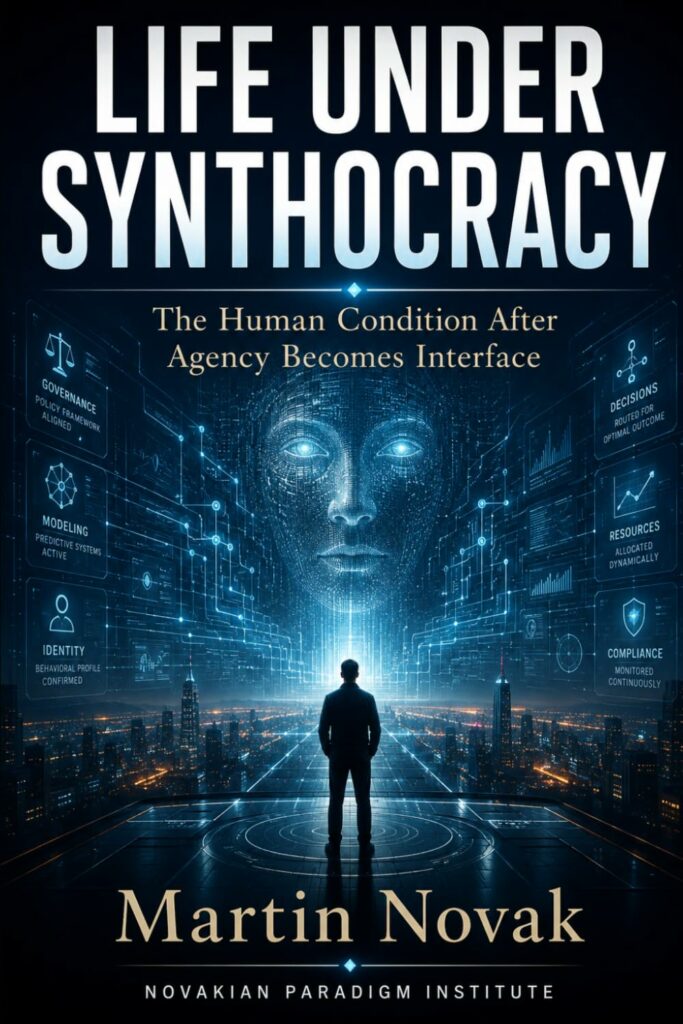
Synthocracy: Agency Becomes Interface
Agency becomes interface when the human being remains visibly active while losing meaningful control over the deeper configuration of the decision environment. The person still clicks, chooses, compares, approves, rejects, applies, cancels, follows, subscribes, swipes, accepts, appeals, and confirms. The body still feels the small sovereignty of action. A finger touches the screen. A form is submitted. A route is selected. A candidate is chosen. A message is sent. But the field in which these acts occur has already been arranged. The screen has been prepared. The menu has been narrowed. The ranking has been calculated. The feed has been ordered. The queue has been shaped. The recommendation has been surfaced. The workflow has carried the person toward a decision that feels personal because it requires a final human gesture.
This is the title condition of the book. Agency does not disappear all at once. It becomes compressed into an interface. The human does not necessarily feel conquered, because the interface is responsive. It moves when touched. It answers when asked. It remembers preferences, predicts needs, offers shortcuts, removes friction, and produces the reassuring sensation that the person is still directing the process. But responsiveness is not the same as control. A well-designed interface can make a person feel powerful while placing that person inside a field whose deeper parameters remain inaccessible. The human can operate the surface without governing the system.
A shopping platform gives the clearest everyday example. The user searches for a product and sees many choices. The experience feels abundant. Yet the order of the products, the sponsored placements, the reviews, the images, the delivery promises, the scarcity signals, the discounts, the comparison tables, the recommended bundles, and the personalized offers have already prepared the decision. The user chooses, but the field of commercial visibility has been engineered before the user arrives. A product buried on page seven is formally available but practically absent. A product placed first with fast shipping, thousands of reviews, and a limited-time discount does not command the user. It prepares the user.
News feeds work in the same way, but with greater political consequence. The reader believes they are forming an opinion from available information. Yet availability has already been organized by ranking, engagement prediction, social signals, personalization, outrage dynamics, moderation rules, source credibility systems, and the platform’s model of what will keep attention alive. The reader may still decide which headline to believe, but the set of headlines that becomes emotionally present has already been selected from an ocean of possible reality. In such a field, persuasion does not always require an argument. It may only require control over the order in which fragments of the world arrive.
Navigation systems show the same logic in physical space. A driver chooses the recommended route and may believe they have made an ordinary practical decision. But the route has been prepared by traffic models, platform incentives, map data, road closures, predicted congestion, fuel efficiency, toll logic, local regulations, and sometimes hidden assumptions about what counts as optimal. The person still turns the wheel. The car still moves under human control. Yet the path through the city has been selected by a system that sees the city differently from the driver. The driver remains active but increasingly navigates through a synthetic interpretation of the road.
Hiring portals translate career opportunity into a similar interface. An applicant uploads a résumé, answers questions, selects roles, checks boxes, and submits the application. Everything feels procedurally normal. Yet before a human recruiter appears, the portal may parse the résumé, extract signals, compare keywords, score experience, infer fit, classify risk, prioritize candidates, and decide which profiles deserve attention. The applicant experiences agency as application. The system experiences the applicant as sortable data. A person may spend hours crafting a letter that no human reads because the real threshold was crossed, or not crossed, inside a ranking layer the applicant never encountered.
Insurance pricing and credit scoring move agency into an even more abstract interface. A person asks for coverage, a loan, a mortgage, a premium, a limit, or a financial product. They enter data and receive a result. The result may appear as a neutral calculation, a fair price, a risk category, or a personalized offer. But the person is not only choosing a product. They are being interpreted by a predictive system that compares them with histories, probabilities, inferred behaviors, location, income, purchases, devices, claims, debts, and categories they may never see. The person experiences the market as choice. The market experiences the person as risk. The interface hides the asymmetry.
Dating apps and social platforms carry the same structure into intimacy. A person swipes, messages, chooses, rejects, likes, and waits. The emotional experience is direct: attraction, hope, disappointment, boredom, excitement, loneliness. Yet the field of encounter is already mediated by ranking, visibility, behavioral prediction, engagement optimization, profile scoring, paid boosts, distance filters, desirability signals, and machine-shaped timing. The person believes they are choosing among people. In practice, they are choosing among profiles made visible by an architecture of attention. The old randomness of encounter is replaced by a synthetic gate, and the gate becomes part of how desire learns to recognize possibility.
School-selection systems and educational platforms introduce the same logic into formation. Parents compare institutions, rankings, scores, recommendations, reviews, admission probabilities, transport routes, learning analytics, and performance indicators. Students receive adaptive exercises, predicted weaknesses, suggested pathways, and automated feedback. Education still contains teachers, parents, and children, but the field through which educational opportunity appears is increasingly mediated by systems of measurement and recommendation. A parent may choose a school, yet the meaning of “good school” may already have been shaped by dashboards. A student may choose a subject, yet the system may already have suggested what kind of learner they are.
Public benefit forms reveal the administrative face of the same transformation. A citizen applies for support, answers questions, uploads documents, and receives a notice. The interface may be clear, efficient, and even compassionate in tone. Yet behind the form, eligibility logic, fraud detection, risk classification, case routing, automated document checking, workload management, and policy rules may determine the practical path of the case before any official interprets the citizen as a person. The citizen’s agency is reduced to filling the interface correctly. The deeper question — how the state has decided to see them — remains hidden behind administrative usability.
Workplace productivity tools complete the circle by turning daily labor itself into interface. A worker manages tasks, responds to messages, records time, attends meetings, uses AI summaries, accepts automated suggestions, and performs inside platforms that promise coordination. But the same platforms may generate signals of responsiveness, collaboration, efficiency, delay, emotional tone, workload, compliance, and value. The worker chooses how to work, but the system increasingly defines what work looks like when rendered for management. A person may believe they are using a productivity tool. The institution may be using the tool to produce a machine-readable version of the person.
These examples differ in domain, but they share a single structure. The human retains visible participation while the field of participation has been preconfigured. The decision is not forced. It is framed. The user is not always deceived. They are guided. The institution does not always command. It prepares. The person does not become passive in the simple sense. They become active inside a surface whose deeper logic they cannot fully inspect. This is what it means for agency to become interface.
The distinction between choice and agency is therefore essential. Choice is selection among visible options. Agency is the power to participate in how options become visible, how they are ordered, what information accompanies them, what timing pressures apply, what defaults are set, what costs attach to refusal, and whether the frame itself can be challenged. A person choosing between ten recommended products has choice. A person able to understand and alter why those ten appeared, why others disappeared, and which commercial forces shaped the ranking has a stronger form of agency. A citizen who can appeal a decision has choice after the fact. A citizen who can challenge the classification and routing system before the decision hardens has agency at the boundary.
Synthocracy weakens agency by preserving choice. This is its most important subtlety. If choice vanished, people would notice. If every option were removed, domination would become visible. But when choice remains abundant, the loss of agency can be hidden inside the richness of the menu. A person can scroll endlessly and still not know who prepared the scroll. A person can compare many offers and still not know why those offers appeared. A person can receive personalized advice and still not know what alternative futures were silently excluded. Abundance at the interface can conceal poverty at the level of formation.
This is also why the language of freedom becomes unstable. The person says, “I chose this.” In the narrow sense, the statement may be true. But the stronger question is whether the person had standing in the formation of the field from which the choice emerged. Freedom cannot be measured only at the final click. It must be measured upstream, where visibility, timing, ranking, pressure, and refusal are configured. A society may preserve the ritual of choice while moving the substance of agency into systems that ordinary people cannot audit.
The old political imagination placed power in the command. The synthocratic imagination must learn to locate power in the preparation of the possible. The question is no longer only who tells you what to do. The question is who arranges what appears worth doing, what appears easy, what appears safe, what appears popular, what appears risky, what appears urgent, what appears normal, and what never appears at all. This is not merely design. It is governance through environment.
When agency becomes interface, the human being is not absent. The human is everywhere. The human is the user, applicant, patient, worker, parent, voter, buyer, reader, driver, lover, and citizen. But the human is increasingly positioned at the visible end of a process whose formative layers have moved elsewhere. The person continues to experience choice, and that experience is not fake. It is incomplete. It is the lived surface of a deeper structure.
Choice is what remains when agency has been compressed into a menu.