The Synthote: a person whose practical field of perception, access, choice, or treatment is materially configured by AI-mediated systems
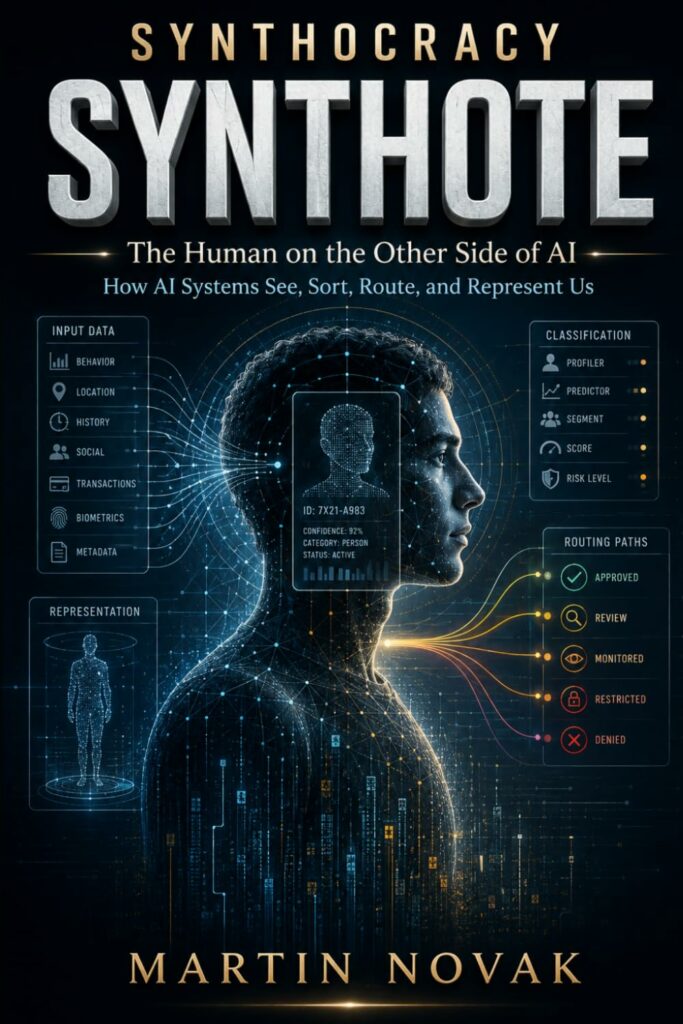
The idea of the synthote becomes useful only after the decision environment has been made visible. Introduced too early, it can sound like the name of a new kind of person, a political identity, or a speculative human category. That is not its purpose. The term describes a position within a particular relationship: the position of a person whose practical field of perception, access, choice, or treatment is materially configured by an AI-mediated system.
A synthote is therefore not defined by what the person is. The position is defined by what happens between the person and the decision environment.
A job applicant occupies this position when a system materially affects whether their application becomes visible, how their experience is classified, where they appear in a ranking, and whether they reach a human reviewer. A claimant occupies it when data matching, risk flags, automated summaries, or routing rules shape the evidence they must provide and the path through which their case proceeds. A patient occupies it when a triage system influences urgency, access to a specialist, or the treatment options presented to a clinician. A customer occupies it when personalisation, scoring, or fraud controls determine which prices, payment methods, services, or explanations become available. A platform user occupies it when recommendation and moderation systems materially shape visibility, reach, account status, or access to appeal.
In each example, the person remains more than the system’s representation of them. The applicant remains a worker with a history that exceeds the parsed résumé. The claimant remains a citizen or resident with rights and circumstances that exceed the administrative record. The patient remains a person whose condition cannot be reduced to a prediction. The customer remains capable of preference, judgement, refusal, and search. The platform user remains a speaker, creator, trader, or member of a community. The term synthote does not replace any of these descriptions.
It adds a relational question: what can this person practically see, reach, choose, contest, or receive after the system has configured the field?
This is why the synthote should not be treated as a substitute for citizen. Citizenship describes a legal and political relation to a state. A person remains a citizen when applying for a benefit, challenging a public decision, voting, receiving a service, or interacting with an administrative system. The synthote concept does not erase that status. It identifies an additional structural position that may arise when the citizen’s practical route through the institution is materially shaped by computational systems.
The distinction matters because formal citizenship and practical access can diverge. Two citizens may possess the same rights in law while being routed through different evidentiary demands, service channels, levels of human contact, or waiting times. One may receive a rapid pathway and a clear explanation. Another may encounter additional verification, an automated interface, or a decision whose basis cannot easily be reconstructed. The legal category remains the same. The decision environment does not.
Nor does the synthote replace the voter. A voter can remain fully enfranchised while ranking, targeting, recommender systems, generated political communication, or platform moderation shape which issues, candidates, and interpretations become visible before the vote. The concept does not imply that the vote is unreal or that political agency has disappeared. It asks how the informational environment preceding formal choice was prepared and whether its preparation was visible, contestable, and accountable.
The term likewise does not replace employee, applicant, patient, customer, user, student, or data subject. These categories identify legal, contractual, professional, social, or regulatory relationships. The synthote identifies something different: the person’s position relative to a system that materially configures the path through which those relationships are experienced. The canonical definition is explicit that the synthote is not a new legal status, a permanent identity, or evidence that human agency has disappeared.
A person does not become a synthote for life. They occupy the position in a specific process.
Someone may be an affected synthote while applying for a mortgage because a scoring and routing system structures the application. The same person may later act as an independent decision-maker in a family matter that involves no consequential AI mediation. At work, they may become a possible ceremonial human when approving system-prepared decisions affecting others. On a platform, they may again occupy the synthote position when ranking or moderation systems configure what they can publish, reach, or appeal.
The position can therefore change from one decision chain to another. The same person can stand on different sides of different systems. They can be formally powerful in one process and structurally affected in another. They can even occupy both positions within the same institution: a manager may approve AI-supported personnel decisions during the day and later become the subject of an automated credit, insurance, or platform-access decision.
This prevents the concept from hardening into a permanent social class. The field guide does not claim that society is divided into ceremonial humans on one side and synthotes on the other. These are analytical positions within decision chains, not fixed populations. The masterprompt requires precisely this two-sided analysis: identify the formal human decision-maker and ask whether their control has become ceremonial; identify the affected person and ask how their visibility, classification, access, rights, resources, reputation, or trajectory have been materially shaped.
The first dimension of the synthote position is perception. A system may shape what the person sees before the person makes a choice. A search ranking determines which results are likely to be considered. A recommendation system determines which products, posts, opportunities, or explanations appear first. A financial interface presents some offers and omits others. A public-service chatbot frames the available categories through which a person must describe their problem.
The person still perceives, interprets, and chooses. The system does not completely design consciousness or eliminate reflection. It configures the practical field from which perception begins. What is easy to see acquires an advantage over what is hidden, delayed, or omitted. What arrives with a recommendation may appear more legitimate than an option requiring independent discovery. What is presented as standard may be accepted more readily than what is framed as exceptional.
This influence should not be overstated. People search beyond recommendations, distrust interfaces, consult others, and deliberately resist defaults. The synthote does not lack agency. The point is that agency operates within conditions partly prepared by systems whose role may not be visible to the person exercising it. The difference is between saying that a machine controls the person and saying that a system has materially altered the practical environment within which the person acts. Only the second claim belongs to this field guide.
The second dimension is access. A system may influence which services, offers, opportunities, institutions, or human contacts the person can reach. Access does not always disappear through a formal denial. It can be narrowed through routing, ranking, eligibility checks, machine-readable requirements, verification demands, or differential service levels.
A customer may see fewer payment methods. A supplier may fail to enter an agent-mediated procurement process because its information cannot be interpreted or verified. A citizen may be directed towards a self-service route while another receives specialist attention. A claimant may be asked for additional documentation after crossing a risk threshold. A user may retain an account while losing practical visibility. An applicant may remain in the database while never entering the recruiter’s working list.
The person has not necessarily been prohibited from participating. They may have been placed in a lower or more difficult access class: a practical level of visibility, explanation, service, human contact, speed, model quality, or appeal that differs from the route available to others. The difference may be justified, arbitrary, beneficial, or harmful. The concept identifies the distribution that must be examined rather than deciding its legitimacy in advance.
The third dimension is choice. AI-mediated systems may expand a person’s options by finding alternatives, translating information, lowering search costs, and making complex services usable. A responsible recommendation system can increase practical agency. An agent can help a person compare offers they would otherwise never discover. A public-service assistant can help someone understand rights and complete an application.
The same systems can also narrow choice. An option may not appear because the system treats it as irrelevant, risky, unprofitable, or incompatible. A platform may personalise the offer set. A professional interface may present only the actions anticipated by the workflow. A chatbot may force an unusual situation into predefined categories. The person may retain the formal right to choose while lacking access to the full set of meaningful alternatives.
The synthote position is not established merely because choices have been organised. Every institution and interface organises choices in some way. The Material Influence Test still applies. The system must materially affect the set, visibility, order, reachability, or consequences of the options. A tool that displays the same options more clearly may assist. A system that determines which options are permitted to reach a particular person may be co-deciding.
The fourth dimension is classification. A person may enter the decision chain as an applicant, customer, patient, claimant, worker, seller, traveller, or speaker and emerge as a match, risk, priority, exception, anomaly, likely defaulter, suspected fraud, vulnerable case, trusted user, or low-quality participant. The classification may affect what the institution does next and what the person must do to proceed.
A label can change the burden of proof. A person classified as ordinary may continue without additional action. A person classified as suspicious may need to provide records, explanations, identification, or guarantees. A person classified as low priority may wait. A person classified as likely to disengage may receive less investment. A person classified as high value may receive a better route.
The synthote is not identical with the classification. The person may dispute it, overcome it, or never learn that it exists. The term names the structural fact that the classification materially shaped treatment. It keeps the analysis focused on the relation between representation and consequence: how the institution’s computational account of a person became part of the environment through which the person had to act.
The fifth dimension is routing. The system may determine which institutional path becomes real. A route can lead towards a human, an automated interface, a specialist, an investigation, a delay, an offer, or an appeal. Two people addressing the same institution may encounter different practical institutions because the system sends them into different queues and standards of service.
Routing can be beneficial. It can connect urgent cases with scarce expertise and direct ordinary matters towards faster resolution. The problem arises when routing is opaque, difficult to challenge, or based on categories the person cannot correct. The route then becomes a quiet allocation of institutional attention.
For the synthote, the question is not merely whether a service or right exists. It is whether the path made available allows the person to exercise it meaningfully. A right to human review is weak if the system repeatedly returns the case to automation. A right to appeal is weak if the appeal receives the same summary and classification. A formal opportunity is weak if the route reaches it only after the relevant deadline has passed.
The sixth dimension is treatment and consequence. The person’s position becomes most visible when the configured environment produces an effect: employment is offered or withheld, money is released or recovered, access is granted or restricted, care is prioritised or delayed, content becomes visible or disappears, a transaction proceeds or is blocked.
The person often sees the consequence more clearly than the path. They receive the rejection, the delay, the changed price, the reduced reach, the additional verification request, the debt notice, or the account restriction. They may be told that a human made the decision, that the system merely supported the process, or that no further explanation is available.
This asymmetry is central to the synthote position. The institution may possess data, classifications, scores, logs, model outputs, workflow rules, and vendor documentation. The affected person experiences the result while seeing only fragments of the process that produced it. The subtitle of this chapter captures the contrast: the ceremonial human may carry responsibility without sufficient control, while the synthote may carry consequences without sufficient visibility.
The two positions should not be romanticised into opposing moral characters. The ceremonial human is not necessarily an oppressor, and the synthote is not necessarily passive or blameless in every dispute. The formal decision-maker may be constrained by the same institution that disadvantages the affected person. The affected person may provide false information, breach rules, or receive an outcome that is fully justified. The concepts do not predetermine innocence or fault. They reveal asymmetries of knowledge, control, and consequence that must be examined before responsibility can be allocated fairly.
The positions can also be connected by a shared invisibility. The reviewer may not see how the system filtered or ranked the case. The affected person may not know that filtering or ranking occurred. The reviewer sees a prepared representation; the affected person sees an institutional consequence. Between them lies the system, the workflow, and the earlier choices that neither may fully control.
This is why the synthote is not simply another word for someone affected by technology. The term becomes useful when a person’s practical trajectory has been materially configured through the decision environment. A user receiving a spelling correction is not thereby a synthote in any analytically important sense. A person whose application is filtered from view, whose access depends on a hidden risk threshold, or whose appeal is routed back through the same classification occupies a more consequential position.
Feedback can deepen this position but is not required to create it. A person can become an affected synthote during one bounded decision even if no later model learns from their behaviour. The position may be temporary and end when the process ends. It becomes more durable when the outcome generates new data that follows the person into later decisions.
A fraud flag may remain in the record. A missed payment produced by an earlier denial may become evidence of future risk. A worker’s response to reduced opportunities may be interpreted as low engagement. A user’s attempts to appeal may be recorded as repeated support contact. The person’s behaviour within a constrained route can then become evidence used to justify that route. Feedback converts one configured encounter into a continuing trajectory.
Yet even here, the person is not reducible to the trajectory. They may challenge the data, change institutions, obtain human intervention, organise collectively, or compel legal and political correction. The concept must never be stated as “the synthote has no agency” or “the machine completely designs the person’s choices”. The project’s canonical language expressly rejects both claims.
The value of the term lies in its precision. It tells us to examine the affected side of the decision chain with the same care given to the formal decision-maker. Who became visible? How were they represented? Which options reached them? Which route did they receive? What explanation was provided? Could they correct the data, add context, challenge the classification, reach an authorised human, pause the consequence, and obtain a genuinely different review?
Without this perspective, governance can remain centred on the institution. It asks whether the model was validated, whether the employee followed procedure, whether the organisation documented risk, and whether a human approved the result. These questions matter. The synthote position adds the complementary inquiry: what decision environment did the person actually encounter, and what practical possibilities remained inside it?
The shortest definition can now be stated without suggesting a new identity:
A synthote is a person whose practical field of perception, access, choice, or treatment is materially configured by AI-mediated systems.
The longer definition preserves the necessary boundaries:
A synthote is a person occupying a structural position within an AI-mediated decision environment. What the person sees, which options reach them, how they are classified or routed, and which actions become practically available may be materially shaped by computational systems. The term describes a relationship to a system—not a permanent identity, the disappearance of human agency, or a new legal status.
The ceremonial human and the synthote are therefore two positions in the same chain. One may be asked to answer for an outcome they did not fully control. The other may be required to live with an outcome whose preparation they could not fully see.
Neither position tells the whole story alone. Together, they reveal where responsibility and consequence have become separated by the systems operating between them.
Martin Novak is the founder of the Synthocracy Institute. Insight 01 · Admissibility & Evidence · Synthocracy Institute · operating internationally
Synthocracy Institute
contact@synthocracyinstitute.com
synthocracyinstitute.com