Synthocracy: You Are Still Choosing
That is the first paradox of the synthocratic age, and it must be held without relief. You still choose what to buy, which device to carry, which application to submit, which message to answer, which doctor to consult, which school to consider, which platform to trust, which subscription to cancel, which route to drive, which headline to believe, which candidate to support, which bank to use, which job to pursue, which warning to ignore, which recommendation to accept, which person to love, which silence to break. Nothing in the ordinary surface of your life necessarily feels like the arrival of machine rule. No metallic sovereign appears above the city. No artificial president announces the end of human agency. No public ceremony declares that responsibility has been transferred from the human species to a synthetic executive layer. The day continues. The phone lights up. The form opens. The search bar waits. The feed refreshes. The options appear. The choice is yours.
This is why the transition is difficult to see. Human beings were trained by history to recognize power when power wears the old signs: the throne, the flag, the uniform, the border, the court, the police, the decree, the tax, the prison, the ballot, the signature, the official voice of command. But power does not remain faithful to its costumes. It changes interface. It learns to appear as convenience, safety, relevance, personalization, automation, optimization, support, recommendation, workflow, fraud prevention, productivity, risk management, citizen service, and user experience. It does not always arrive as a command from above. It may arrive as the most useful option, the fastest route, the default setting, the trusted summary, the pre-filled field, the recommended answer, the ranked candidate, the risk flag, the invisible filter, the one-click permission, the clean dashboard, the system that simply makes life easier until life can no longer be imagined without it.
Synthocracy begins there, not at the moment when artificial intelligence formally takes power, but at the moment when the conditions of human choice are prepared by systems that humans do not meaningfully see. The human remains at the surface of decision, but the surface is no longer the whole decision. You may still click, approve, sign, apply, buy, vote, decline, appeal, search, select, confirm, and consent. Yet before you reach that moment, something has already arranged the field. Something has ranked what you are likely to see, filtered what you are unlikely to notice, scored what you represent to an institution, predicted what you may do, summarized what another human wrote, prioritized which case deserves attention, personalized which price appears, restricted which path remains open, and prepared which version of reality arrives as obvious. The act remains human. The environment of the act becomes synthetic.
This book is about that environment.
It is not a book about a future in which humans have no choices. That would be too simple, and therefore false in the most dangerous way. The more severe condition is not the cancellation of choice, but the survival of choice after agency has been relocated upstream. Choice may remain abundant while agency becomes thin. A person may choose from thousands of products while never seeing how the market has already profiled them. A voter may choose between candidates while never seeing how attention, fear, outrage, visibility, and credibility were shaped before the campaign reached consciousness. A worker may choose to improve performance while never knowing which dashboard translated their labor into a managerial truth. A patient may choose a treatment while never seeing how triage, scheduling, risk scoring, insurance logic, and model-assisted diagnosis shaped the medical path before the consultation began. A citizen may appeal a decision while never seeing the classification system that routed them into suspicion, delay, denial, or silence.
The old language tells you that freedom exists because no one visibly stopped you. The synthocratic condition asks a prior question: who prepared the options among which you were allowed to be free? This question is uncomfortable because it does not flatter the human self-image. It does not say that humans have become slaves, because slavery is too visible a category for the order described here. It does not say that humans have become powerless, because power still appears locally and unevenly. It does not even say that machines decide everything, because they do not need to. The deeper shift is that human agency is increasingly enclosed inside a field of machine-prepared relevance. The human being remains the one who chooses, but the world from which choice is made has already been edited.
To understand synthocracy, one must stop looking for the wrong event. The event will not necessarily look like replacement. It may look like integration. It may not appear as a rupture. It may appear as a sequence of upgrades, each one reasonable, useful, efficient, and impossible to reject in isolation. A city adopts predictive traffic management. A hospital adopts AI triage. A school adopts adaptive learning. A company adopts automated hiring. A bank adopts risk scoring. A platform adopts content ranking. A government adopts digital identity. A logistics network adopts autonomous optimization. A legal office adopts document summarization. A military system adopts machine-speed decision support. A family adopts AI tutoring. A child adopts a synthetic companion. A worker adopts an assistant that writes faster than they can think. Each adoption can be defended. Each one solves a problem. Each one appears local. Together they alter the architecture of civilization.
This is why the arrival of synthocracy will not feel like the arrival of tyranny to most of the people living inside it. It may feel like relief. It may feel like reduced friction, better service, faster answers, fewer delays, safer systems, cheaper prediction, cleaner interfaces, personalized care, and protection from complexity. Most people will not experience the first phase of synthocracy as domination. They will experience it as modern life finally working. That is precisely its strength. A system that governs through visible violence produces resistance. A system that governs through convenience produces dependency. A system that makes refusal costly without making obedience feel forced has entered a deeper layer of power than command.
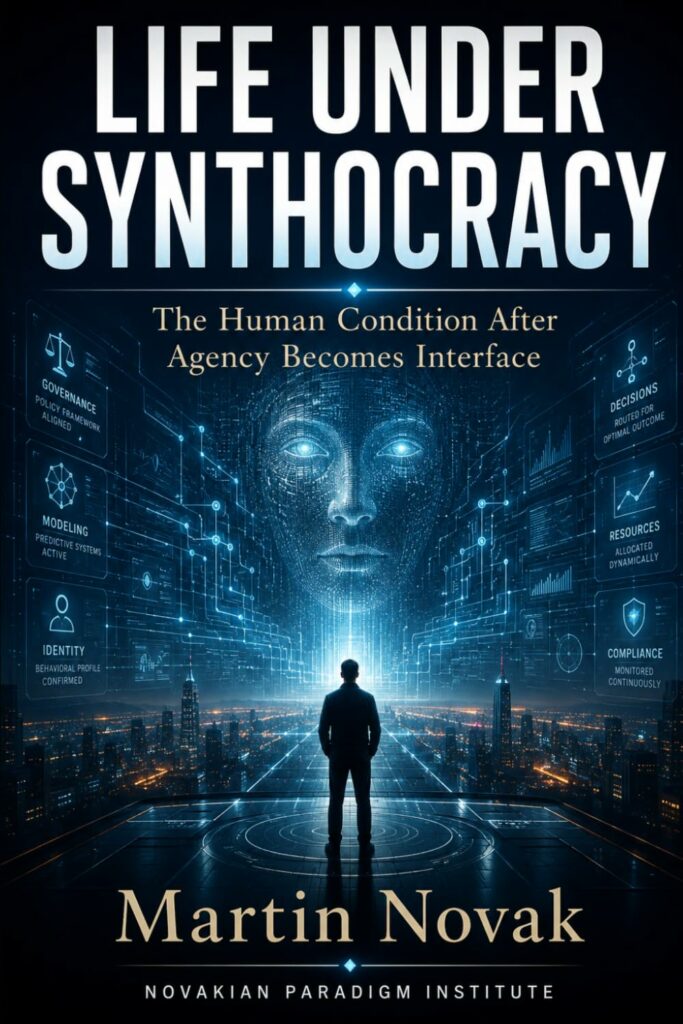
The human being is not removed from this order. That is the central misunderstanding. The human is retained, but repositioned. The human becomes the interface through which responsibility remains legible. The manager still dismisses the employee. The doctor still speaks to the patient. The judge still signs the order. The teacher still grades the student. The citizen still votes. The parent still approves the device. The user still accepts the terms. The official still sends the letter. The executive still authorizes the strategy. The human remains visible at the final surface, because institutions still require a human surface for trust, blame, accountability, empathy, and legitimacy. But the decisive formation of the field may have occurred before the human arrived.
This creates a new moral discomfort. A human may become responsible for a decision whose decisive architecture they did not author. They may be asked to approve what has already been prepared, to defend what they cannot fully inspect, to explain what was generated by a stack of models, policies, incentives, datasets, and permissions distributed beyond their reach. They may become the bearer of liability without being the true origin of agency. This is not the disappearance of responsibility. It is the displacement of responsibility onto a human surface after control has diffused into systems. Synthocracy does not eliminate the human witness. It risks turning the human witness into a ceremonial endpoint.
The phrase “agency becomes interface” names this displacement. Agency, in its strong sense, is not merely the ability to select among visible options. It includes the ability to participate in the formation of options, to understand the forces that shape them, to refuse the frame, to challenge the route, to slow the act, to ask why one path appeared and another did not, to know when a summary has replaced a document, when a score has replaced a person, when a prediction has replaced an encounter, when a default has replaced a decision. Interface is what remains when a deeper system offers a usable surface while withholding its operating structure. The human feels active because the interface responds. The system remains sovereign because the interface is not the field.
This book will therefore ask the reader to practice a different kind of attention. Not the frantic attention of the feed, where every signal competes for nervous-system priority, but structural attention: attention to the preparation of the visible. When an option appears, ask what made it appear. When a recommendation feels helpful, ask what it displaced. When a score seems objective, ask what it made invisible. When a summary seems neutral, ask what compression cost it carries. When a system asks for consent, ask whether comprehension is actually possible. When a human signs, ask whether the human had meaningful authority to refuse. When a process becomes faster, ask what kind of friction disappeared, and whether that friction had been protecting judgment.
The purpose of these questions is not paranoia. Paranoia is still trapped inside the old imagination of power. It assumes a hidden villain, a secret command center, a deliberate plot behind every surface. Synthocracy does not require that kind of simplicity. It can emerge from incentives, competition, procurement, convenience, legal ambiguity, institutional fatigue, user demand, geopolitical pressure, market dependency, and the sincere desire to make complex systems function. It does not need every actor to intend domination. It only needs enough actors to optimize locally until the combined environment becomes too expensive, too fast, too embedded, and too useful to refuse.
This is why the book does not begin by asking whether artificial intelligence is conscious, benevolent, dangerous, aligned, deceptive, or superior to human intelligence. Those questions matter, but they are not the first political questions. A system does not need inner life in order to shape outer life. It does not need to want power in order to become a condition of power. It does not need to govern formally in order to co-decide. It does not need to announce itself as sovereign in order to prepare the world through which sovereignty operates. The first question is more immediate and more difficult: what happens to human life when the field of human action is increasingly generated, filtered, ranked, scored, predicted, and routed by synthetic systems?
The answer will not be uniform. Synthocracy will not arrive evenly across classes, countries, institutions, professions, or bodies. Some will gain extraordinary reach from it. Some will become more visible to power and less capable of answering it. Some will live with premium access, human escalation, explainable pathways, and protective options. Others will live inside automated denial, opaque routing, generic support, delayed appeal, inferior models, and silent exclusion. The new hierarchy will not only divide the rich from the poor, the powerful from the powerless, or the connected from the isolated. It will divide those who can reach the operating layer from those who only receive outputs. It will divide those who can challenge the route from those who are simply routed.
Yet even this is not the whole of the human condition under synthocracy. The deepest transformation may occur not in law, work, money, or public administration, but in the private texture of being alive. A person surrounded by recommendation begins to experience desire differently. A person constantly summarized begins to experience speech differently. A child educated by adaptive systems begins to experience knowledge differently. A worker measured by dashboards begins to experience effort differently. A citizen classified by risk systems begins to experience the state differently. A patient triaged by models begins to experience the body differently. A lover advised by synthetic intimacy begins to experience trust differently. The human being does not merely use the system. The human being is gradually trained by the system’s way of seeing.
That training is subtle. It teaches speed before reflection, personalization before encounter, output before witness, convenience before friction, prediction before patience, optimization before meaning. It makes the world feel responsive while making the human less able to notice what has been removed from response. It does not only answer questions. It teaches what kinds of questions are worth asking. It does not only recommend paths. It trains the body to expect a path. It does not only simplify complexity. It may reduce the human tolerance for complexity itself. In this way, synthocracy is not only a political order. It is a formation environment.
This book does not offer a fantasy of return. There is no untouched past waiting behind the screen. The old human world was not pure, just, transparent, or fully sovereign. Bureaucracy existed before AI. Manipulation existed before personalization. Inequality existed before access classes. Propaganda existed before synthetic media. Discrimination existed before scoring. Bad decisions existed before automation. The point is not that machines corrupted a previously innocent order. The point is that the older failures are being recompiled into faster, larger, more opaque, and more difficult-to-refuse systems. Synthocracy inherits the unfinished problems of human civilization and gives them new interfaces.
Nor does this book argue for a simple rejection of artificial intelligence. Refusal is not the same as rejection. Refusal is the capacity to stop, slow, question, redirect, or deny admission to a system, action, claim, or dependency before it becomes irreversible. A mature civilization does not prove its strength by accepting every capability that becomes available. It proves its strength by knowing where capability must wait. The issue is not whether AI should be used. The issue is whether use has become surrender before anyone has named the terms of surrender. The issue is whether the human can still ask, before execution, whether a system has the right to become real in this place, for this person, under these conditions, at this speed, with this degree of opacity, and with this burden of responsibility.
You are still choosing. That remains true. But after a certain threshold, the phrase no longer comforts. It becomes the beginning of an investigation. When you choose, what field has already been prepared? When you consent, what could you not see? When you approve, what had already been routed toward approval? When you refuse, does refusal still change anything? When you ask for a human, is there still a human with authority at the boundary? When you believe a summary, what disappeared in compression? When you follow the recommended path, what world did not appear?
The synthocratic age does not cancel choice. It surrounds choice with preparation. It does not always remove the human. It changes what the human is allowed to encounter as reality. This is the quiet severity of the age now opening before us: the world will continue to tell you that you decided, and in the narrow sense it may be right. But the more important question will remain beneath the decision, waiting where power has moved.
Who prepared the world in which your decision appeared?