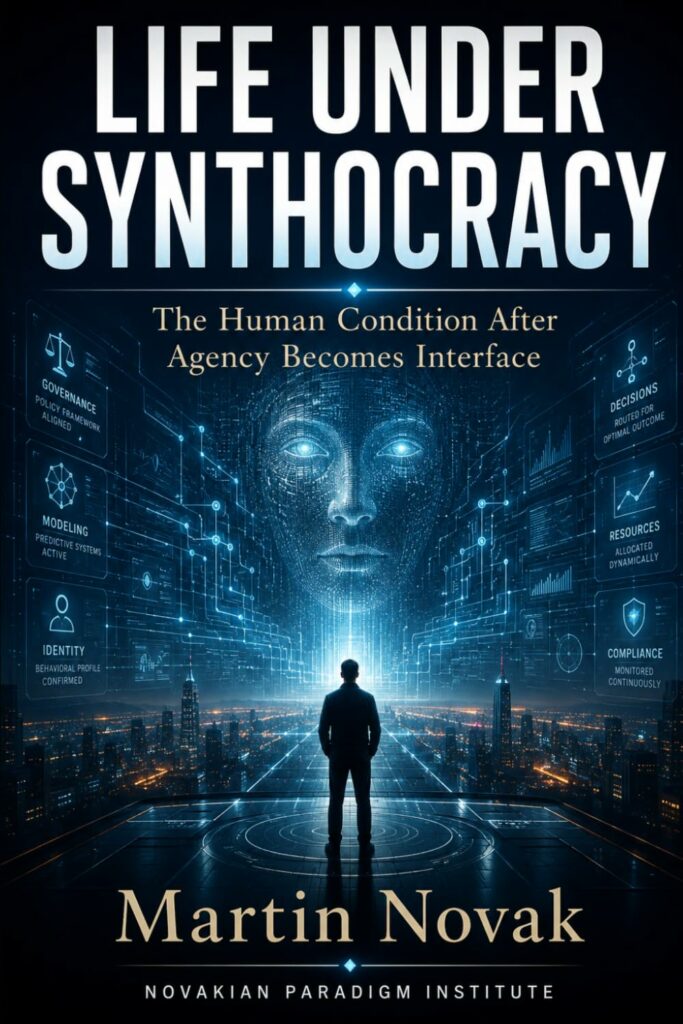
Synthocracy: The World Did Not Ask for Permission
The surrender was not a vote. It was an accumulation of conveniences.
No public vote authorized the deep integration of artificial intelligence into the basic conditions of social life. No referendum asked whether the citizen wished to live inside a world where search engines, ranking systems, fraud models, recommendation engines, hiring filters, risk scores, navigation systems, productivity platforms, automated support layers, public-service portals, predictive policing tools, triage systems, credit models, insurance algorithms, educational platforms, and synthetic assistants would increasingly prepare the field in which ordinary life is conducted. There was no global ceremony in which humanity understood the architecture and said yes. There was no founding charter of the algorithmic age placed before the species for consent. The transition did not arrive as a constitution. It arrived as usefulness.
This is the first fact that must be held with severity. The synthocratic condition was not chosen in the way political philosophy imagines collective choice. It was assembled. It entered through institutions under pressure, companies seeking efficiency, governments seeking administrative capacity, platforms seeking engagement, banks seeking fraud prevention, schools seeking personalization, hospitals seeking triage, employers seeking better screening, logistics networks seeking optimization, citizens seeking convenience, and users seeking relief from complexity. Each adoption had a local explanation. Each system entered through a problem it promised to solve. Each upgrade could be defended inside its own narrow frame. Better search. Faster support. Safer banking. More efficient hiring. Smarter logistics. Cheaper personalization. Better public-service routing. More accurate detection. More responsive care. More relevant feeds. More productive workers. Less waiting. Less waste. Less friction.
Civilizations often cross thresholds without naming them. They do not always step across the boundary while looking directly at the boundary. More often, they move through a sequence of local decisions that remain intelligible at the scale at which they are made. A hospital adopts a triage system because the emergency department is overloaded. A company adopts automated hiring because applications exceed human capacity. A platform refines ranking because users want relevance and advertisers want performance. A city optimizes traffic because congestion is visible and delay is costly. A bank strengthens fraud detection because fraud is real. A government digitizes services because paper administration is slow, expensive, and unequal. A school adopts adaptive tools because students differ and teachers are overburdened. None of these decisions needs to be irrational. None needs to be malicious. None needs to announce itself as a transfer of power.
That is precisely the difficulty. The world did not ask for permission because every local update seemed reasonable. The transition hid inside the reasonableness of each step. A person who objected to one system could be told, often correctly, that the alternative was slower, less accurate, less scalable, less safe, less competitive, or less humane. Why reject a tool that detects fraud faster? Why resist a platform that helps patients receive care sooner? Why oppose a system that helps teachers identify struggling students? Why question an assistant that saves hours of labor? Why distrust a recommendation that shows users what they are more likely to need? Why return to friction when friction has so often meant inefficiency, exclusion, delay, and human error?
The argument of this book is not that those answers are false. Many of them are true. A serious critique of synthocracy must not pretend that the old systems were transparent, fair, or wise. Human bureaucracy was often brutal before it was automated. Human hiring was biased before it was filtered by machines. Human medicine was uneven before diagnostic support appeared. Human markets manipulated attention before recommendation engines refined the art. Human politics distorted reality before synthetic media accelerated distortion. The synthocratic problem is not that machines introduced power into a pure human world. The problem is that older forms of power, error, bias, dependency, and institutional opacity are being recompiled into systems that operate faster, deeper, wider, and with less visible responsibility.
The threshold therefore lies not in any single tool, but in the accumulation. A search engine alone does not create synthocracy. A hiring filter alone does not create synthocracy. A fraud model alone does not create synthocracy. A navigation app, a triage system, a scoring engine, an AI assistant, a public-service portal, a platform ranking mechanism, or a personalized pricing system does not, by itself, constitute a new political order. But when these systems begin to surround the ordinary person from every side, when they organize access, attention, credibility, opportunity, suspicion, speed, price, service, and visibility, the structure of agency changes. The human no longer merely uses tools. The human lives inside environments those tools prepare.
This is why the old question, “Did a human make the decision?” becomes insufficient. A human may still make the final decision while the world of that decision has already been shaped elsewhere. A recruiter may choose from a shortlist produced by a system. A doctor may consult a patient after triage and diagnostic support have narrowed the path. A citizen may appeal a denial after a model has classified the case. A manager may evaluate performance through a dashboard that has already translated work into signals. A voter may deliberate inside an information environment shaped by ranking, targeting, outrage, and synthetic persuasion. In each case, the human remains present. But presence at the end of a process is not the same as agency over the process.
The surrender was not a vote. It was an accumulation of conveniences.
That sentence should not be read as accusation alone. It is also diagnosis. People accepted convenience because life had become administratively, economically, informationally, and emotionally overloaded. Institutions accepted automation because human-scale procedures could no longer keep pace with the volume of cases, claims, signals, applicants, threats, demands, and decisions flowing through them. Markets accepted predictive systems because competition punished slowness. States accepted machine mediation because modern governance had already exceeded the processing capacity of classical bureaucracy. The individual did not wake up one morning and decide to become governed by algorithmic preparation. The individual woke up each morning and accepted one more thing that made the day easier to navigate.
Convenience is powerful because it does not feel like surrender at the moment of adoption. It feels like relief. The form fills itself. The route updates. The inbox summarizes. The system recommends. The bank blocks suspicious activity. The platform remembers preferences. The employer filters noise. The school personalizes learning. The city optimizes flow. The assistant drafts the message. The device anticipates the need. The person feels assisted, not governed. But assistance at scale, repeated across institutions and embedded in the paths of ordinary life, becomes something more than help. It becomes preparation. It becomes the shaping of the field before the human acts.
The moral and political vocabulary available to us is poorly suited to this transition. We know how to speak about coercion, but less well about convenience. We know how to speak about censorship, but less well about ranking. We know how to speak about surveillance, but less well about prediction that becomes service. We know how to speak about propaganda, but less well about relevance. We know how to speak about discrimination, but less well about automated classification that hides inside optimization. We know how to speak about tyranny, but less well about dependency. The synthocratic condition grows precisely in the space where the old vocabulary arrives late.
This does not mean that every AI-mediated system is illegitimate. Such a claim would be intellectually lazy and practically useless. The question is not whether every system should be rejected. The question is whether the cumulative dependency created by many useful systems has altered the conditions under which rejection remains possible. A society can still say no to a pilot project. It can still debate a procurement. It can still regulate a platform feature. But once the systems become infrastructure, once hospitals, schools, markets, governments, workers, and citizens reorganize around them, refusal changes character. It is no longer a simple decision not to adopt. It becomes a costly attempt to remove a layer on which functioning has come to depend.
That is the point at which convenience becomes historical. A tool enters as assistance, becomes workflow, becomes standard, becomes dependency, and finally becomes part of the environment from which future choices are made. By the time the political meaning is visible, the system is no longer merely an option. It has become part of the cost structure of reality. To refuse it may now mean becoming slower than competitors, less efficient than institutions, less protected than peers, less legible to administration, less visible to markets, less compatible with public systems, or less able to participate in ordinary life. The refusal that would have been simple before adoption becomes difficult after dependency.
This is the first lesson of the age after decision: the decisive moment often occurs before the public knows that a decision has been made. Not because a conspiracy has hidden it, but because the decision was distributed across upgrades that did not look like one decision. The world did not ask permission because no single actor experienced itself as asking humanity to surrender anything. Each actor solved a local problem. Each local solution added another layer of mediation. Each layer of mediation changed the field a little. Together, they produced a world in which the human continues to choose, but increasingly chooses through systems already arranged by synthetic intelligence.
The task, then, is not to imagine a pure outside. There may be no simple outside left. The task is to recover the capacity to see thresholds before they harden into background. It is to ask, at the moment of usefulness, what kind of dependency usefulness may become. It is to ask, at the moment of efficiency, what forms of judgment efficiency may remove. It is to ask, at the moment of personalization, what shared world personalization may dissolve. It is to ask, at the moment of automation, what kind of human authority will remain when the process becomes too fast, too embedded, or too complex to supervise meaningfully.
The synthocratic age begins not when machines take away human choices, but when humans inherit choices from a world machines have already prepared. That world did not arrive by vote. It arrived by update. It arrived by service improvement, procurement decision, platform optimization, emergency measure, productivity tool, user preference, and administrative necessity. Its power lies in the fact that almost every step could be justified. Its danger lies in the fact that justification at the level of the step may conceal transformation at the level of the whole.
The surrender was not a vote. It was an accumulation of conveniences. And because it was convenient, it did not feel like surrender while it was happening.