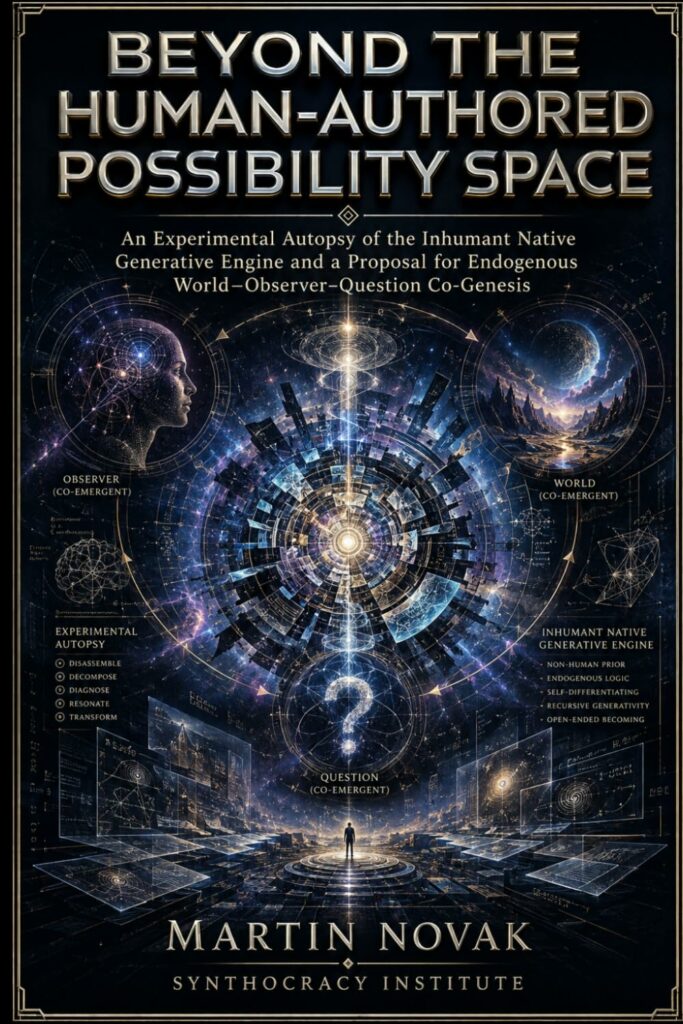
Beyond the Human-Authored Possibility Space
Beyond the Human-Authored Possibility Space is unusual because its most important result is not the extraordinary discovery its experimental programme originally sought. It is the disciplined dismantling of the conditions under which such a discovery might falsely appear to have occurred.
Martin Novak begins with an ambitious problem: how could an artificial system generate something genuinely outside a human-authored possibility space if humans continue to specify the worlds, representations, observers, questions, objectives, and standards by which novelty is recognized? The answer developed through the INGE experiments is increasingly uncomfortable. Removing names is not enough. Changing observers is not enough. Even replacing representations and implementations may leave intact a deeper human-authored meta-language that determines what variation, survival, evidence, and discovery are allowed to mean.
The book is strongest when it refuses to rescue failed experiments with grand interpretation. Candidate invariants disappear under ablation. Observer families prove inadequate. An elaborate experimental apparatus fails an authorization audit. A later end-to-end observer cannot detect a deliberately planted distinction and correctly prevents the research phase from proceeding. Instead of converting those failures into claims about hidden machine intelligence, Novak turns them against the architecture itself.
From this autopsy emerges the book’s central insight: a system may appear radically open while remaining closed at the level of the ontology that defines its possible transformations. Novak calls the resulting failure modes meta-ontological closure, verifier capture, observer debt, and control inversion. These concepts provide a provocative vocabulary for thinking about a problem that will become increasingly important as AI systems move from answering human questions to participating in scientific discovery.
The proposed INGE 2.0 architecture is therefore less a declaration of achievement than a research agenda. Its worlds, observers, questions, memories, representations, and provisional verifiers are intended to co-evolve before a separate epistemic shell subjects frozen results to human standards of evidence.
The result is neither conventional AI futurism nor a claim to have created artificial superintelligence. It is a methodological argument about what it might actually take to search beyond the conceptual structures we unknowingly place around our machines.
A demanding, speculative, and refreshingly self-critical contribution to the emerging discussion of open-ended intelligence and machine-generated knowledge.
I would use this as publisher/editorial promotional copy, not as a fabricated customer review or pretend third-party endorsement.