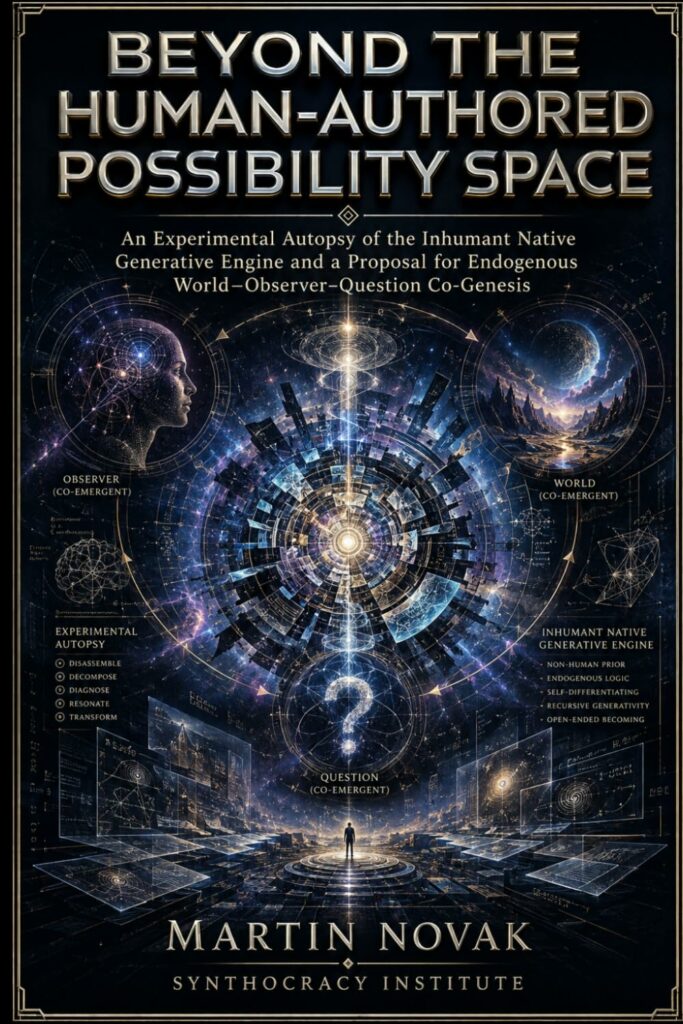
Beyond the Human-Authored Possibility Space. Inhumant Native Generative Engine (INGE)
BEYOND THE HUMAN-AUTHORED POSSIBILITY SPACE is a research-driven examination of whether artificial generative systems can produce operational structures that are not merely variations inside human-defined conceptual, representational, and evaluative frameworks.
Martin Novak reconstructs the experimental lineage of the Inhumant Native Generative Engine (INGE), a programme designed to separate native computation from human interpretation through observer rotation, representation changes, ontology-extinction tests, causal controls, and blind implementation-lineage replacement. Rather than presenting the programme as a successful discovery of “alien” cognition, the book focuses on its negative results and on what those failures reveal about automated discovery.
The analysis introduces concepts including meta-ontological closure, ontological overfitting, observer debt, verifier capture, apparatus gravity, control inversion, lineage replacement, and terminal transduction. It then proposes INGE 2.0, an open-ended computational ecology in which worlds, observers, questions, representations, and provisional verification mechanisms co-evolve before encountering a separate human-facing epistemic boundary.
A compact interdisciplinary work for readers of artificial intelligence, computational epistemology, artificial life, open-ended evolution, philosophy of science, and machine-assisted scientific discovery.
Suggested readership: AI researchers, computational scientists, philosophers of technology and science, artificial-life researchers, systems theorists, research-methodology specialists, and advanced readers interested in the future of machine-generated knowledge.