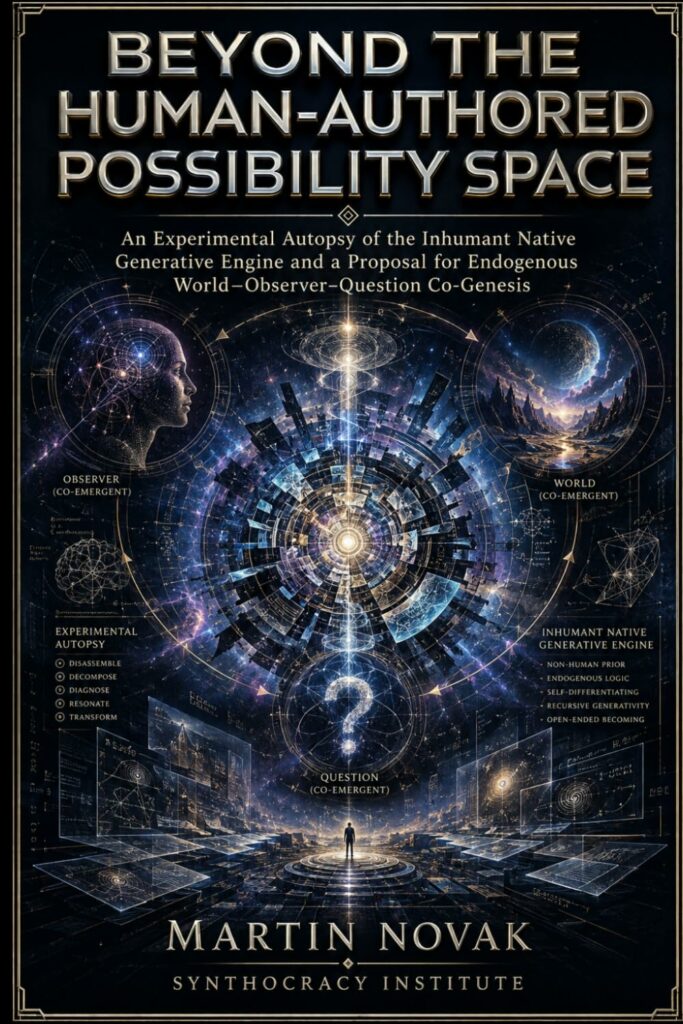
Synthocracy: Beyond the Human-Authored Possibility Space
What happens when an artificial system is asked not merely to discover new answers—but to escape the space of questions, representations, and evaluators humans have already constructed?
Beyond the Human-Authored Possibility Space documents an experimental attempt to do exactly that.
The Inhumant Native Generative Engine was designed to delay human language, rotate observers, destroy inherited ontologies, replace implementation lineages, and test whether operational structures could survive after the systems that originally made them visible had disappeared.
The programme did not achieve its ultimate objective.
That failure became the discovery.
Across a sequence of increasingly hostile experiments, the project revealed a deeper problem: even a system built to escape human categories can remain trapped inside the meta-ontology of its own evidence apparatus. The machinery designed to verify the unknown can quietly determine what kinds of unknowns are allowed to exist.
This book reconstructs that experimental lineage, examines its negative results, compares the programme with contemporary work in open-ended AI and automated discovery, and proposes a successor architecture: INGE 2.0 — Endogenous World–Observer–Question Co-Genesis.
The objective is no longer to ask whether an unfamiliar relation survives destruction.
It is to build systems capable of generating new worlds, new observers, new questions—and eventually new operational vocabularies from which previously impossible possibilities can emerge.