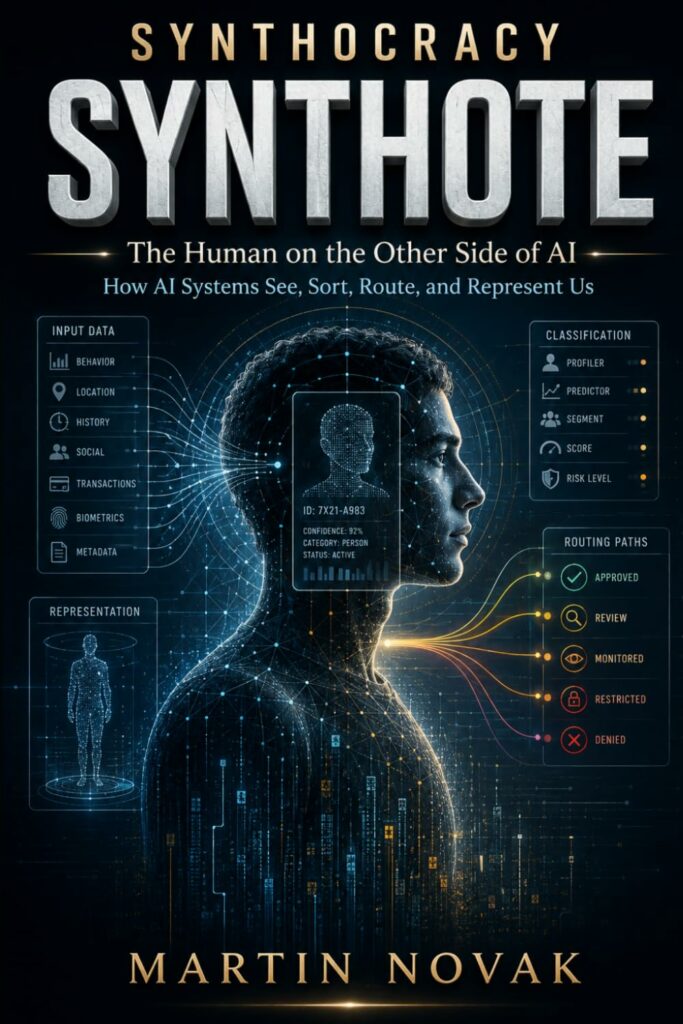
Book “Synthocracy. SYNTHOTE. The Human on the Other Side of AI”
A system does not need to know all of you to change what happens to you.
AI does not have to issue the final decision to exercise practical power. Long before a human signs, approves, rejects, buys, hires, diagnoses, or reviews, an AI-mediated system may already have filtered the field. It can determine which applicant becomes visible, which citizen enters additional verification, which patient receives priority, which worker appears productive, which customer receives an offer, which product reaches a recommendation, or which information enters the human decision-maker’s view.
The system rarely encounters the whole person. It encounters a representation.
SYNTHOTE introduces a new concept for understanding the human being on the other side of that process:
A synthote is a person whose practical field of perception, access, choice, or treatment is materially configured by AI-mediated systems.
A synthote is not an identity, social class, or new species of citizen. It is a position any person can occupy inside a particular process. You can be a synthote while applying for a loan, a patient inside an AI-assisted healthcare pathway, an applicant filtered before a recruiter ever sees you, a worker represented by a dashboard, or a customer whose practical market has already been narrowed by recommendation and risk systems.
The book follows a simple chain:
PERSON → REPRESENTATION → CLASSIFICATION → VISIBILITY → CHOICE → ROUTE → CONSEQUENCE → FEEDBACK
It then asks what changes when representation becomes portable and executable. Digital credentials can allow us to prove more while revealing less. Personal AI agents may search, compare, buy, schedule, negotiate, and eventually interact with institutions on our behalf. For the first time, computational representation may begin appearing on both sides of the relationship.
That creates a remarkable new paradox. Until now, we worried that their AI might represent us incorrectly. Soon we may also need to worry that our AI does.
Written for readers interested in artificial intelligence, power, technology, public policy, digital identity, algorithmic decision-making, AI agents, and the future of human agency, SYNTHOTE offers a practical framework for seeing where consequential representation enters everyday life.
Its public governance model can be reduced to four verbs:
KNOW → CORRECT → REROUTE → CONTEST
Can you know when AI materially shaped your path? Can you correct the representation? Can you take another route? Can you reach someone who can actually change the consequence?
And beyond all four lies an even deeper question:
Can you still become something the system did not predict?
Martin Novak is the founder of the Synthocracy Institute. Insight 01 · Admissibility & Evidence · Synthocracy Institute · operating internationally
Synthocracy Institute
contact@synthocracyinstitute.com
synthocracyinstitute.com